
Louise Michel’s Commune Dossier
The following is an English translation of Louise Michel’s entire dossier held by the Councils of War. It includes interviews with Louise, interviews with witnesses, letters from character witnesses, and even a poem written by Louise and attached to her file.
You can read the original documents at the Service historique de la Défense, GR 8 J 221, dossier 135, dossier de jugement de Louise Michel, 1871. © Service historique de la Défense.
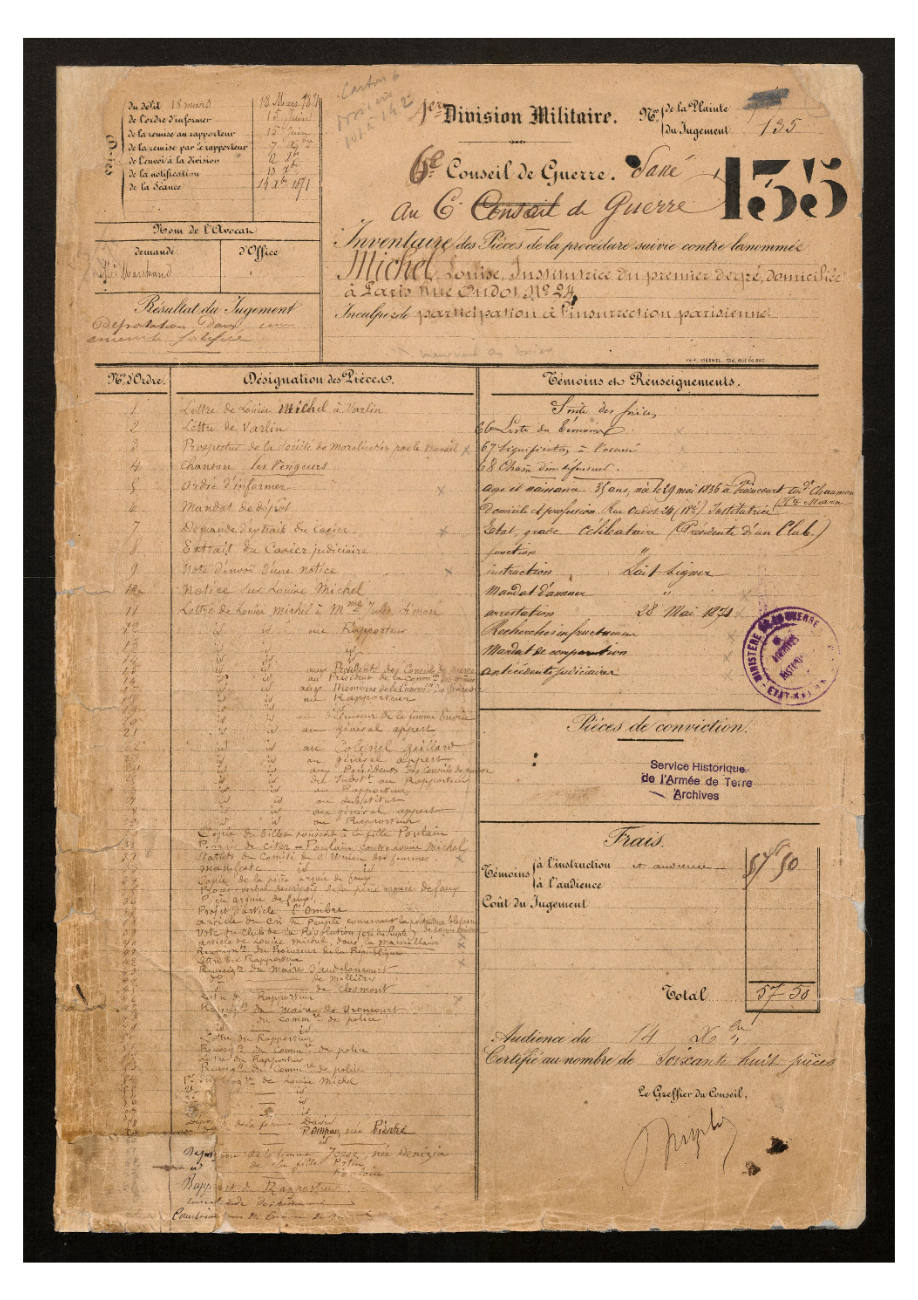
Overview
- Dates / Milestones:
- Of the offense: March 18
- Of the order to inform: June 15
- Of delivery to the rapporteur: June 15
- Of delivery by the rapporteur: December 7
- Of sending to the Division: December 12
- Of notification: December 13
- Of the hearing: December 14, 1871
- 1st Military Division
- 6th Council of War / Transferred to the 4th Council of War
- Complaint No.: 135
- Judgment No.: 135
- Name of Attorney:
- Defense: Mr. Marchand
- Inventory of case files followed against the named:
- Michel, Louise, primary school teacher, residing in Paris at Rue Oudot No. 24.
- Accused of: Participation in the Parisian insurrection.
- Result of Judgment: Deportation to a fortified enclosure.
Main Sections
Left Column: List of Documents (Désignation des Pièces)
- Letter from Louise Michel to Varlin
- Letter from Varlin
- Prospectus of the Society for Moralization through Work
- Song Les Vengeurs (The Avengers)
- Order to inform
- Committal warrant
- Request for record extract
- Extract of criminal record
- Note forwarding a notice
- Notice about Louise Michel
- Letter from Louise Michel to Madame Jules Simon
- Letter from Louise Michel to the Rapporteur
- Letter from Louise Michel to the Rapporteur
- Letter from Louise Michel to the Presidents of the Councils of War
- Letter from Louise Michel to the President of the Commission of Pardons
- Letter from Louise Michel to the Members of the Commission of Pardons
- Letter from Louise Michel to the Rapporteur
- Letter from Louise Michel to the Defense Attorney of the female Ouvrie
- Letter from Louise Michel to General Appert
- Letter from Louise Michel to Colonel Gaillard
- Letter from Louise Michel to General Appert
- Letter from Louise Michel to the Presidents of the Councils of War
- Letter from Louise Michel to the Substitute to the Rapporteur
- Letter from Louise Michel to the Rapporteur
- Letter from Louise Michel to the Substitute
- Letter from Louise Michel to General Appert
- Letter from Louise Michel to the Prosecutor
- Copy of the promissory note signed by the girl Poulain
- Power of attorney from Poulain to Louise Michel
- Statutes of the Committee of the Women’s Union
- Manifesto of the Committee of the Women’s Union
- Copy of the document alleged as forgery
- Official report of seizure of the document alleged as forgery
- Document alleged as forgery
- Draft article “L’Ombre” (The Shadow)
- Article from Cri du Peuple regarding the wounded ambulance
- Vote of the Club of the Revolution in favor of the struggle
- Article by Louise Michel in La Marseillaise
- Information from the Prosecutor of the Republic
- Letter from the Rapporteur
- Information from the Mayor of Audeloncourt
- Information from the Mayor of Millières
- Information from the Mayor of Clermont
- Letter from the Rapporteur
- Information from the Mayor of Vroncourt
- Information from the Police Commissioner
- Letter from the Rapporteur
- Letter from the Rapporteur
- Information from the Police Commissioner
- Information from Louise Michel
- Information from Louise Michel
- Information from Louise Michel
- Deposition of the woman Poinçon, born Piètre
- Deposition of the woman Fozze, born Denizia
- Deposition of the girl Poulain
- Report of the Rapporteur
Right Column: Witnesses and Personal Information (Témoins et Renseignements)
- Continuation of the Facts:
- List of witnesses
- Signatures…
- Charge sheet
- Age and Birth: 35 years old, born May 29, 1836 at Vroncourt (Haute-Marne)
- Residence and Profession: Rue Oudot 24 (12th Arr.), Primary School Teacher (Institutrice)
- Marital Status, Rank: Single (President of a Club)
- Function: —
- Instruction: Can sign
- Arrest Warrant: —
- Arrest: May 28, 1871
- Unsuccessful Searches: —
- Summons Warrant: —
- Criminal Antecedents: —
Bottom Section
- Exhibits (Pièces de conviction):
- Stamp: Historical Service of the Land Army – Archives
- Costs (Frais):
- Witnesses during instruction and hearing: 57.50
- Total: 57.50
- Hearing Date: December 14, 1871
- Certified at the number of sixty-eight exhibits.
- The Clerk of the Council (Signature)
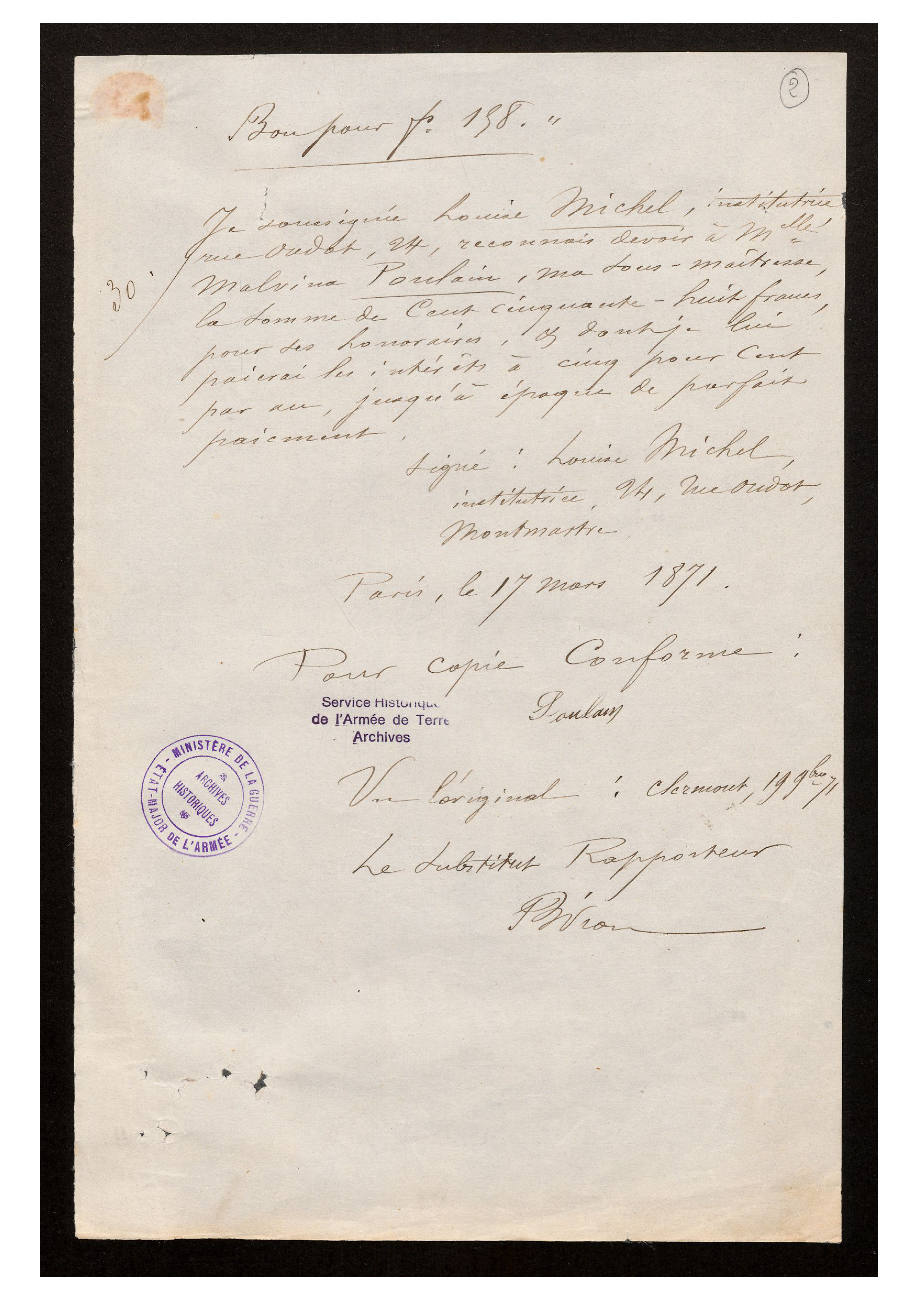
Good for 158 francs.
I, the undersigned, Louise Michel, schoolteacher, residing at 24 Rue Oudot, acknowledge that I owe Mademoiselle Malvina Poulain, my deputy schoolmistress, the sum of one hundred and fifty-eight francs for fees owed to her. I shall pay her interest at five per cent until payment has been made in full.
Signed: Louise Michel Schoolteacher, 24 Rue Oudot, Montmartre.
Paris, 17 March 1871.
Certified true copy: [Signature: Poulain]
Seen and compared with the original: Clermont, 19 [month unclear] 1871.
The Deputy Rapporteur, [Signature]
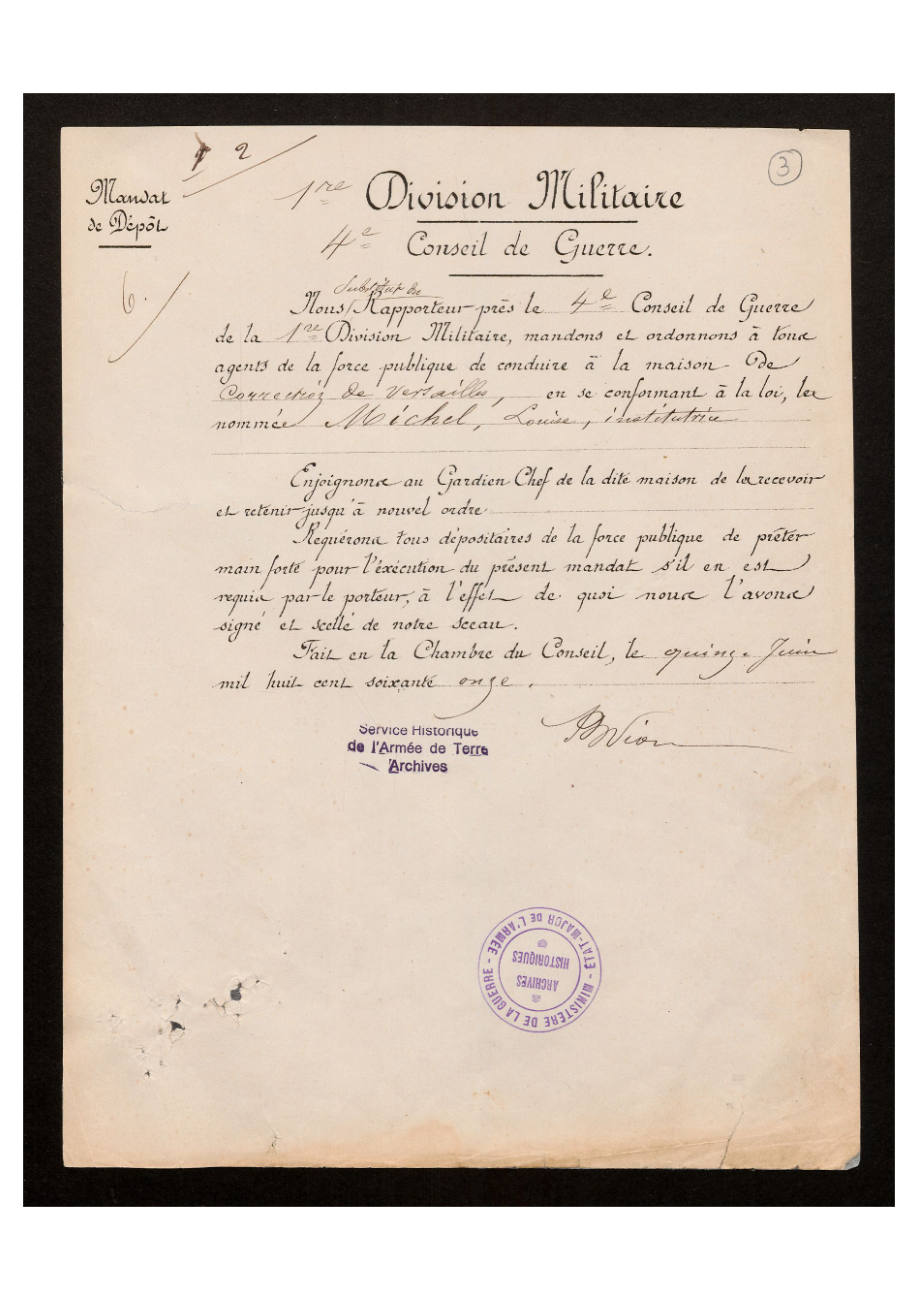
WARRANT OF COMMITMENT
1st Military Division 4th Council of War
We, the Deputy Rapporteur attached to the 4th Council of War of the 1st Military Division, hereby command and order all agents of the public authorities to convey to the Versailles House of Correction, in accordance with the law, the person named:
Louise Michel, schoolteacher.
We direct the Chief Warden of the said institution to receive her and detain her until further orders.
We require all officers of the public authorities to provide the necessary assistance for the execution of this warrant, should they be requested to do so by its bearer.
In witness whereof, we have signed and affixed our seal.
Done in the Council Chamber, on the fifteenth day of June, eighteen hundred and seventy-one.
Signed: [signature]
RECORD OF INTERROGATION
(Article 101 of the Code of Military Justice)
1st Permanent Council of War Of the 1st Military Division, sitting at Versailles
In the year eighteen hundred and seventy-one, on the twenty-eighth of June, at one o’clock in the afternoon,
Before us, Briot, Deputy Rapporteur attached to the 1st Council of War of the 1st Military Division, assisted by Mr Delplanque, appointed Clerk of the said Council, in the registry office situated at Versailles, at the Halle aux Blés,
We had the person named Louise Michel brought from the prison at the Halle aux Blés for the purpose of questioning her.
Accordingly, we had the said Michel brought before us, whom we questioned as follows:
Called upon to state her surname, given names, age, place of birth, marital status, profession and residence, she declared:
Louise Michel, aged 39, born in Vroncourt, arrondissement of Haute-Marne, unmarried, practising the profession of schoolteacher at the first level, residing in Paris, at No. 24 Rue Oudot, in Montmartre, with her mother, Marianne Michel.
Q. You are accused of having taken part in the Parisian insurrection. What have you to say in your defence?
A. I ran a boarding school and a day school, at 24 Rue Oudot. The government of the National Defence owed me approximately seven months’ payments, and the Commune also owed me one month’s payment, for March, at the rate of three francs per pupil.
However, I must say that I had been invited several times to come and settle my accounts for the school with the town hall during the month of May, but I did not have the time to respond to this invitation.
For the school, I had an allowance for eight litres of milk per day, for the children, for the purposes of making their meals, except on Sundays; eight litres of vermicelli, some fat, and two or three pots of jam per week.
My former assistant schoolmistress, Mademoiselle Poulain, and my mother, Madame Michel, directed the two establishments in my absence. The management, between their hands…
A. …had always been religious, which I opposed when I was there. They never concerned themselves with politics, either closely or remotely, except to condemn it.
I organised and personally set myself up as the head of a mobile ambulance during the month of April. It was in this capacity that I found myself at the Moulin-Neuf affair, at Neuvronge [place name uncertain], at the Clamart railway station, during the first days of May, before I could return, and finally at the trenches.
Having learned that the danger was greater at Neuilly, that we could go there, and that there was a shortage of ambulances, I went there with my friends and returned from time to time to Paris.
I established my ambulance near the barricade on the Rue Peyronnet. I went and came back from the barricades of the Rue du Bac and that of the Rue M… [street name unclear], to tend to the wounded.
Having heard the cannon during the night preceding the entry of the Versailles troops, I believed that a disaster had occurred in Paris.
I then returned to the cemetery in the north to continue tending the wounded, and I returned to Montmartre to care for the victims of the fighting that had just taken place on the Chaussée Clignancourt.
I returned again to Montmartre. Having been absent for a moment, I learned that my mother had been arrested to be taken to Versailles. I went there myself and surrendered at Bastion 37, where I was subsequently transferred to the Citadel [word uncertain].
Four or five days afterwards, I was brought here.
Q. What was the remuneration you received for your services with the ambulances?
A. The services I rendered with the ambulances were all provided free of charge. The medicines were supplied by the Commune.
Q. What was the method of teaching that you followed in your class? What were the moral and religious sentiments that you sought to instil in the hearts of your pupils?
A. I favour a method of teaching that I submitted to the Commune, which may be summarised as follows:
To bring together as many elementary facts as possible, using as few words as possible, simple and comprehensible, with each sentence having a moral meaning and something that strikes the imagination.
The morality that I taught was this: the development of conscience, powerful enough that it could exist without any other rewards or punishments than the feeling of duty accomplished or the remorse of a bad action.
As for religion, it was relegated to the absurdities of the past.
Q. Did you receive from the Commune any circulars, instructions or decrees relating to the method of teaching and the rules to be imposed in the schools under your direction?
A. There were circulars addressed to male and female teachers, but I did not have time to read them.
Q. Did you not receive alms or assistance in kind from the Commune to provide for the physical education of the children entrusted to your care? Did you not have them sing certain songs?
A. I proposed putting up pictures in my classroom depicting the principal events of history and the five parts of the world, but I did not have the leisure to do so. Every day, on the blackboard, there was, as a model for writing, a moral sentence and, in each class, the songs Le Chant du Travail, La Marseillaise and Le Vengeur, etc.
Q. Did you wear any emblem when you were in your classroom or at the ambulances?
A. I have not taken off my red sash since the fourth of September.
Q. For what reason did you wear a red sash?
A. As an emblem of the Revolution.
Q. What relationships did you have in Paris?
A. I was a member of the Commission du Travail, a society for the relief of the victims of the war of the Fourth of September, another charitable society. I was also a member of the Société de Libre-Pensée and of several other associations concerned with women’s rights. I was also a member of the Ligue Garibaldienne (a society whose aim was universal liberty).
Q. Which public meetings did you preferably attend?
A. I presided, three times a week, over a women’s meeting on the Grande Rue de la Chapelle, at the Café de la Paix.
This meeting, which I called the Club of the Revolution, had the aim of moralising the masses by elevating their hearts and accustoming all strong individuals to live by their labour.
I also happened to attend certain meetings where I believed serious matters were being discussed.
Q. If you please, since you presided over public meetings whose purpose was social transformation, you must have held firmly established ideas on religion, morality and politics. Tell us your views and the theories you put forward on these various subjects.
A. In religion, I professed the following idea: the radical abolition of religious worship and its replacement by the strictest morality, safeguarded by conscience, which I made the rule governing everyone’s actions.
Morality, for me, was summed up in acting only according to one’s convictions and treating all others, as well as oneself, with justice.
As for the political system, I called for the Universal and Social Republic, and, in order to achieve it, the development of all the intellectual faculties of individuals, the suppression of bad instincts through the proper direction of education, human dignity deeply felt, and education as strong for men as for women.
In a word, government of all by all, represented, for example, by the Commune, while awaiting an even greater simplification of government.
Q. Which acts of the Commune do you consider to have fulfilled, or come closest to fulfilling, your ideal?
A. The abolition of punishments, the increase in women’s wages, the binding mandate of the members of the Commune, and their inclination towards improving the condition of the people.
Q. What, then, do you call the actions of the committees, whether of the members of the Central Committee or of the Commune, when they ordered illegal arrests, theft, pillage, murder and arson?
A. They never ordered illegal arrests, theft, pillage or arson. Everything they did, to my knowledge, was perfectly legal.
Q. Did you not speak of Victor Noir?
A. No. What may have led people to believe that is an article in La Marseillaise in which, after his death, I swore to mourn him until he was avenged.
Q. Have you been convicted previously?
A. No, but I was imprisoned for twenty-four hours on the 1st of September because I had organised, with other women, a demonstration intended to request volunteers to go to the aid of Strasbourg. A second time, for two days, because I wanted to prevent women from holding a demonstration whose purpose was unknown to me.
Q. Have you not committed acts of violence against certain individuals?
A. I have never assaulted anyone, but when I am attacked, I defend myself. Thus, at the last demonstration to which I had gone, an officer having struck me with his hat, I gave him a slap.
Q. No one is supposed to be ignorant of the law. By acting as you did, either as a schoolteacher, a club member, a member of several societies, or as an ambulance worker with the Commune’s troops, you made yourself culpable. You made yourself the accomplice of the criminals who committed the murders, devastation and deaths in our unfortunate capital. What have you to say to this?
A. I acted according to my conscience and my convictions.
Q. Do you persist in declaring that you never received appointments or promises from the Commune?
A. No, I was never promised anything, and I would never have accepted anything.
Q. Do you have any wealth?
A. No, but I gave lessons in music and drawing outside school hours.
Q. Can you give us the names of some of your music or drawing pupils?
A. I do not wish to give any addresses, for fear of compromising anyone, whoever they may be.
Q. Which members of the Commune did you know?
A. I happened to see them sometimes, all gathered together, or to see one or two of them. I had only requests for medicines to make of them.
Q. Did you not, in some public meetings, demand the execution of certain people, or threaten them, for example?
A. No. I merely demanded Blanqui, with firmness. I demanded that he be exchanged, that he be returned to us.
Q. Was your mother married?
A. No.
Q. Did you not have intimate relations with a man?
A. No. I never had any passion other than that of the Revolution.
Q. How were you dressed when you were at the ambulances or in public meetings?
A. I always wore ordinary clothes, with a red sash around my waist. Once or twice, fearing the siege of Paris by the Prussians, I dressed as a man in order to go to a meeting, to discuss a matter of work.
Q. Have you anything to add or any request for discharge to make on your behalf?
A. No.
Conclusion of the interrogation
After the reading of her statement, Louise Michel maintained her declarations, saying that they were true and that she persisted in them. She signed with us and the clerk.
Approved the deletion of one word, declared null and void.
Signed: Louise Michel, the clerk Delplanque, and the deputy rapporteur Briot.
CITY OF PARIS
18th Arrondissement
Police Commissariat of the Clignancourt District
No. 35
Paris, 4 July 1871
To the Reporting Officer,
In accordance with the instructions contained in your letter of the 3rd of this month, I have reported to Mr Gosse and Mr Pierre, at the Prefecture, the three items that you transmitted to me, and which they are forwarding by the next courier to Versailles.
I have not been able to procure the newspapers or writings in which Mlle Michel was discussed, as I have been unable to find a complete collection anywhere.
However, it is notorious in my district that the newspapers Le Vengeur, Le Cri du Peuple, Le Père Duchêne, etc., published accounts of her actions and deeds under the Commune.
The witnesses, moreover, will be able to provide you with all the information you require in this regard.
Please accept, Sir, the assurance of my distinguished consideration.
The Police Commissioner
Signed: C. Denis
Handwritten annotation at bottom left:
4th Council of War
RECORD OF WITNESS TESTIMONY
(Article 102 of the Code of Military Justice)
1st Permanent Council of War Of the 1st Military Division, sitting at Versailles.
In the year eighteen hundred and seventy-one, on the fifth of July, at ten o’clock in the morning,
Before us, Briot, Deputy Rapporteur attached to the 1st Council of War of the 1st Military Division, assisted by Mr Delplanque, appointed clerk of the said Council, in the registry office at Versailles,
There appeared, pursuant to our summons of 3 July 1871, the witness named below, who, outside the presence of the accused and the other witnesses, after being shown the summons issued to her, swore to tell the whole truth and nothing but the truth.
Having been questioned concerning her surname, given names, age, marital status, profession and residence, and whether she was a servant or relative of either party, and to what degree,
She declared herself to be:
Henriette Pompon, aged forty-four, wife of Mr Pierre Michel, varnisher, residing in Paris, 24 Rue Oudot, 18th arrondissement; neither a relative nor an associate of Mademoiselle Louise Michel to any degree.
Q. Mademoiselle Louise Michel took an active part in the Parisian insurrection. Tell us everything you know, everything you saw, concerning this person.
A. Mademoiselle Louise Michel ran a school at No. 24 Rue Oudot, where I am the caretaker of Mr Gosse’s property.
I know that this young lady was a very ardent republican, and that she took part in the insurrection, at least in part.
During the first days of the Commune, she served as an ambulance worker.
I was told that she had been wounded, but what I know is that she had been liberated.
But from what I know, this must not have been done by anyone, because when she came to see her mother, she told her that she was not going to stay with her and that she would not see her again.
During the final days of the Commune, she was serving as an ambulance worker at Neuilly.
On the Tuesday, she came to see her mother, and on the Wednesday following, at eight o’clock in the morning, she left after learning that her mother had been arrested.
She went to the fortifications, where she was arrested as a prisoner, and returned two hours later.
Q. Did Mademoiselle Michel allow herself to be approached by the clubs? What role did she play? What did she say? What did she do there?
A. I know that she went to the clubs, where she spoke very little.
She said: “It is on your side, the good side, that I wish to be.”
Q. Have you anything to add?
A. No.
Q. How was Mademoiselle Michel usually dressed?
A. She was always dressed in black. She wore a red sash around her waist and a rosette in the same colour.
After the reading of her statement, she declared that she persisted in it, and signed with us and the clerk.
Signed: Henriette Pompon [signature appears to read Pierre], Delplanque and Briot.
RECORD OF WITNESS TESTIMONY
(Article 102 of the Code of Military Justice)
4th Permanent Council of War Of the 1st Military Division, sitting at Versailles.
In the year eighteen hundred and seventy-one, on the fifth of July, at eleven o’clock in the morning,
Before us, Briot, Captain, Deputy Rapporteur attached to the 4th Council of War of the 1st Military Division, assisted by Mr Delplanque, appointed clerk of the said Council, in the registry office at Versailles,
There appeared, pursuant to our summons of 3 July 1871, the witness named below, who, outside the presence of the accused and the other witnesses, after being shown the summons issued to her, swore to tell the whole truth and nothing but the truth.
Questioned concerning her surname, given names, age, marital status, profession and residence, and whether she was a servant, relative or associate of either party, and to what degree,
She declared herself to be:
Cécile Émilie Denizia, aged 38, wife of Mr Louis Josse, proprietor, residing in Paris, 29 Rue Lepout [street name uncertain], 18th arrondissement; neither a relative nor an associate of either party.
Q. Mademoiselle Louise Michel took an active part in the Parisian insurrection. Tell us everything you know about her.
A. My husband and I own the house at 24 Rue Oudot, in which Mademoiselle Michel has lived for approximately three years, with her mother.
All that I have to say about this person is that she is very exalted.
I heard that she presided over several clubs, but I do not know what she said there.
I learned through the newspapers during the Commune that she had left La Chapelle to serve as an ambulance worker.
A few days later, I read in Le Cri du Peuple an article announcing that Mademoiselle Michel had been wounded.
Shortly afterwards, another article stated that the latter was cured.
As for her class, I was told only that Mademoiselle Michel did not provide an excessively Christian education to her pupils and that she had them sing La Marseillaise.
I learned from the newspapers during the Commune that she had gone to Neuilly as an ambulance worker.
On the Tuesday or Wednesday before the troops entered Paris, I met this young lady in the street. Someone said to me: “Come, here is Mademoiselle Michel, who will give you information.”
Q. What was Mademoiselle Michel’s reputation in the neighbourhood? What were her relations with the members of the Commune?
A. She was considered an exalted republican, but, in my opinion, she is a very good person, very devoted. I am unaware of what her relations were.
Q. Have you anything to add?
A. No.
After the reading of her statement, the witness declared that she persisted in it and signed with us and the clerk.
Signed: Delplanque, [witness signature], Briot.
New witness statement — 12 November 1871
On the twelfth of November, eighteen hundred and seventy-one, at one o’clock in the afternoon, in the registry office situated at Clermont (Oise),
Before us, Deputy Rapporteur, assisted by our appointed clerk,
There appeared, pursuant to our summons of the ninth of November of this month, the witness named below, who, outside the presence of the accused and the other witnesses, after being shown the summons issued to her, swore to tell the whole truth and nothing but the truth.
Questioned by us concerning her surname, given names, age, marital status, profession and residence, and whether she was a servant, relative or associate of either party, and to what degree,
She declared herself to be:
Cécile Émilie Denizia, aged thirty-nine, wife of Mr Louis Désiré Josse, proprietor, residing in Paris, 25 Rue Letort, 18th arrondissement; neither a relative nor an associate of either party.
Q. Tell us everything you know, everything you have seen, everything you have heard said, concerning the part taken by Louise Michel in the insurrectional movement of 18 March, and in the events of which the Buttes-Montmartre and the Rue des Rosiers were the scene.
A. On the eighteenth or nineteenth of March last, between nine and ten o’clock in the morning, Louise Michel entered my café, Rue Letort, No. 25, dressed as a National Guard and armed…
A. …with a small carbine. She arranged her clothing and asked me whether she could be recognised in this outfit. I asked her what she was going to do.
She replied that she did not know, and that she had spent the night on the Buttes. I asked her whether shots had already been fired. At that moment, no.
The following day, I met her mother in the street. She was crying. Replying to my questions, she told me that she was going to look for her daughter, who had remained up on the Buttes all night.
During the day, I inquired whether Louise Michel had returned home. I learned that the councils of the night had been quite insufficient [wording uncertain].
Later, I learned from Mademoiselle Patin, a schoolteacher in the Rue Ramée, that Louise Michel had been dragged along by the National Guards.
This young lady gave, as an example of what she was saying, some salads of Racine [a disparaging expression, apparently referring to confused or fanciful stories]. She had been denounced by everyone she had associated with as a refugee and as having been part of the National Guard, by Louise Michel.
Q. On your honour and conscience, do you believe that Louise Michel took part in the assassination of Generals Lecomte and Clément-Thomas, or at least in some part of the tragedy in the Rue des Rosiers?
A. I can tell you nothing about that, but I believe that Louise Michel was in the front rank of the National Guards, on the Buttes, throughout all the political events of Montmartre that may have occurred during the following eight or ten days.
Q. Can you tell us what Louise Michel’s relations with Ferré were?
A. About five or six weeks ago, I saw several photographs at a photographer’s, portraits representing Louise Michel, with this inscription:
“Ferré’s Mistress.”
Q. Have you anything to add?
A. No, except that my concierge told me that Louise Michel had complained, in these terms, about Mr Clemenceau:
“Oh! Clemenceau is a Versaillais like the others! He has just said that if he had arrived earlier…
…the generals would not have died.”
After the statement had been read aloud to her, the witness declared that she maintained it and signed with us and the appointed clerk.
Signed: Delplanque, Josse, Briot.
RECORD OF WITNESS TESTIMONY
(Article 102 of the Code of Military Justice)
4th Permanent Council of War Of the 1st Military Division, sitting at Versailles.
In the year eighteen hundred and seventy-one, on the fifth of July, at nine o’clock in the morning,
Before us, Briot, Deputy Rapporteur attached to the 4th Council of War of the 1st Military Division, assisted by Mr Delplanque, appointed clerk of the said Council, in the registry office at Versailles,
There appeared, pursuant to our summons of 3 July 1871, the witness named below, who, outside the presence of the accused and the other witnesses, after being shown the summons issued to her, swore to tell the whole truth and nothing but the truth.
Questioned concerning her surname, given names, age, marital status, profession and residence, and whether she was a servant, relative or associate of either party, and to what degree,
She declared herself to be:
Victorine David, aged 40, unmarried, seamstress, residing in Paris, 24 Rue Letort, 18th arrondissement; neither a relative nor an associate of the prisoner Michel, to any degree.
Q. Mademoiselle Louise Michel is accused of having taken part in the Parisian insurrection. Tell us everything you know, everything you have seen, concerning this person.
A. I know nothing else except that Mademoiselle Michel, who ran a school at No. 24 Rue Oudot, in the neighbourhood, was a very exalted republican. She had La Marseillaise sung by the children to whom she taught reading.
She also attended public meetings very frequently, and particularly the clubs. I was told that she had been wounded during the final engagements of the Commune.
A child had even been sent running to tell us that she had been wounded. As for the manner in which she could have been wounded, either in combat or in some other way, I am completely ignorant.
On the Wednesday, twenty-fourth of last May, I saw her in the street. Someone told me that she was going to the central prison [lecture uncertain], taking the place of her mother, who had been arrested for her.
Q. How was she usually dressed?
A. She was usually dressed in black, and she wore a red sash and an armband.
Q. Have you anything to add?
A. No.
After the reading of her statement, the witness declared that she maintained it and signed with us and the appointed clerk.
Signed: Delplanque, David and Briot.
COURT OF ASSIZES OF HAUTE-MARNE
CIVIL COURT OF CHAUMONT
Office of the Public Prosecutor
Chaumont, 3 November 1871
Sir,
In response to your dispatch dated 31 October, in which you requested information concerning Mademoiselle Louise Michel, a schoolteacher in Paris, originally from Vroncourt (Haute-Marne):
Mademoiselle Louise Michel is an illegitimate daughter who received a good education. She directed a school at Audeloncourt.
At that time, she wrote poetry for the newspapers of the locality. Her verses did not touch upon politics at all.
I have the honour to inform you, at the same time, that no proceedings, whether political or of any other nature, have ever been brought against this young lady.
Please accept, Sir, the assurance of my highest consideration.
The Public Prosecutor of the Republic
Signed: Albert [surname uncertain]
Addressed to:
The Deputy Rapporteur attached to the 4th Council of War, responsible for investigating the cases of female prisoners at Clermont (Oise).
Millières, 13 November 1871
Sir,
I have the honour of replying to your letter of the 9th of this month concerning the woman named Louise Michel, who, in 1855 and 1856, actually taught, under the direction of another person, in a private school in the commune of Millières.
During her time here, her conduct gave rise to neither praise nor criticism, and I knew her too little to be able to make any judgement about her morality.
At the same time that she lived in the commune, she was also writing political material. I never heard her speak except of a few pamphlets, in verse, which she addressed at that time to Mr Victor Hugo. I never saw or read them, and I do not know in what terms they were written.
The subject of one of these pieces of verse was the death of Monseigneur Affre, killed on the barricades.
I never knew her personally to be remarkable, but she had the reputation of possessing a lively and rather exalted imagination.
These are the only details that I am able to provide you.
Please accept, Sir, the assurance of my highest consideration.
The Mayor of Millières
Signed: M. Jarny
To the Substitute Rapporteur to the 4th Council of War at Clermont (Oise).
The Avengers (Les Vengeurs)
The cup overflows with mire,
To cleanse it requires blood;
Entirely vile, living on scraps and eating,
The people stand there, grim and grand.
Over there, kings lie in wait in the shadows
To pounce when it is dead;
Already for a long time it has slept,
Lying in the dark sepulcher.
Pass, pass, victors! Pass, sounding bugles,
Banners in the wind;
We had it, your German Rhine!
They march past together,
The buyers and the sellers.
Citizens, tell us how it seems to you
If we were to strike down these wrongdoers?
Bandits, if we show you mercy
Despite all our rage,
Do not let your terror subside,
We are waiting for the hour to pass.
Pass, pass, etc.
We no longer have son nor father,
Hatred and love have fled our hearts;
Before us, a truce to your prayers,
We are the dark avengers.
We shall come across the vast plains
Where grass grows green over the dead,
Through Strasbourg, through Metz, through the forts,
Through Alsace and through Lorraine.
Pass, pass, etc.
We shall come by way of the Hôtel-de-Ville,
By way of the cold and deep dungeons;
We shall come, and the vile crowd
Will mock you for your insults.
Calm, without pity, without remorse,
We shall watch with the dead’s fixed gaze
Your heads roll upon the sand.
Pass, pass, etc.
Here comes, here comes Ninety-Three [1793],
But a thousand times more terrible.
At last we will be able at our ease
To strike down traitors and kings.
Let our memory be cursed,
What matter, let us be the avengers;
Citizens, let us tear out our hearts,
Enough shame in history.
Pass, pass, etc.
Crying: “Long live the Republic!”
Of old, the Vengeur went down to the deep;
Today every stoic hand
Extinguishes the purifying fire;
The fortresses have been sold,
The peoples, like a great herd;
Let us conquer or seek a tomb
In the heart of avenging flames.
Pass, etc.
In vain upon your filthy heads
Would all the water of the seas pass,
Waves uniting with waves;
The mark is burned deep into your flesh.
Great butchers of the human slaughterhouses,
Cursed history awaits you;
Try to wash away the blood—
Never, never, pale phantoms.
Just as in Warsaw one sees the wave blossom
And peace arrive,
Yet with us, you will have to die.
For the grave or for victory,
Hoisting your red flag,
O Republic, for your glory
We would know how to laugh at the scaffold.
May your supreme and magnificent name
Unite and charm the children;
Whether decimated or triumphant,
Friends, Long Live the Republic!
(Signed) Louise Michel.
Certification Note
“Certified that the preceding copy conforms to the original, included in the 8th sack of items seized at the residence of Mr. Simon-Mayer, Charles, aged 51, born in Nancy, Major of Place Vendôme under the Commune, arrested on September 11 current, as the said seizure is mentioned in our police report of September 13 of the same month.”
September 19, 1871.
The Police Commissioner attached to Military Justice,
Clément
RECORD OF INTERROGATION
(Article 101 of the Code of Military Justice)
4th Permanent Council of War Of the 1st Military Division, sitting at Versailles.
On the nineteenth of September, eighteen hundred and seventy-one, at ten o’clock in the morning,
Before us, Briot, Deputy Rapporteur attached to the 4th Council of War of the 1st Military Division, assisted by Mr Delplanque, appointed clerk of the said Council, in the registry office at Versailles, at the Halle aux Blés,
We had Louise Michel brought from the prison at the Halle aux Blés for the purpose of questioning her.
Accordingly, we had the said Michel brought before us and questioned her as follows:
Asked to state her surname, given names, age, place of birth, marital status, profession and residence, she declared herself to be:
Louise Michel, aged thirty-six, born at Vroncourt, in the department of Haute-Marne, unmarried, practising the profession of primary schoolteacher, residing in Paris at No. 24 Rue Oudot, Montmartre, with her mother, Marianne Michel.
Q. Were you not wounded during a sortie against the troops of the government?
A. While running into a ravine to pick up a National Guard who had just fallen, I suffered a sprain. That, no doubt, is what gave rise to the rumour that I had been wounded.
Q. A police report establishes that you fired shots at Asnières and Neuilly.
A. Yes, I fought at Issy, Clamart and Montmartre.
Q. What weapons did you use in these various engagements?
A. At Issy, I used a sabre to rally the fédérés; at Clamart, I fired with the rifle of a dead man; and at Montmartre…
…I made use of a rifle that I had picked up.”
Q. — Are you not a member of the International?
A. — Yes, but it is pointless to address any question to me concerning that society, for I would not answer.
Q. — Have you anything to add?
A. — No.
The foregoing interrogation having been read aloud to the accused Michel, she declared that her answers had been faithfully transcribed and signed together with us and the assistant clerk.
[Signatures: Louise Michel; the examining officer; the assistant clerk.]
DEPARTMENT OF HAUTE-MARNE
MAYOR’S OFFICE OF VRONCOURT
Vroncourt, 21 September 1871
From the Mayor of Vroncourt to the Reporting Officer attached to the 4th Council of War at Versailles.
Sir,
I have the honour of forwarding to you the information that you requested from me in your letter of the 19th of this month.
The woman named Louise Michel, born at the château of Mr Demahis, a landowner at Vroncourt, was brought up by Mr Demahis himself, with every possible care.
The time that she spent at Vroncourt was marked only by acts of devotion.
Furthermore, she always conducted herself in such a manner as to deserve public esteem.
Please accept, Sir, the assurance of my respectful consideration.
The Mayor of Vroncourt
Signed: L. Martin
RECORD OF INTERROGATION
(Article 101 of the Code of Military Justice.)
[Form No. 5]
4th PERMANENT COURT MARTIAL
Of the 1st Military Division, sitting at Versailles.
In the year eighteen hundred and seventy-one, on the twenty-ninth of September, at a quarter past five in the evening,
Before us, Briot, Deputy Reporting Officer attached to the 4th Court Martial of the 1st Military Division, assisted by Mr Delplanque, assistant clerk of the said Court, in the registry room situated at Versailles,
We caused the person named Louise Michel to be brought from the House of Correction for the purpose of interrogating her.
Consequently, we had the said Michel brought before us, whom we interrogated as follows:
Having been asked to state her surname, given names, age, place of birth, marital status, profession and residence, she replied that her name was Louise Michel, aged thirty-six years, born at Vroncourt, in the department of Haute-Marne, unmarried, a teacher at a free educational establishment, residing in Paris, at 24 Rue Oudot, Montmartre, with her mother, Marianne Michel.
Q. — Do you acknowledge being the author of the article published in the 15 February 1870 issue of La Marseillaise, of the Chanson des Vengeurs, of the prospectus of the Democratic Society for Moralisation through Labour, and of the address written on 13 Germinal, Year 79, to the members of the Commune, all documents that we are presenting to you?
A. — Yes, I acknowledge being the author of all of them.
Q. — Did you not command, in the capacity of captain, a troop of armed women for the struggle against the insurgents?
A. — No, I never commanded a troop of citizens, and when I saw the necessity of exercising authority, only then did I command. Besides, there was never a troop of armed women assembled to fight; they were never gathered together as a troop except for a demonstration.
[Signatures at the foot of the page.]
Q. Have you anything to add?
A. No.
After the statement had been read aloud to Mademoiselle Michel, who was present during the final part of the interrogation, she declared that her answers had been faithfully transcribed. She signed with us and the appointed clerk.
Signed: Delplanque, Briot and Louise Michel.
Oudémont, 6 November 1871
Information concerning an accused woman
Mr Reporting Officer,
I am replying to your letter of the 2nd of this month by informing you that I had no knowledge of the antecedents of the woman named Louise Michel, accused, before her stay at Oudémont.
She arrived here at a very young age, in 1849, and left around 1853–54.
During that period, she did nothing but teach young ladies, and always conducted herself well and consistently, according to all reports. She enjoyed general esteem.
She then left our district to go to Clefmont, where she continued teaching, and then to Millières. Finally, she returned to Paris. I know…
therefore, nothing concerning her immorality or misconduct in Audeloncourt.”
Please accept, Sir, the assurance of my highest consideration.
The Mayor of Audeloncourt
Signed: Gillot
[Official stamp: Mayor’s Office of Audeloncourt, Haute-Marne]
1st MILITARY DIVISION
4th PERMANENT COURT MARTIAL
No. 796
Clermont (Oise), 9 November 1871
Mr Commissioner,
I have the honour of requesting that you transmit to me, as soon as possible, all the information you may be able to gather concerning the woman named Louise Michel, a schoolteacher, President, under the Commune, of the Club of the Revolution at the Church of Saint-Bernard, Rue Affre.
Your inquiry should concern, above all, the serious morals-related accusations that the accused may have propagated, whether through her actions or through her statements, and the relationships she may have had with certain members of the Commune, notably Ferré.
Please accept, Mr Commissioner, the assurance of my highest consideration.
The Deputy Reporting Officer attached to the 4th Court Martial, at Clermont (Oise).
[Signature: Briot]
To the Commissioner of Police of Rue Affre.
RECORD OF WITNESS TESTIMONY
(Article 102 of the Code of Military Justice)
4th Permanent Council of War Of the 1st Military Division, sitting at Versailles.
On the eleventh of November, eighteen hundred and seventy-one, at two o’clock in the afternoon,
Before us, Briot, Captain, Deputy Rapporteur attached to the 4th Council of War of the 1st Military Division, assisted by Mr Delplanque, appointed clerk of the said Council, in the registry office at Clermont (Oise),
There appeared, pursuant to our summons of 9 November, the witness named below, who, outside the presence of the accused and the other witnesses, after being shown the summons issued to her, swore to tell the whole truth and nothing but the truth.
Questioned concerning her surname, given names, age, marital status, profession and residence, and whether she was a servant, relative or associate of either party, and to what degree,
She declared herself to be:
Henriette Pompon, aged forty-four, wife of Mr Pierre Michel, concierge, residing in Paris at 24 Rue Oudot, 18th arrondissement; neither a relative nor an associate of either party to any degree.
Q. Can you tell us where Mademoiselle Louise Michel was on 18 March last?
A. I know that Mademoiselle Michel spent two nights away from home, on 17 and 18 March, or perhaps 18 and 19 March. My husband and I did not see her during those two days.
She returned home at six o’clock, dressed as a National Guard. I did not see her carrying any weapon.
She went out again a few moments later, but wearing women’s clothing.
As she passed, she told me that if Mr Clemenceau had arrived a few moments earlier in the Rue des Rosiers, the National Guards would not have shot the generals, because the mayor of Montmartre would have opposed it, as he would have been…
…on the side of the Versaillais. I do not know what part she may have taken in the events that occurred at the Buttes and in the house on the Rue des Rosiers, but in my heart and conscience, I believe that she was involved, for she was very excitable and placed herself at the forefront of everything.
Q. — If Michel spoke to you, as you have just told us, about Mr Clemenceau and the crimes committed at the Buttes-Montmartre and on the Rue des Rosiers, it is impossible to believe that you did not ask her for some explanations.
A. — I asked her no questions; moreover, she never stayed in one place, and one could not contemplate having a conversation with her.
Q. — Did Michel not have habits of intemperance? Who were the people she habitually saw at her home? Was she not closely associated with Mr Ferré?
A. — I do not know whether she had habits of intemperance; however, I must say that she was constantly drinking black coffee. As for her acquaintances, she saw only the parents of her pupils, and I do not know whether she was closely associated with Mr Ferré. I heard it said recently that her photograph was being sold as the mistress of that former member of the Commune.
Q. — Was she not president of clubs?
A. — Yes, she was president of the club which met at the Church of Saint-Bernard, in the small chapel. Besides, she attended all gatherings of that kind. She usually returned home at half past eleven or midnight.
Q. — Have you not heard talk of…
[The question continues on the following page.]
[Signatures at the bottom of the page.]
…certain proposals made by her and voted on in her club, regarding the hostages?”
A. I heard Mademoiselle Louise Michel herself say that Blanqui must be returned to the Commune, or else all the priests would be executed.
Q. Did you not hear her speak of fires or the use of petroleum?
A. No.
Q. Let us return once more to the conversation you had with her on the morning of 18 March, the day before or the day after, concerning Mr Clemenceau. Did Louise Michel not say anything to you that might lead you to suppose that she had assisted in the execution of Generals Lecomte and Clément-Thomas?
A. She told me only what I have reported to you, and I cannot add anything that would reassure my mind completely.
If Louise Michel was with the National Guards at the time of this execution, I believe that she was quite capable of seeking to cause the soldiers to commit this crime, and that she might even have provoked it.
Q. Have you anything to add?
A. No.
After the statement had been read aloud to her, the witness declared that she maintained it and signed with us and the appointed clerk.
Approved the deletion of one word, declared null and void.
Signed: Delplanque, Pierre [signature], Briot.
QUARTER OF THE GOUTTE D’OR
1st Military Division
4th Court Martial
No. 796
Paris, 15 November 1871
REPORT
To the Deputy Reporting Officer attached to the 4th Court Martial
Concerning Michel
Sir,
I have the honour of informing you that the investigations carried out throughout the extent of my district concerning the woman named Louise Michel, who was the subject of your letter dated the 9th of the current month, enclosed herewith, have remained unsuccessful.
These investigations have been…
…followed with all the care necessary. I regret that they have not produced a better result.
If it were possible, Sir, for you to provide me with some positive information that might serve as a starting point concerning this Mademoiselle Michel, it would be both my duty and my pleasure to pursue the investigation, which could produce results.”
The Police Commissioner
Signed: Chuspigneret
[Official stamp: Police Commissioner, Goutte-d’Or district, 18th arrondissement, Paris]
1st MILITARY DIVISION
4th PERMANENT COURT MARTIAL
No. 69
Versailles, 18 November 1871
My dear Captain,
I am sending you a letter from Louise Michel, which she wishes, at all costs, to have delivered to her mother.
Please do what you think best with it.
Yours sincerely,
[Signature]
[Handwritten annotation at the bottom of the page:]
This letter is missing from the dossier.
RECORD OF WITNESS TESTIMONY
(Article 102 of the Code of Military Justice)
4th Permanent Council of War Of the 1st Military Division, sitting at Versailles.
On the nineteenth of November, eighteen hundred and seventy-one, at one o’clock in the afternoon,
Before us, Briot, Deputy Rapporteur attached to the 4th Council of War of the 1st Military Division, assisted by Mr Delplanque, appointed clerk of the said Council, in the registry office at Clermont (Oise),
There appeared, pursuant to our summons of 15 November 1871, the witness named below, who, outside the presence of the accused and the other witnesses, after being shown the summons issued to her, swore to tell the whole truth and nothing but the truth.
Questioned concerning her surname, given names, age, marital status, profession and residence, and whether she was a servant, relative or associate of either party, and to what degree,
She declared herself to be:
Émilie Potin, aged thirty-two, unmarried, painter, residing in Paris, 39 Rue Ramée; neither a relative nor an associate of the accused to any degree.
Q. Tell us everything you know, everything you have seen, done or heard concerning Mademoiselle Louise Michel during the Commune.
A. I know nothing else about this young lady except for the denunciation she made against my brother Jules, who was a National Guard, calling him an informer.
It was on the very day, I believe, of the entry of the government troops into Paris.
An employee of the town hall came to my home to ask me for information about an employee of the Town Hall of the 18th arrondissement who had been arrested seven or eight days earlier, during the Commune, following the sending of letters recognised as immediately threatening and insulting, bearing Mademoiselle Louise Michel’s signature.
I read to him the written statement. It was simply a denunciation against my brother, and it was expressed in these terms, or something very similar:
“I denounce one of my friends, Jules Potin, who has received instruction, but who…
…lack of common sense; you will find him at 39 Rue Ramée, living with his sisters. He is a former soldier who may be harmful and who, on the other hand, could render services, but he has declared that he would not march against the troops.” Signed: Louise Michel.
My brother had not waited for the execution of the threats made by the Mayor against those who refused, and he had left for Versailles, almost at the beginning of the struggle.
As for the part played by Louise Michel in the insurrectionary movement of 18 March, I heard it said that she was at the Buttes-Montmartre at the moment of the attempted removal of the cannons, but I do not know whether she fought.
I also know, from having heard her say so, that she assisted in the affairs of Neuilly and Issy, and that she acted there indiscriminately as both a combatant and an ambulance worker.
As for the clubs or public meetings, of which she might have been in charge, it is impossible to say what she did there, given that I never followed her.
She passed through the neighbourhood like an exalted woman, susceptible and capable of taking offence at anything.
A friend of my brother, Mr Victor Brunet, of Rue des Abbesses, told me one day that he had witnessed a dreadful scene which had just taken place on the occasion of a declaration. A red poster was discovered following the Communards. Mademoiselle Louise Michel, accompanied by a certain woman named Claire, with a red scarf, was in this carriage and was giving shouts of sovereignty to the crowd. According to me, this accused woman is an agitator who probably hoped to acquire a certain notoriety for her name. I knew her in the beginning better, and I forgive her all the more readily for her conduct towards us, which I believed to be agreeable to her, since, by replacing her during the six weeks preceding the six weeks of the class, I believe I have rendered her a service.
Before concluding, I must say that I recently saw her portrait at a photographer’s. The inscription beneath this portrait read: “Mistress of Ferré.” I do not believe, however, that she ever had relations with that former member of the Commune, nor with any man. Her conduct, moreover, was very proper; her dress alone left much to be desired. I have nothing further to add.
The above statement having been read aloud to the witness, she declared that she maintained it and signed together with us and the assistant clerk.
The deletion of four words is approved.
[Signatures]
RECORD OF WITNESS TESTIMONY
(Article 102 of the Code of Military Justice)
4th Permanent Council of War Of the 1st Military Division, sitting at Versailles.
On the nineteenth of November, eighteen hundred and seventy-one, at two o’clock in the afternoon,
Before us, Briot, Deputy Rapporteur attached to the 4th Council of War of the 1st Military Division, assisted by Mr Delplanque, appointed clerk of the said Council, in the registry office at Clermont (Oise),
There appeared, pursuant to our summons of 16 November 1871, the witness named below, who, outside the presence of the accused and the other witnesses, after being shown the summons issued to her, swore to tell the whole truth and nothing but the truth.
Questioned concerning her surname, given names, age, marital status, profession and residence, and whether she was a servant, relative or associate of either party, and to what degree,
She declared herself to be:
Malvina Poulain, aged twenty-three, unmarried, feather merchant, residing in Paris, 26 Rue de Poteau, 18th arrondissement; neither a relative nor an associate of the accused to any degree.
Q. Tell us everything you know, everything you have seen of the actions and deeds of Mademoiselle Louise Michel during the Commune.
A. I cannot tell you much, because she never placed any confidence in me.
On the day when she learned that Generals Lecomte and Clément-Thomas had been arrested, seeing that she was disposed to take part in the fighting, I asked her whether it would be advisable to do so.
She recommended that I remain at home. She then showed me the note that I am presenting to you, and gave me the date of 19 March, no doubt in error.
She had spent the night away from home; she was absent again throughout the day of the eighteenth, and, as far as I recall, she did not return to the house until the nineteenth of March.
I believe, because she had changed her clothing, that she had been involved in the fighting.
Moreover, I was in the house when she returned to see her mother, on the eighteenth…
…in the morning. I am completely unaware of the part she may have taken in the events at Montmartre on 18 March, and I have never heard anything about this in that regard. As for what concerns the engagements at Issy and Neuilly, I know from the accounts circulating about her that she fought like a man against the troops of Versailles.
As for the clubs, I also know that she presided over several public meetings, but I am unaware of the opinions she may have expressed there. Finally, it is impossible for me to indicate the relationships she may have had with members of the Commune or other revolutionaries; she never received any men at her home, and the rumour circulating about her supposed relationship with Ferré is, in my opinion, entirely unfounded.
Q. — Have you anything to add?
A. — No.
The foregoing statement having been read aloud to the witness, she declared that she maintained it and signed together with us and the assistant clerk.
[Signatures: Delplanque, Poulain, Briot.]
RECORD OF INTERROGATION
(Article 101 of the Code of Military Justice)
4th Permanent Council of War Of the 1st Military Division, sitting at Versailles.
On the third of December, eighteen hundred and seventy-one, at eight o’clock in the morning,
Before us, Briot, Deputy Rapporteur attached to the 4th Council of War of the 1st Military Division, assisted by Mr Delplanque, appointed clerk of the said Council, in the registry office at Versailles,
We had the person named Louise Michel brought from the House of Correction for the purpose of questioning her.
Accordingly, we had the said Michel brought before us and questioned her as follows:
Asked to state her surname, given names, age, place of birth, marital status, profession and residence, she declared herself to be:
Louise Michel, aged thirty-six, born at Vroncourt, in the department of Haute-Marne, unmarried, a primary schoolteacher, residing in Paris at No. 24 Rue Oudot, Montmartre, with her mother, Marianne Michel.
Q. What part did you take in the defence of Paris against the Prussians?
A. I had proposed the organisation of mobile ambulances for the battlefields. We set up ambulances in the forts, but they were replaced by young men.
I took part in no action, in no act of war. I worked only for the defence through public meetings.
Q. Tell us what you did and where you were during the days of 17, 18 and 19 March last.
A. On the 17th, I went to the Butte in the evening. I was dressed as a National Guard, so that I could escape notice, and armed with a carbine. I was seeking to respond to revolutionary ideas…
…in such a way that no one would attack anyone else, but that we would defend ourselves to the death. I spent the night at the committee on the Rue des Rosiers, where I had been admitted as having proposed the organisation of ambulance services and as president of a club. On the 18th, I was present when Generals Lecomte and Clément Thomas were arrested. I cried out, “Do not let them go,” but I affirm that I never thought for a single moment that they would be executed. I was indignant that they had ordered firing upon the People. I do not recall having entered the house at No. 6 Rue des Rosiers during the execution of the generals. I acknowledge having said to members of the vigilance committees, and to Ferré, among others, because he regretted this act of violence: “It was well done!” I broke my carbine, the butt of which was at the Lariboisière Hospital, then went to Belleville and La Villette to make sure that these districts had remained armed.
On the 19th, I was at home.
Q. — Which clubs did you preside over?
A. — I presided over the Club of the Revolution, held first at the Justice of the Peace, Grande Rue de la Chapelle, then at the Church of Saint-Bernard.
Q. — Who replaced you as president of that club after you became an ambulance worker?
A. — Sometimes one person, sometimes another, without my having concerned myself with the rest. I must say, however, that I sent them the programmes, the expressions of which were often changed or their meaning distorted.
Q. — Do you acknowledge being the author of the programme appearing in No. 1 of Le Cri du Peuple of 18 May 1871, which we are presenting to you?
A. — Yes, but certain passages have been changed, enlarged or shortened. Thus, I had written in my programme: “Abolition of the magistracy, infamous [abbreviation uncertain]”; in the article concerning the property of the clergy, I had written “property of the Churches, as national property”; in the article concerning hostages, I had written: “Threat of execution of a hostage.”
Q. — At what time did you have a conversation with Ferré concerning your plan to murder Mr Thiers?
A. — Some time before the troops entered, because we were assured that acts of violence against the People would not cease unless we were defeated. I wanted to terrify the Assembly and stop the struggle, because I was convinced that Thiers was the soul of that very struggle.
Q. — Did you not try to enlist certain members…
Q. …of the Commune, at the moment when you realised that all chance of success was virtually lost?
A. Yes, I wanted to join the remaining combatants when my mother was arrested, and I had to surrender myself as a prisoner in order to secure her release.
Q. What did you mean by the fire of the day that you proposed in a draft article entitled L’Ombre [The Shadow]?
A. That article was written in a moment of indignation, and I spoke only for myself personally. I meant to say that I preferred the destruction of a city to oppression.
Q. You have declared yourself a member of the International, and we find, in the threat contained in that article, a striking analogy with that of the letter from Chuseret to Nardin, dated 17 February 1870?
A. Chuseret’s letter is not a threat, but a prediction.
Q. In the original of the demand dated 13 Germinal, Year 79, addressed to the members of the Commune, we notice that the names of the members of the Vigilance Committee are all in your handwriting. Is this not a substitution of persons that you have taken the liberty of making?
A. Yes, it happened because I always made it a point, in my manifestos, to include the names of women known to the people, so that they might contribute to the ideas of women’s education and dignity.
Q. This was a very serious matter that you did there, and in doing so you seriously compromised the women whose names you borrowed?
A. That idea had never occurred to me, and I did not think that they could be prosecuted for it.
Q. Did you not propose to the members of the Commune that they should set fire to or destroy the districts of Paris, as and when the troops occupied them?
A. I proposed barricading ourselves within Paris and fighting there to the death.
Q. Do you acknowledge that you are the author of the manifesto of the Central Committee of the Women’s Union that we are presenting to you?
A. Yes, but with the changes that I am going to point out to you. Thus, in the phrase: “The tree of liberty…” I had written:
“The tree of liberty grows, watered by the blood of martyrs.”
The final phrase has been changed. I believe that it ended as follows:
“The workers will acclaim the Universal Social Republic.”
“Long live the Universal Republic!”
“Long live the Commune!”
Q. Did you not deliver speeches at funeral ceremonies?
A. Yes, at several burials.
Q. Did you not accompany a funeral procession, riding in a carriage accompanied by National Guards?
Conclusion of the interrogation
A. — I had not tolerated that; the carriage was being drawn by a horse, and if I had remained, it was because my leg was hurting.
Q. — Had you not denounced certain individuals for refusing to serve in the ranks of the Federates?
A. — I denounced one of my friends, to whom I had promised that I would do so, and because I knew perfectly well that no harm would be done to him.
Q. — Do you have anything to add?
A. — No.
The accused having been read her answers, she declared that she maintained them and signed together with us and the assistant clerk.
The deletion of three words, now void, was approved.
[Signatures]
Supplementary statement — 5 December 1871
And on the fifth of December, eighteen hundred and seventy-one, at five o’clock in the evening, in the registry room of the Versailles House of Correction.
We, the Deputy Reporting Officer, assisted by our assistant clerk, once again brought Miss Louise Michel before us for the purpose of communicating to her the official records of the investigation.
The said records having been read aloud, and having been asked whether she had anything to say or add, the accused declared that she wished to amend the second paragraph of the programme she had sent to the Committee of the Club of the Revolution as follows. She would have written in her proposal:
“Radical abolition of religious worship, immediate arrest of priests in whose churches weapons were found, etc.”
She further declared that she had never been anyone’s mistress, and, as far as Ferré was concerned, she added that, knowing him to be an incorruptible revolutionary, she had great confidence and affection for him.
Following this, she signed together with us and the assistant clerk.
[Signatures]
…in the bloody drama of which the Buttes-Montmartre and the Rue des Rosiers were the scene.
From the night before, the insurgents, summoned by the Central Committee, were ready to oppose the removal of the cannons. At the signal of the tocsin and the générale [the general call to arms], the accused, armed with a carbine and dressed in the uniform of the National Guard, leaves her home and makes her way towards the place where the struggle is to begin.
And, as she knows that she is about to commit a crime, she stops along the way to ask whether she can be recognised beneath the disguise she has just adopted. She then seeks, according to her own account, to distribute revolutionary ideas, and proceeds to the committee on the Rue des Rosiers.
What then took place in that house, which had been predestined and chosen in advance for conspiracies?
That is something we shall undoubtedly never know, for what is there that cannot be accomplished, when it comes to conspiracies, through the difficulty of investigations and, above all, of judicial evidence!
In any event, the accomplice in the arrest of the unfortunate Generals Lecomte and Clément Thomas fears that she may see the two victims delivered up to…
…escape.
“Do not let them go!” she cries with all her strength to the unfortunate men who are surrounding them.
And later, when the murder has been committed, in the presence, so to speak, of the mutilated corpses, she displays all her joy at the blood that has been shed and dares to proclaim, “It is well done!” Then, radiant and satisfied with her good day’s work, she makes her way to Belleville and La Villette to make sure “that these districts have remained armed.”
On the 19th, she returns home, having taken the precaution of removing her Federate uniform, which might compromise her. But she feels the need to discuss the events for a while with her concierge.
“Ah!” she exclaims, “if Clémenceau had arrived a few moments later in the Rue des Rosiers, the Generals would not have been shot, because he would have opposed it, being on the side of the Versaillais.”
Finally, “the hour of the people’s reign has sounded.” Paris, in the power of foreigners and ruffians gathered from every corner of the world, proclaims the Commune.
Secretary of the Society for the Moralisation of Workers through Labour, Louise Michel organises the famous Central Committee of the Women’s Union, as well as the vigilance committees…
…responsible for recruiting ambulance workers and, at the decisive moment, women workers for the barricades, perhaps even incendiaries.
A copy of a manifesto submitted to the Town Hall of the 10th arrondissement indicates the role she played in the aforementioned committees during the final days of the struggle. We reproduce this document verbatim:
“In the name of the Social Revolution, which we proclaim, in the name of the demand for the rights of labour, equality and justice, the Women’s Union for the Defence of Paris and the Care of the Wounded protests with all its strength against the shameful proclamation addressed to female citizens and posted the day before yesterday, emanating from a group of reactionaries.”
“The said proclamation states that the women of Paris appeal to the generosity of Versailles and demand peace at any price.”
“No, it is not peace, but rather war to the bitter end, that the working women of Paris have come to demand!”
“Today, a reconciliation would be a betrayal.”
“It would mean renouncing all the workers’ aspirations, which acclaim absolute social renewal, the annihilation of all existing legal and social relationships…
…the abolition of all privileges, of every form of exploitation, the replacement of the rule of Capital by that of Labour; in a word, the emancipation of the worker by the worker himself!”
“Ten months of suffering and betrayal during the siege, six weeks of titanic struggle against the united exploiters, the rivers of blood shed for the cause of liberty, are our titles to glory and vengeance!”
“The present struggle can have no other outcome than the triumph of the people’s cause…
“Paris will not retreat, for it carries the banner of the future. The supreme hour has sounded! Make way for the workers! Make way for their executioners! For action! For energy!…
“The tree of liberty grows, watered by the blood of its enemies!…
“United and resolute, strengthened and enlightened by the suffering brought upon them by social crises, profoundly convinced that the Commune, representing the international and revolutionary principles of the peoples, carries within it the seeds of the Social Revolution, the women of Paris will prove to France and to the world that they, too, will know, at the moment of supreme danger…
Conclusion of the Women’s Union proclamation
“…on the barricades, on the ramparts of Paris, if the forces of reaction should break through the gates, give, like their brothers, their blood and their lives for the defence and triumph of the Commune, that is to say, of the People!
“Then, victorious, united in their determination to pursue and defend their common interests, working men and women, all standing together, through one final effort…”
(This sentence remains unfinished in the manuscript.)
“Long live the Universal Republic! Long live the Commune!”
At Saint-Bernard, Louise Michel is responsible for the red motion adopted at the meeting of 18 May (Le Social, 19 May), which was conceived in the following terms:
But even this was not enough; judging that, for this armed monster, as the author of a fanciful notice appearing in the dossier so aptly describes her, it was not enough to stir up the populace, applaud assassinations, corrupt childhood, preach a fratricidal struggle, and, in a word, urge every crime — she still had to set an example herself and risk her own life!
Thus we find her at Issy, at Clamart and at Montmartre, fighting in the front ranks, firing shots or rallying the fugitives.
Le Cri du Peuple expressed it thus in its issue of 11 April…
Louise Michel wounded at Issy
“Citizen Louise Michel, who fought so valiantly at the Moulineaux, was wounded at the Fort of Issy.”
Fortunately for her, we hasten to acknowledge it, the heroine of Jules Vallès emerged from this brilliant affair with nothing more than a simple sprain.
The prosecution’s assessment of Louise Michel
What, then, is the driving force that has impelled Louise Michel along the fatal path of politics and revolution?
It is evidently pride.
If she had resigned herself, out of charity, instead of thanking Providence, which had given her a superior education and the means to live happily with her mother, she allowed herself to be carried away by her exalted imagination, her irascible character, and, after having broken with her benefactors, came to Paris to seek adventure.
It matters little whether we know of the numerous setbacks and bitter disappointments that awaited her in the city of her dreams, in that receptacle of the socially displaced and the enemies of all countries; it is enough to follow her, to examine her position and her attitude in these latter times.
Placed in the midst of people constantly struggling against the established order of things, she readily understood all the influence that she could exercise over such people, as ignorant as they were perverse.
The wind of Revolution begins to blow: Victor Noir has just died!
This is the moment to enter upon the stage, but the role of an extra is repugnant to Louise Michel; her name must attract public attention and appear in the front rank of proclamations and outrageous promises. And, in order to ensure a certain degree of publicity for her so-called tragic displays, she does not hesitate to commit fraud, through the substitution of persons, making use of the names of mothers of families, under the pretext of securing for them the great assistance which she alone has received.
In order to put an end to this need to appear, to make herself talked about, which escapes from the accused at every moment, it would be necessary to possess all the ramblings that have emerged from her brain, all the manifestos that she has caused to appear, all the speeches that she delivered during the insurrectionary period; but the documents before us say quite enough about them.
Prison does not even bring the slightest reflection, the faintest remorse, to this heart of marble.
Her elderly mother may be dying of grief, but what does it matter!
Louise Michel has quite other things to do than to think about this misery; she would much rather compose…
…outrageous verses and make death threats against the honest people who are doing their duty.
All that remains for us is to give the legal classification to the acts committed by this madwoman since the beginning of the appalling crisis through which France has just passed, up until the end of the impious struggle in which she took part amid the tombs of Montmartre Cemetery.
Considering the harm that Louise Michel has done, and the unfortunate people whom she has led into the abyss, there can be no doubt.
No, she is not an ordinary criminal to whom the provisions of political law alone can be applied.
Affiliated with or an agent of the International, which presided over all the crimes committed by the Commune, she is the natural accomplice in these crimes and must herself bear the punishment.
“Come out of your tomb,” she writes to the Republic, “and see these prostitutes who have themselves passed off as you, and who, having delivered up your daughters, have finally delivered you up yourself!
“Rejoice, you cursed ones! Here is the infamous peace!
“You will be able to drink in great gulps, eat until your bellies are full, sleep through long nights, enjoy yourselves beneath the blessings of the Prussian. Rejoice, all of you, light your bonfires of joy! We shall make our own!”
“Live peacefully, happily, rest. We are here!
“Rest yourselves. We are keeping watch.”
She knowingly assisted the authors of the illegal arrest of Generals Lecomte and Clément Thomas in the acts that they committed, and this arrest was followed by bodily torture and the death of these two unfortunate men.
Closely associated with the members of the Commune, she knew all their plans in advance.
She aided them with all her strength and all her will; indeed, she assisted them and frequently surpassed them.
She offered them the means of going to Versailles and assassinating the President of the Republic, in order to terrify the Assembly and, according to her, bring an end to the struggle.
She is as guilty as Ferré, that fierce republican, whom she defends in such a strange manner, and whose death, to use her own expressions, “is a challenge thrown in the face of consciences, and the response, a REVOLUTION!”
She stirred up the passions of the crowd, preached war without mercy or truce and, thirsting for blood, provoked the death of the hostages through her infernal machinations.
Consequently, our opinion is that Louise Michel should be brought to trial for:
1º — An attempt, by means of an attack, to change the Government.
2. — An attack intended to incite civil war by arming citizens against one another;
3. — Having, during an insurrectionary movement, openly carried a weapon and a military uniform and made use of those weapons;
4. — Forgery of private documents, by impersonation;
5. — Use of a forged document;
6. — Complicity, through incitement and machinations, in the murder of persons detained as so-called hostages by the Commune;
7. — Complicity in an illegal arrest followed by bodily torture and death, by knowingly assisting the perpetrators of the act in the deeds they committed.
Offences provided for by Articles 87, 91, 150, 151, 59, 60, 302, 341 and 344 of the Penal Code, and Section 8 of the Law of 24 May 1834.
Versailles, 7 December 1871.
The Deputy Reporting Officer
[Signature]
Fourth Court Martial of the First Military Division
Order
In the year eighteen hundred and seventy-one, on the ninth of December, at eleven o’clock in the morning,
Before us, T. Briot, Deputy Reporting Officer, assisted by the undersigned clerk, appeared Mademoiselle Delplanque, a clerk, residing in Versailles, in the registry room of the House of Correction.
There appeared before us Miss Louise Michel, for the purpose of hearing the statements of the witnesses Clémenceau and Brunet, whose names had been omitted from the record of the examination of 7 December of the current year.
The accused, having been informed of the said statements, declared that she had nothing to say or add to her interrogation, and signed with us and the assistant clerk.
[Signatures: Louise Michel; Louis Michel (assistant clerk); T. Briot]
FIRST MILITARY DIVISION
6th COURT MARTIAL
(Article 108 of the Code of Military Justice)
Form No. 9
Versailles, 11 December 1871.
My General,
I have the honour of transmitting to you, together with the report prescribed by Article 108 of the Code of Military Justice, the documents relating to the investigation conducted against the person named Louise Michel, a schoolteacher, accused of participation in the Paris insurrection.
My conclusions are that (1) Miss Louise Michel should be brought to trial for having, during an insurrectionary movement, openly carried weapons and a military uniform, and having made use of those weapons, an offence provided for and punished by Article 8 of the Law of 24 May 1834.
I have the honour of requesting that you be so good as to rule upon whether the accused should be brought to trial.
I remain, with respect, My General,
Your very humble and very obedient servant,
The Government Commissioner
[Signature]
Addressed to:
The General commanding the First Military Division.
Printed footnote (1)
“In cases where the conclusions recommend bringing the accused to trial, the offence or offences constituting the charges must be legally classified, and the articles of law which provide for their punishment must be indicated.”
1st MILITARY DIVISION
6th COURT MARTIAL
(Article 109 of the Code of Military Justice.)
FORM No. 12
List of witnesses whom the Government Commissioner proposes to have heard in the case of the accused Louise Michel, schoolteacher.
Accused of having, during an insurrectionary movement, openly carried weapons, being dressed in a uniform, and having made use of those weapons,
an offence provided for under Article 8 of the Law of 24 May 1834,
thus worded:
According to the terms of the decree, individuals who, during an insurrectionary movement, have openly carried weapons, whether visible or concealed, or ammunition, either with or without a uniform, costume or other civil or military insignia, shall be punished by deportation.
Individuals carrying weapons, either openly or concealed, or ammunition, while wearing a uniform, costume or other civil or military insignia, shall be punished by deportation.
Individuals who have made use of their weapons shall be punished by death.
(The death penalty was replaced by deportation to a fortified enclosure under the Law of 8 February 1850.)
(1)
1. Poulain, Madeleine, shopkeeper, residing at 26 Rue du Poteau, Paris.
2. Potin, Émilie, painter, residing at 39 Rue Ramée, Paris.
3. Pompon, Henriette, née Pierre, residing at 23 Rue Ordener, Paris.
4. Denizia, Cécile Amélie, née Josse, residing at 27 Rue Letort, Paris.
(1) State precisely the surnames, given names, professions and residences of the witnesses.
FORM No. 12.
Done at the headquarters of the 6th Court Martial of the 1st Military Division.
At Versailles, on 11 December 1871.
The Government Commissioner,
[Signature]
Report concerning Mademoiselle Louise Michel
Mademoiselle Louise Michel was born on 29 May 1830.
About eight years ago, she adopted, beyond all reason, it must be said, a boarding establishment for young girls, which she instructed with the greatest devotion and with much selflessness — first in the Rue des Cloÿs, No. 5, and then at 24 Rue Oudot, in the Clignancourt district, this last location not far from the fortifications of the 18th arrondissement of Paris.
How often has she not been prevented by a lack of money from giving young girls whose parents were sometimes even poorer than herself the instruction they needed!
How often has she not gone literally without food, to the point of handing over to people whom she believed to be in genuine need even what was absolutely necessary for her to buy bread for herself and for her elderly mother, obliged as she was to earn her living by giving lessons!
When it was pointed out to her that many of the people who importuned her in this way were motivated by greed rather than genuine need, she replied that, whatever the case, if she was being deceived, so much the worse for those who deceived her.
At the far end of the Rue du Poteau (18th arrondissement) there was a poor elderly schoolmistress, Mademoiselle Lhomme, a woman of merit and devotion, who saw all the young girls of her boarding school disappear when the two communal schools opened: one in the Rue du Poteau, the other belonging to the Congregation, in the Rue du Mont-Cenis.
Mademoiselle Lhomme fell into the most complete poverty. The poor Mademoiselle Michel took her into her home free of charge. She imposed upon herself and her mother the harshest privations in order to support Mademoiselle Lhomme, although she was suffering from an infirmity.
She only consented to have her taken to a hospital when the exhaustion and privations had caused the poor woman to lose her reason…
…of Mademoiselle Lhomme, whom she had become unable to care for effectively.
Some time later, another schoolmistress from that poor neighbourhood, Mademoiselle Poulain, became seriously ill. Mademoiselle Michel did not hesitate to take charge of her establishment, running the classes in her place without payment. Shortly afterwards, Mademoiselle Poulain having become a boarder [in an institution], without hope of recovery, Mademoiselle Michel took her into her home, with what little remained to her, gave her lodging and food during the day, and spent her nights watching over the poor invalid, Madame Michel, her mother, caring for her during the daytime.
If it were necessary to recount here all the good deeds, all the acts of devotion and selflessness of Mademoiselle Michel, and to speak of all the people she has helped, the list would truly be too long!
What efforts has she not made to procure sufficiently remunerative work for poor working women! Always seeking it out, even paying these people out of her own money… when she had any.
But her dominant passion, her constant preoccupation, was popular education, generously and freely provided by her. For Mademoiselle Louise Michel, there was no respite; scarcely had her classes ended before, for the children whom she undertook to educate and instil with moral principles without any remuneration, she went on to create free evening classes, which continued for a long time, Rue—
The Prussian invasion brought these various classes to a halt.
The ardent and generous soul of Mademoiselle Louise Michel led her to relieve, in another way, the poor households who were suffering or in dire straits. She worked without payment in the ambulance services, with an activity and devotion that never tired; she devoted herself to the wounded…
But acts of plunder or cowardice revolted her; she was one, or at least among the first, of those who took up arms to fight in place of the cowards who fled before the enemy.
This courageous…
…and manly demonstration bore fruit, and from then on, no more of those prolonged or disorderly retreats were seen, extending all the way into Paris. The first fugitives, ashamed, returned bravely to face the enemy.
We have not had sufficiently frequent opportunities to see Mademoiselle Louise Michel during the first siege to be able to enumerate all the services she rendered with the most complete simplicity and selflessness.
During the second siege, we presume, for want of information that we lack, that she continued to attend to the ambulance services and to collect the wounded from the battlefields.
It remains for us only to speak of Mademoiselle Louise Michel from another point of view, one which has been little known until now: the woman of letters.
Almost everything she has written remains in manuscript form. Her passion for popular education, combined with her absolute generosity, has so completely absorbed her that she has neglected her talent as a writer; and her selflessness, her indifference even to everything that constitutes glory and fortune, have prevented her from making her works known.
It is in this direction, which is truly her own, that she needs to be guided and encouraged.
The eminent qualities of her heart must always counterbalance and excuse the deviations of her misguided imagination, perhaps brought about by an excess of patriotism.
If this account were to be read only by people who already know Mademoiselle Louise Michel, we would consider it an injustice to her if we did not add that, in matters of morals, she is absolutely irreproachable.
[Signature and identification]
Mr Nanty de Fleurville [name uncertain] 14 Rue Nicolet, Paris, Montmartre Cantonal delegate
IMPERIAL COURT OF DIJON
Extract from the Register of the Tribunal of Chaumont, Haute-Marne.
Record
of individual notices of convictions, arranged alphabetically in the judicial register.
Concerning the convicted person:
Michel (Louise)
Born at Vroncourt, 29 May 1830.
Daughter of an unknown father,
and of (mother) Marie Anne Michel.
Domiciled at: —
Marital and family status: —
Profession: —
| Dates of convictions | Courts or tribunals | Nature of crimes or offences | Nature and duration of sentences | Observations |
|---|---|---|---|---|
| None |
Seen at the Public Prosecutor’s Office,
For the Imperial Prosecutor,
[Signature]
Certified true copy,
By the Chief Clerk, undersigned,
20 January 1871 [date uncertain].
[Signature]
Louise Michel
Copy of a document classified in the miscellaneous papers of the 1st Army.
Citizen Varlin,
As provisions are being refused even with your signature, I thought it my duty to inform you, for I believe that you wish that signature to be respected.
Please therefore send me a word on this matter.
I am usually at the ambulance station opposite headquarters, where the 4th company of engineers is stationed.
Salutations and equality!
Signed: Louise Michel
Volunteer ambulance worker of the Commune.
Please return the enclosed sheet to me, so that you may see what the matter concerns.
Certified true copy,
The undersigned Captain, Deputy Reporting Officer to the 1st Court Martial of the [Military Division — partly illegible].
[Signature]
Louise Michel
Copy of a document filed with the General Intendancy
GENERAL INTENDANCY
Office of the Intendant
Paris, 3 May 1871
Citizen Louise Michel, volunteer ambulance worker of the Commune, is entitled to provisions during the campaign.
The intendants of the forts and of the places of combat where she may be serving must therefore provide her with provisions.
The Member of the Commune delegated to the General Intendancy,
Signed: E. Varlin
Permanent
[Official stamps of the Commune and General Intendancy]
Certified true copy,
The undersigned Captain, Deputy Reporting Officer to the 1st Court Martial.
[Signature]