
The Prussian Siege
Before the Prussian Siege, France was ruled by an Emperor: Louis-Napoleon III, a nephew of Napoleon Bonaparte. He had began his government as President, being elected into the seat in 1848, following the ‘February Revolution’ which overthrew the former King Louis-Philippe and established the Second Republic. But in 1851, unwilling to obey the constitution which limited presidents of France from serving consecutive terms, he staged a coup d’état, dissolved the National Assembly, suppressed opposition and established authoritarian control. One year later, in December 1852, he proclaimed the Second French Empire and assumed the title Napoleon III. His imperial government would rule France for almost eighteen years.
Napoleon III’s reign saw economic expansion, industrialisation, and the transformation of Paris under Baron Haussmann, who replaced the city’s medieval streets with broad boulevards, grand avenues, parks and monumental public buildings. Railways expanded, banking and commerce flourished, and Paris became internationally renowned for its wealth, culture and sophistication. Yet beneath this prosperity lay deep political tensions. Working class Parisians were pushed to the edges of Paris as their suburbs were consumed and replaced by buildings to accommodate the wealthy, gathering them together in suburbs such as Montmartre and Belleville. Napoleon III initially suppressed political opposition, meetings and the press, although this control was eased during the 1860s.
In 1870, the ambitious Prussian Chancellor Otto von Bismarck, who sought to unify Germany around a common cause, provoked Napoleon III into a war over a minor diplomatic dispute. Napoleon III’s government declared war on Prussia on 19 July 1870, but the decision proved disastrous. France’s armies were poorly prepared, and the German forces, supported by other German states, rapidly overwhelmed them.
On 2 September, Napoleon III was captured following the French defeat at Sedan. News of the catastrophe reached Paris, where the Empire collapsed and the Third Republic was proclaimed on 4 September. The new Government of National Defence resolved to continue resistance, but German armies advanced towards the capital. On 19 September 1870, Paris was surrounded, beginning a siege that would last more than four months, over a winter so cold that the Seine froze solid.
Life and Hardship During the Siege of Paris
For the inhabitants of Paris, the siege brought impossible hardship. Surrounded on all sides, they gradually exhausted all their reserves of food, fuel and medicine. As the autumn of 1870 gave way to an exceptionally bitter winter, prices soared, queues lengthened outside bakeries and food shops, and hunger became a daily reality. Horses were slaughtered for meat, followed by dogs, cats and rats.
Shortly before Christmas 1871, the animals of the Jardin des Plantes were sacrificed to eat.
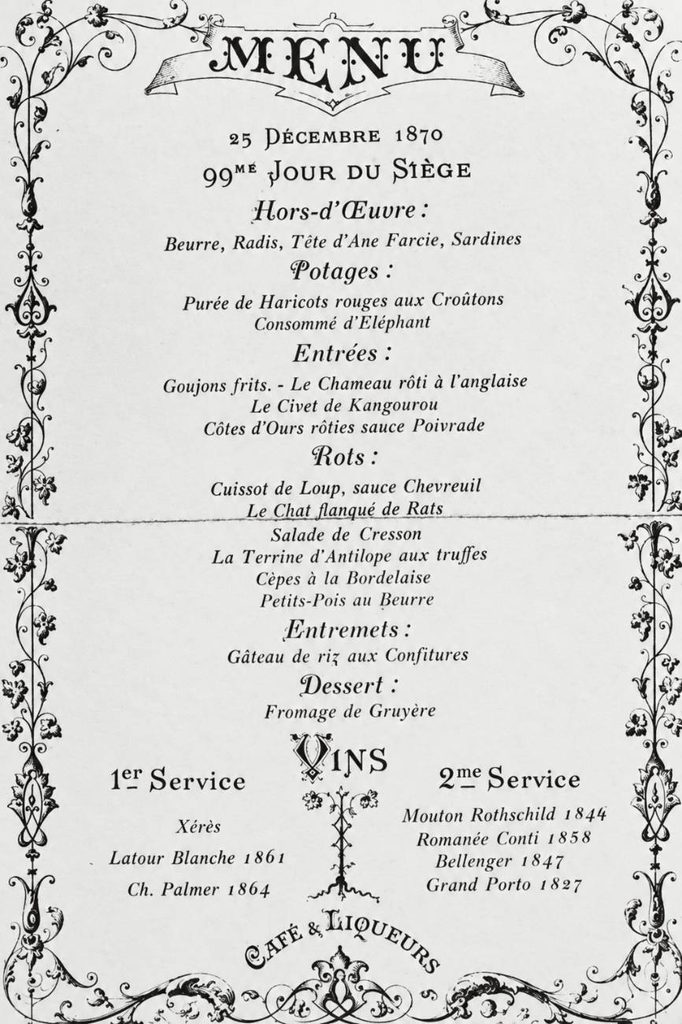
This famous menu was issued by Café Voisin, a fashionable Parisian restaurant at 261 rue Saint-Honoré, for Christmas Day, 25 December 1870, during the Prussian Siege of Paris. It commemorates the 99th day of the siege and is famous for its extraordinary dishes, including elephant consommé, roast camel, kangaroo stew, bear and wolf.
The elaborate menu is associated with chef Alexandre Étienne Choron, who became famous for preparing unusual dishes during the siege. The restaurant was known for serving affluent Parisian diners despite the severe food shortages.


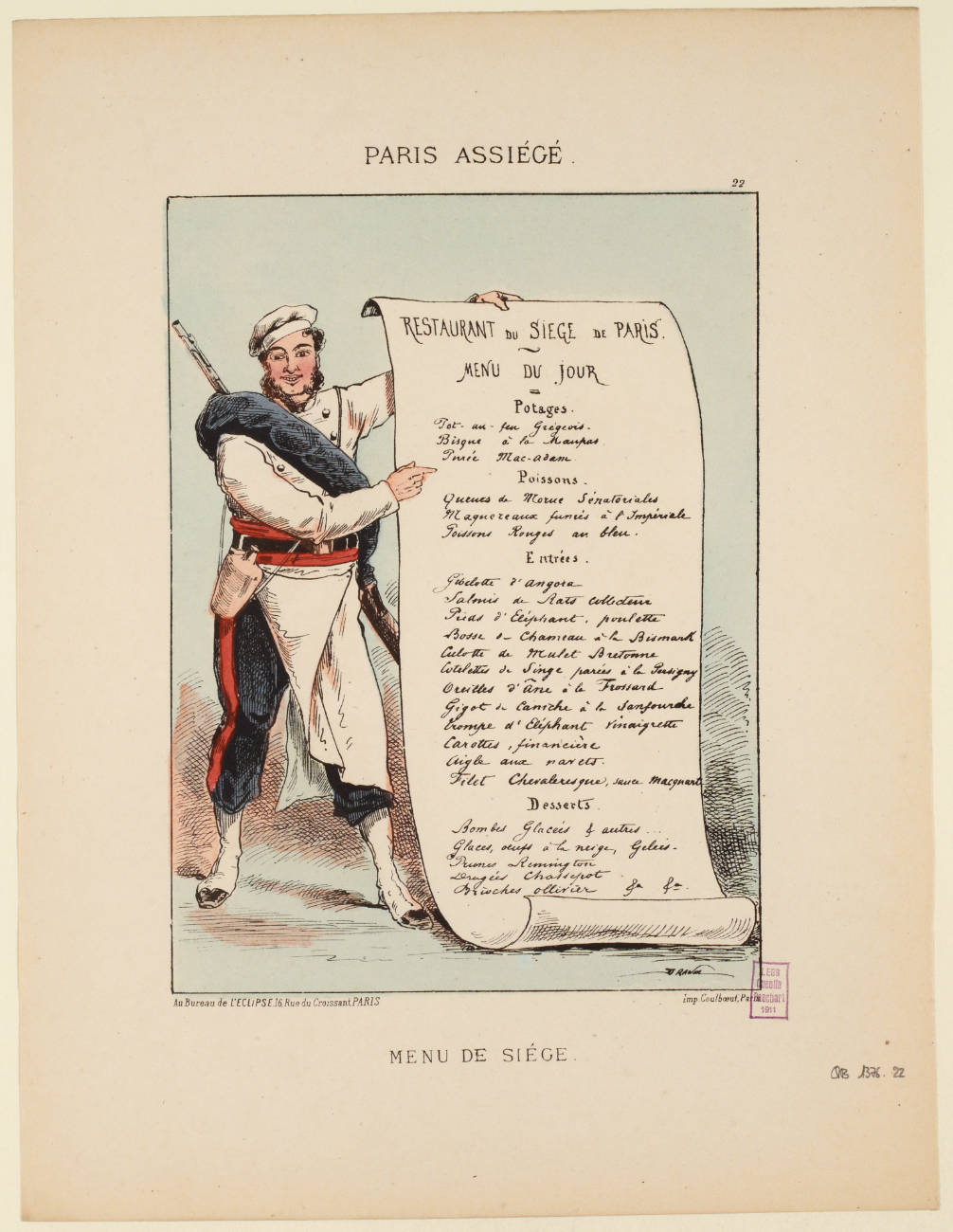
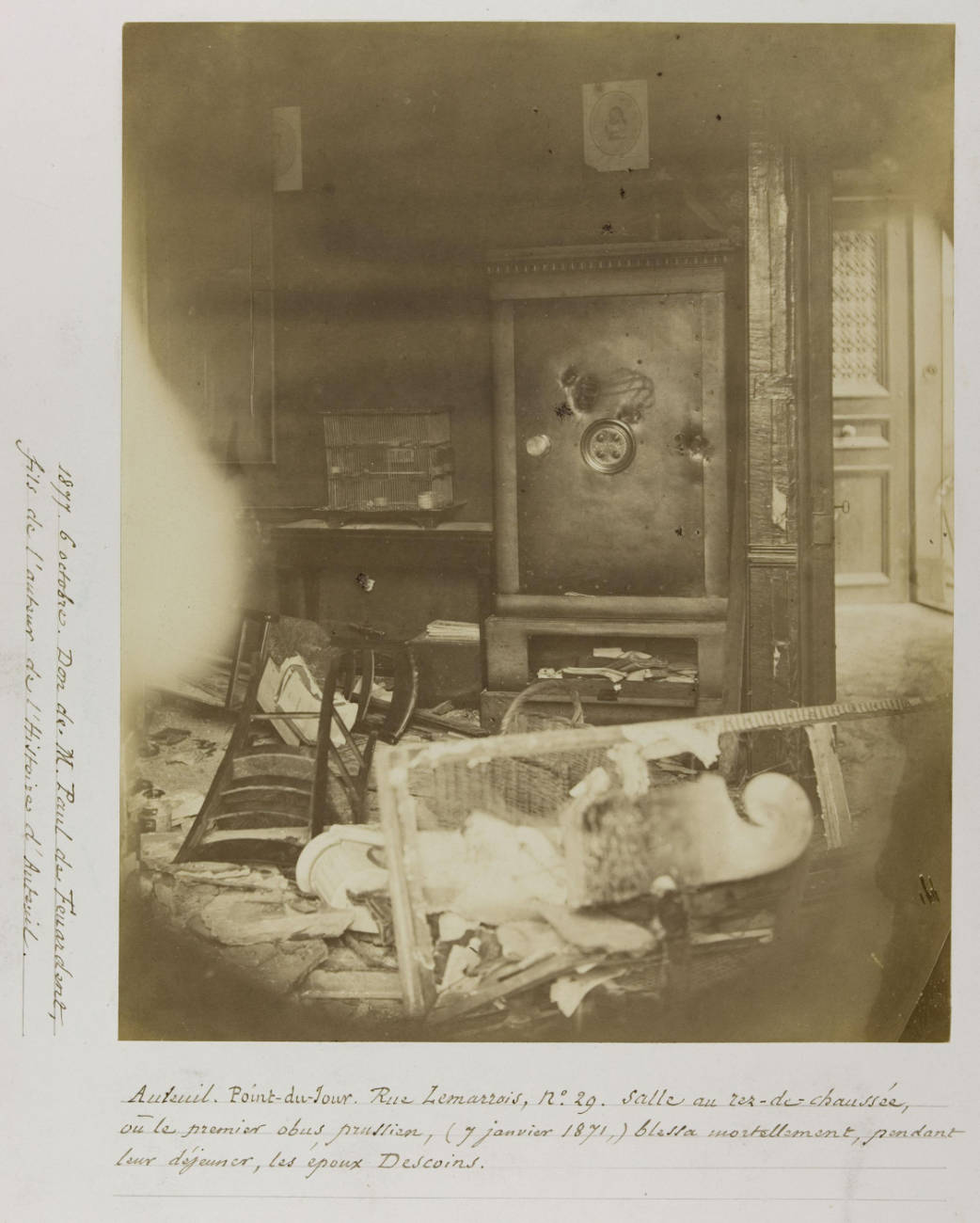
Yet hunger was only one of the hardships confronting the besieged population. Coal and firewood became desperately scarce, leaving families struggling to heat their homes through freezing temperatures. Illness spread, infant mortality increased, and the poor suffered disproportionately as employment disappeared and household resources dwindled.
Although Paris remained defiant, attempts by French forces to break the encirclement repeatedly failed, and hopes of relief gradually faded. Communication with the outside world depended increasingly upon ingenious methods, including carrier pigeons and balloons, one of which carried the republican leader Léon Gambetta out of the city.
In January 1871, German artillery began bombarding Paris itself, adding destruction and civilian casualties to the population’s mounting suffering. The situation was exacerbated by a number of devastating failed sorties, in what many in Paris believed was due to the fatalistic actions of the Government of National Defense who wished to negotiate a surrender to Bismarck.
By late January, four months of starvation, disease, exhaustion and military defeat were shown to be for nothing, when the Government of National Defense signed an armistice on 28 January 1871, ending the 132-day siege. Paris’s humiliation of defeat, a deepening class resentment and distrust of the republican government, and crushing war reparations, which fell predominantly upon those poor Parisians who had remained in Paris to fight the Prussians, would help ignite the revolutionary uprising of the Paris Commune just weeks later.
Public domain Images sourced from Wikimedia Commons and Paris Musees