
The Pétroleuse Trials
The Pétroleuse Interrogations
Captain Briot conducted the interviews of some of the 8000 poor women accused of being petroleuses after Bloody Week. The interrogations of these women offer a glimpse into the atmosphere of suspicion, fear and accusation that followed the fall of the Paris Commune.
In these military court records, women were questioned about where they had been, what they had worn, whether they had carried weapons, whether they had seen petroleum used, and whether they had helped set fire to buildings. Some admit to fighting, carrying arms or moving among the barricades; others insist they were there only as cantinières, nurses, companions or passers-by.
These documents show not only the wide accusations against the women, but also how quickly so-called sexual ‘promiscuity’, political activity, unconventional behaviour and proximity to the barricades could become evidence of incendiarism.
The Pétroleuse Trials
The most famous of the pétroleuse proceedings was the collective trial of Élisabeth Rétiffe, Léontine Suétens, Joséphine Marchais, Eulalie Papavoine and Lucie Maris, who were prosecuted together before the 4th Council of War. The case became one of the central legal episodes through which the image of the female incendiary was fixed in the public imagination.
The women were accused of participating in the Commune’s final fighting and, more seriously, of involvement in the fires around the Légion d’Honneur, Rue de Lille and neighbouring districts during Bloody Week. Yet their interrogations both beforehand and at trial reveal a much more complicated picture. Whilst most admitted to assisting the Commune as canteen workers or ambulance workers, they denied carrying weapons or petroleum. Much of the case against them rested on disputed sightings, hearsay, rumours of planned incendiarism, and assumptions drawn from their presence among the Federals. The resulting sentences were extremely severe, including death sentences later commuted in several cases to forced labour or deportation.
You can read about each of these women in more detail below:
Alongside this collective prosecution were a series of individual trials and investigations of other women accused of incendiarism or militant participation, including Victorine Gorget, Aurore Machu, Louise Desjardins, Rosalie Chérelle, Louise Chilly, Florence Vanderval, Jeanne Durivault and Marie-Jeanne Moussu.
These cases varied widely. Some women openly admitted firing on Versailles troops; others admitted being present near fires but denied taking part in them. In several interrogations, the military examiners repeatedly pushed the accused toward an interpretation of their actions as organised incendiarism, while the women themselves offered explanations ranging from nursing and supplying troops to personal revenge, fear, companionship, or simple presence at the scene. Taken together, the individual trials show that there was no single pétroleuse profile: the label was applied across a broad spectrum of conduct, from armed participation in combat to allegations of arson that were never clearly proven.
You can read more about these women in more detail below:
Newspaper Coverage
The newspapers reported voraciously on the petroleuse trials. An example of the language used by the press to cover the plight of these poor women can be found in Le Bien Public, dated 5 September 1871:
Hearing of September 4
The hearing opened at 12:10 p.m.
The president gave the order to bring in the accused.
The public, who expected to see pretty, spruce, and coquettish girls, experienced a real disappointment upon seeing five women of the common people, squalidly dressed, repulsive in every respect.
Élisabeth Rétiffe was dressed in a wool dress, a black plush coat, and wore an excessively white linen bonnet. She squints terribly.
Léontine Suétens has all the appearance of one of those low-class street strumpets that one meets in secluded streets. Very ugly, moreover, she wore a dress of questionable taste. Her blouse was black and white; long fake pearl drop earrings hung from her ears; a dirty green ribbon was braided into her light chestnut hair.
Two true heads of shrews are those of Joséphine Marchais and Eulalie Papavoine.
Joséphine is dark-haired, dry, with downcast eyes; she seems indifferent to what is happening around her.
Eulalie Papavoine — who already bears a famous name — is tall, gangly, and above all brazen. The particular feature of her physiognomy is her mouth, whose thin, pinched lips turned downward give her an air of genuine ferocity.
Lucie Maris, wife Bocquin, looks completely stupefied: short and dark, her face has the cut of an Aztec face.
These women, it seems, accuse each other mutually and shift onto one another all the crimes with which they are charged.
The public smiled upon hearing that these horrible girls, who seemed to have come out of Saint-Lazare yesterday, were accused of an attempt against the government…
Witnesses
Witnesses were also called to testify against some of the pétroleuses. You can read extracts of their interrogations below:
To jump ahead to the closing remarks of Captain Jouenne’s prosecution speech, which gives a clear outline of how the military courts approached their judgements of the pétroleuses, you can jump ahead:
Interrogation of Léontine Eugénie Suétens


Léontine Eugénie Suétens was a 25 year old laundress at the time of the Commune. Her father had raised her with a revolutionary consciousness, and had moved their family from the provinces to Paris shortly after she was born. At twenty years old, she was sentenced to a year in prison for theft, and by 1871 had lived for six years in a defacto relationship with a stonemason, Louis Aubert, who would become a quartermaster sergeant in the 135th battalion.
Thomas writes:
In the Commune’s early days she had joined the regiment as a canteen-worker; she had taken part in all the fighting. at Neuilly, Issy, Vanves and Levallois-Perret, where she had been wounded twice. Armed with a chassepot rifle and wearing a red scarf, she had been seen in the courtyard of the Legion d’Honneur. She was bringing drink to the fighters, gathering up the wounded, and was said to have taken part in the building of the barricades.
Léontine was sentenced to death by the 4th Council of War on 4 September 1871. Her sentence was commuted on 27 November to forced labour for life, and she was transported to French Guiana. She remained there after the 1880 amnesty and died at Saint-Laurent-du-Maroni on 2 November 1891, aged forty-five.
Translation of excerpt from interrogation of Léontine Suétens
RECORD OF INTERROGATION
4th Permanent Court Martial
1st Military Division, sitting at Versailles.
In the year eighteen hundred and seventy-one, on 6 August, at eight o’clock in the morning,
Before us, Briot, deputy reporting officer attached to the 4th Court Martial of the 1st Military Division, assisted by Mr Delplanque, clerk of the said Council, in the registry office at Versailles,
We caused Léontine Suétens to be brought from the prison at the Halle aux Blés for the purpose of questioning her.
Accordingly, the said Suétens was brought before us and questioned as follows:
Asked to state her surname, given names, age, place of birth, civil status, occupation and residence, she replied that her name was:
Léontine Suétens, aged twenty-four, born at Beauvais (Oise), unmarried, a laundress, residing in Paris at 3 Impasse Rome.
Q. — You are accused of having taken part in the Paris insurrection. What do you have to say in your defence?
A. — I have lived for six years with a man named Louis Aubert, a metal engraver/chaser, who was sergeant-major in the 135th Battalion of the National Guard, and whom I followed, in the capacity of a cantinière, from the first days of the Commune.
I accompanied him at the fighting at Neuilly, Issy, Vanves and Levallois-Perret.
My role consisted of selling brandy to the National Guardsmen. I did not wear a uniform, and I never carried a weapon. I received seventy-five centimes a day, like the other married women.
On Sunday, 21 May, we were in a barracks beside Les Invalides. On Monday morning, we left that place and went to the district of the Légion d’Honneur.
During that day I watched the barricades being constructed all around the Palace, using mattresses, stones, crates, etc.
At about two o’clock in the afternoon the fighting began and did not cease until seven o’clock the following day.
During this time, the Federates were transporting petroleum, and during Tuesday I learned that the Légion d’Honneur and the barricades situated in the streets were to be set on fire.
When the Federates realised that they could no longer hold their positions, they set fire to the places mentioned above and retreated.
We spent the night from Tuesday to Wednesday in the house in the Rue Solférino, and at about nine o’clock in the morning my captain, my lover and I left the said house in an attempt to return home.
We were arrested in the Rue du Bac by regular army soldiers. As for the other women, they were apparently arrested a little later.
Procès-verbal d’interrogatoire de Léontine Suétens, Versailles, 6 août 1871. © Service historique de la Défense, GR 8 J 105, dossier 21.
Interrogation of Élisabeth Rétiffe


Élisabeth Rétiffe was 39 years old at the time of the Commune. She was employed as a cardboard-maker. Edith Thomas describes her circumstances as follows:
For seven years she had lived fiathfully with a Parisian road-repair foreman, whom she left because he used to beat her. During a period of poverty, she had taken her clothing to the Mont-de-Piete (a pawn shop). From then on, she lived alone on her meager wages. During the Siege, cardboard-makers found work scarce. [She] had to accept the relief furnished to paupers by the city of Paris: a pound of bread and sixty centimes. However, despite her poverty, she found the means to pay her rent regularly. Even though she had been sentenced to twenty days in prison in 1853 for having got into a fight with a woman, and fined sisteen francs in 1855 for having insulted a policeman, she was liked in her neighbourhood of rue du Temple ‘for her gentleness, her honesty, and her good relations with everyone.”
Thomas relates how, early in May, Élisabeth was invited by her neighbour, Eulalie Papavoine, to become a canteen worker for the 135th Federal Batallion of Belleville. The offer was tempting for a woman on the edge of starvation, but soon she found herself also moved by the plight of the soldiers she helped, wounded by Versailles shells. Indeed, her empathy was not limited to the cause of the Commune, with Élisabeth telling the military tribunals, “I would have aided a Versailles soldier just as willingly as a National Guard.”
The witnesses made it difficult to prove accusations of incendiarism. They said they had never seen her fire a rifle, although she was said to carry one, and neither did they see her roll any casks of kerosene. Thomas elaborates,
‘She was busy taking care of food, bringing drink to the barricades..,’ said a witness, ‘and gathering up the wounded’… the witnesses who recognised her ‘had never seen her do anything extraordinary’.
Likewise for another witness, whose questioning is described in detail:
‘After administering first aid,’ said a tavernkeeper, ‘they came to my place and I gave them something to eat.’ Yet it was he who had had Élisabeth Rétiffe arrested. Did he, then, believe that she was guilty?
‘Of what?’
‘Of insurrection.’
‘…’
‘And of the fires too?’
‘Certainly not.’
‘Who set the fires?’ asked the presiding judge.
‘I don’t know. To me, they’re not guilty of that.’
Nonetheless, despite such testimonies, Élisabeth was sentenced to death by the 4th Council of War on 4 September 1871. Her sentence was commuted on 27 November 1871 to forced labour, and she was deported to French Guiana. She was released in 1880 but chose to remain there, dying at Saint-Laurent-du-Maroni on 24 February 1882.
Translation of excerpt from interrogation of Élisabeth Rétiffe
RECORD OF INTERROGATION
4th Permanent Court Martial
1st Military Division, sitting at Versailles.
In the year eighteen hundred and seventy-one, on 26 June, at one o’clock in the afternoon,
Before us, Briot, reporting officer attached to the 4th Court Martial of the 1st Military Division, assisted by Mr Delplanque, clerk of the said Council, in the registry office at Versailles, at the Halle aux Blés,
We caused Élisabeth Rétiffe to be brought from the prison at the Halle aux Blés for the purpose of questioning her.
Accordingly, the said Rétiffe was brought before us and questioned as follows:
Asked to state her surname, given names, age, place of birth, civil status, occupation and residence, she replied that her name was Élisabeth Rétiffe, aged thirty-nine, born at Vézelise in the department of Meurthe, unmarried, a cardboard worker by profession, residing in Paris at 36 bis Rue des Partants.
Q. — Tell us very precisely the number of women who, like you, followed the 13th Battalion on 22, 23 and 24 May last, between the Corps législatif and the Légion d’honneur.
A. — There were five of us, and among them were a woman called Léontine, blonde, twenty-four or twenty-five years old, of average height and somewhat plump; Madame Masson, a German woman, approximately the same height and age as Léontine; a young girl of about fifteen, who was released at the Corps législatif; and finally Eulalie Papavoine, tall, blonde, aged twenty-three or twenty-four.
Léontine wore a skirt with a white background, a black bodice and a cotton apron; her hair was uncovered except for a simple net. Madame Masson wore a brown merino dress like the previous woman; she had only a net over her hair. The young girl wore a brown Orleans-cloth dress and her hair was likewise held in a net.
As for Eulalie Papavoine, she wore a grey Orleans-cloth skirt and a black jacket [word unclear]; her hairstyle was exactly like that of the women just named.
As I have already told you, I was dressed as I am today: a skirt with a red background and black stripes, a black jacket, and on my head a thick muslin kerchief [or small cap], covering half my head.
None of us was carrying any weapon.
Page 2
Q. — Nevertheless, witnesses state that they saw you there.
A. — They may say whatever they like; as for me, I declare and repeat that I never set foot at the Légion d’Honneur.
Q. — Were you not wearing a red sash and carrying a red flag at certain times during Monday and Tuesday, 22 and 23 May last?
A. — No.
Q. — On the day before your arrest, or at any other time, did you offer cartridges to the wine merchant in the Rue Solférino?
A. — No, I formally deny that.
Q. — Did you not see petroleum being transported or poured out? Did you not know that it had been agreed among the Federates to set certain buildings on fire when the Versailles troops approached?
A. — I did not see petroleum being carried or poured out, but I knew that the newspapers were saying that Paris would be burned.
Q. — Did you not enter houses in order to ask for mattresses for the wounded?
A. — No. I entered only the wine merchant’s premises and the concierge’s lodge in the Rue Solférino. I do not know whether it was the Federates or other men who placed the mattresses at the barricades; what is certain is that I touched no furniture, no belongings — in short, nothing whatsoever.
Q. — Do you have anything to add?
A. — No.
The present record of interrogation having been read to Rétiffe, she declared that her answers had been faithfully transcribed and signed it together with us and the clerk.
Procès-verbal d’interrogatoire d’Élisabeth Rétiffe, Versailles, 6 juillet 1871. © Service historique de la Défense, GR 8 J 105, dossier 21.
Interrogation of Joséphine Marchais


Historian Edith Thomas, in her book The Female Incendiaries, describes Joséphine Marchais as a 35 year old ‘day worker’. A day worker, or ‘day labourer’, was someone hired and paid by the day, rather than holding a permanent job with a regular wage. The insinuation of such a description in court records was that she was engaged in casual, low-paid working-class employment without much job security, rather than having a specific profession.
In 19th-century Paris, this often meant precarious manual or service work: washing, cleaning, sewing, carrying goods, market work, factory or workshop labour, or whatever short-term employment was available. A woman described as a journalière might therefore move between different kinds of work depending on demand.
During the Commune, Joséphine was a canteen worker for the Enfants Perdus Battalion so she could remain close to her partner, Jean Guy. She was one of the five women tried together in the celebrated “pétroleuses” trial before the 4th Council of War in September 1871.
The military courts did not look favourably upon her history. Prior to the Commune, she had already been sentenced to six months in prison for theft, her mother had served five years imprisonment and ten years police supervision “for incitement to debauchery”, while her sister had spent her childhood in a correction house and had also been charged with theft. Thomas outlines her charges in 1871 as being:
“She was accused of having participated in the looting of the Count de Béthune’s town house, wearing a Tyrolian hat and armed with a rifle; of having said horrifying things to incite the National Guardsmen to battle… (If I am killed, I want to kill first!); of having led her lover Jean Guy, who wanted to desert, to the barricades… Josephine Marchais denied everything: she was merely going along the rue de Lille to return some linen that she had washed for the Federals.”
Joséphine was sentenced to death following her trial. Her sentence was later commuted to forced labour for life. She was transported to French Guiana, where she died at Saint-Laurent-du-Maroni in 1874, only a few years after the trial.
Translation of excerpt from interrogation of Joséphine Marchais
On the following Thursday or Friday, I passed through the Rue de Lille, and I thought it my duty to go and thank the concierge who had received me so kindly on Sunday, 21 May.
To my great astonishment, when I left her, she told a fire-brigade sergeant to arrest me. That is how I was taken before the Police Commissioner. There, the husband of the concierge in question came and gave evidence that he had seen me with the National Guardsmen and that I was armed with a rifle. I still maintain today that this testimony is completely false.
Q. — Do you persist in saying that you did not spend Sunday and Monday, 21 and 22 May, with the Federates?
A. — Yes. As I have just told you, I left them on Sunday at about four o’clock in the afternoon.
Q. — Were you drunk that day?
A. — No.
Q. — In a report contained in your file, a man named Hublin, concierge at 71 Rue de Lille, states that on Tuesday, 23 May, at the moment when the Battalion of the Avengers was retreating, you allegedly cried out:
“There is nothing left for us here, my friends — set fire to it!”
A. — That is false. I was not present in the Rue de Lille at that time.
Q. — Which battalion did you join after leaving the Avengers?
A. — I did not join any battalion.
Q. — What was the name of the man with whom you were living?
A. — His name was Jean Guy, an ordinary guardsman in the Battalion of the Avengers.
Q. — How were you dressed on Sunday, 21 May?
A. — As I am dressed now: a black skirt and black jacket, with a cotton apron.
Q. — Did you not try to lead the said Guy towards a barricade in the Rue de Lille?
A. — No, since I saw him only in the house where I distributed linen to the Federates.
Q. — Did you not notice some barrels in […]
Procès-verbal d’interrogatoire de Joséphine Marchais (ou Marché), Versailles, 17 août 1871. © Service historique de la Défense, GR 8 J 105, dossier 21.
Interrogation of Eulalie Papavoine


Eulalie Papavoine had no previous criminal record prior to the Paris Commune. According to Thomas, she was motivated by love for her partner, and empathy, in her work as an ambulance nurse during the battle with Versailles.
For two years she had lived with a journeyman engraver, Ernest Balthazar, by whom she had a child. Ernest… was a member of the National Guard in the 135th batallion, and she had followed him as an ambulance nurse to Neuilly, Issy, Vanves, Levallois-Perret, then to the Legion d’Honneur – everywhere that the batallion fought… [After the Avenue Rapp explosion] Eulalie… gathered up the injured, took them to the ambulance station for first aid, then accompanied them to the Charité Hospital. ‘When the Legion d’Honneur started to burn, I was at La Charité,’ she said. ‘I stayed there, captured. I did indeed see the kerosene casks, but I did not have anything to do with them.’
‘You must certainly have suspected that they were going to burn some buildings,’ said the presiding judge. ‘Why did you not leave those wretched people?’
‘I wanted to share my lover’s fate.’
‘Why,’ the presiding judge asked again, ‘did you stay behind when the batallion fled?’
And poor Eulalie Papavoine, seamstress, gave this utterly simple and sublime statement:
‘We had dead and wounded men.’
She was sentenced to banishment in a fortress, but died in 1875 in the asylum of Châlons-sur-Marne.
Translation of excerpt from interrogation of Eulalie Papavoine
[…] in the Rue Solférino, where there were two wounded men. On Wednesday morning, at ten o’clock, we were arrested on the new boulevard at the end of the said Rue Solférino. I was questioned there by Mr [Méacé?], police commissioner, and I was released, as was Léontine Suétens. That is all I have to say in reply to the accusation made against me.
Q. — How were you dressed during 22, 23 and 24 May?
A. — As I am dressed now: a brown barège dress, hitched up, with a black flounce, a black jacket, and a net on my head. I also had a cotton apron and an armband on my left arm. I carried no weapon.
Q. — How were Rétiffe and Suétens dressed?
A. — Suétens wore a grey-white barège skirt with a flounce, a white blouse, a cotton apron, a half red sash, and a net on her head. She too was unarmed. As for Rétiffe, she wore a skirt with red and black stripes, a black jacket, a linen cap, a cotton apron, and around her waist a red sash, the ends of which fell over her apron. She too was without weapons.
Q. — Who were the other women who were with you?
A. — There was also a Madame Masson with us, whose husband was a sergeant in the 132nd Battalion. She wore a brown skirt, black jacket, linen cap, black apron, and the sash of the Commune with broad gold fringes, worn to one side, and an armband. She constantly carried a carbine.
On Tuesday she dressed as a National Guardsman and, according to what some Federates told us, she fired shots that day and killed a concierge.
I should add that Madame Masson is very easy to recognise because she has a German accent. Besides this woman, we were accompanied by a sixteen-year-old girl, very badly dressed, who was arrested at the same time as us and who, I believe, was taken to some house of correction; I do not know where. She did absolutely nothing except care for the wounded and carried no weapon.
Q. — Did you not enter the Palace of the Légion d’Honneur?
A. — Yes. On Monday I went there three or four times, and on the last occasion, at about three or four o’clock in the afternoon, to care for a wounded man who was in the middle of the courtyard. Shortly afterwards he was carried home in a carriage, to 32 Rue des Canardiers. His name was Mr Marcelin Dubois, and he died that same day.
His mistress, Madame Bocquat [surname uncertain], who was also with us, followed the carriage, but she did not return. The following day I went back there two or three times to obtain medicines, staying only for as long as it took to collect what I needed.
Madame Masson, whose lover was the battalion surgeon, a pharmacist in the Rue des Canardiers, had spent about four hours there on Monday. Rétiffe, Léontine Suétens and the young girl whose name I do not know went, like me, several times to the Légion d’Honneur, either to fetch medicines or to care for the wounded. They, no more than I, did anything wrong in that Palace.
Q. — Which women carried water, wine or […] to the National Guardsmen who were defending the barricades?
A. — Rétiffe, Léontine Suétens and, on the first day, Madame Bocquat. As for me, I affirm that I never poured anyone a glass of water or wine.
Q. — Where did they obtain the liquid?
A. — From the wine merchant in the Rue Solférino.
Q. — Did you not enter some of the houses near the Légion d’Honneur — for example, the hotel situated opposite?
A. — I affirm that I went only to the Légion d’Honneur, the Cour des comptes, and the house in the Rue Solférino that I have already told you about. I remained for approximately a quarter of an hour in the apartments above the wine merchant’s […]
Procès-verbal d’interrogatoire d’Eulalie Papavoine, Versailles, 3 août 1871. © Service historique de la Défense, GR 8 J 105, dossier 21.
Interrogation of Lucie Maris, wife of Bocquin

Lucie Maris, according to Edith Thomas, seemed at first to present some difficulties of characterisation to the military courts:
The judges of the Council of War did not understand it at all: she was a ‘quiet’ woman, who had married a ‘decent and hard-working’ labourer: they had a child. Her behaviour was of the most ‘regular’ sort; in her district she was thought of as an industrious worker, ‘whose character was gentle and obliging towards her neighbours.’ Respectful of law and morality, she seemed, therefore, more like a candidate for a good-conduct award than a militant working to subvert society. But her husband left her to join the Army. She became aquainted with one Marcelin Dubois, a guardsman of the 135th Federal Battalion. The crime began with adultery. It is thus that Lucie Bouquin found herself at the Legion d’Honneur on May 2 and 23; there, on the barricades, she gathered up her lover’s body.
The Le Maitron dictionary states that the 5th Council of War sentenced Lucie Bocquin to ten years of solitary confinement. Several years of her sentence were eventually commuted on account of her “…repentance… religious devotion, and… exemplary behaviour.”
Translation of excerpt from interrogation of Lucie Maris
Q. — Did you not receive your share of the looting of the cellars of the mansions in the Rue de Lille?
A. — Two bottles of wine, some bread and some sardines were brought to me, but I do not know where they came from.
Q. — Did you not see petroleum being transported?
A. — No.
Q. — Did you not hear people speaking about fires?
A. — I heard it said that the Faubourg Saint-Germain would be burned.
Q. — Why did you not leave the National Guardsmen on Monday morning, when you came out of the Hamburg barracks?
A. — I did not know that events would turn out like that.
Q. — And later in the day, when you saw the abominable scenes that were taking place around the Légion d’Honneur, why did you not return home?
A. — Because I was afraid.
Q. — Did you not take away belongings while accompanying the body of the man named Dubois to the Rue des Canardiers?
A. — No.
Q. — Did you not receive a certain sum of money during the day on Monday?
A. — No.
Q. — Have you ever been convicted?
A. — No.
Q. — Where did you live before residing in the Rue des Canardiers?
A. — At 12 Place Saint-Sulpice, with Madame Veuve Barthe; at 69 Rue des Gravilliers, in the house of the pork butcher, at the corner of Rue Beaubourg.
Her answers having been read back to the accused, she declared that she maintained them and signed together with us and the clerk.
Confrontation, 18 August 1871
And on 18 August 1871, at three o’clock in the afternoon, we confronted Lucie Maris, wife of Bocquin, with Madame Euphrasie Perrier, wife of Rochais, a dressmaker residing at 64 Rue de Lille, Paris.
This witness declared that she recognised the accused perfectly, having noticed her in the courtyard of the Légion d’Honneur, beside a wounded man, wearing a red sash and carrying a rifle slung over her shoulder.
Q. — You have just heard Madame Rochais’s testimony. What do you have to say in response?
A. — I acknowledge that I was wearing a red sash, but I affirm that I never carried a rifle.
Q. — Do you have anything to add?
A. — No.
Procès-verbal d’interrogatoire de Lucie Maris, Versailles, 17 octobre 1871. © Service historique de la Défense, GR 8 J 105, dossier 21.
Interrogation of Victorine Gorget


At the time of the Commune, Victorine Gorget was a 28 year old laundress who, according to Edith Thomas, had:
…spoken at the Club Saint-Michel des Batignolles to demand a strong organisation and the mobilisation of all the nation’s active force; and she had said to one of her neighbours that ‘the women ought to take up arms to guard the ramparts while the men go out on sorties against the Versailles troops.’ On May 23, she had stated that she was going to go back with the National Guard to ‘arrest the loafers who are hiding out’. But she had been unable to go any farther than the command post.”
At first, Gorget was one of the around 40 women, along with Louise Michel, who were sent to Chantiers following Bloody Week. She and the others were punished by being tied to a stake for several hours whenever they displeased their captors.
Following the trials, she was sentenced to exile and was sent, along with Louise, to New Caledonia.
Translation of excerpt from interrogation of Victorine Gorget
[…] In my opinion, we should have organized ourselves more strongly and employed all the living forces of the population for the resistance, or else opened the gates to the Versailles army.
Q. — You must know the story of the crucifix that you allegedly held to your behind while saying: “Since I am an acquaintance of yours, kiss my ass (sic).”
A. — That is false, I still persist in denying it, as I have done before.
Q. — Were pistols found at your home?
A. — They are nothing but fragments of pistols that I wanted to get rid of this past winter, and no one wanted to buy from me because they were no longer worth anything.
Q. — What was the feeling that prompted you to go to the political clubs?
A. — I wanted to know what a public meeting was like; I had heard that education would be discussed, and I wanted to attend. The organization of labor was also supposed to be discussed there.
Q. — How long have you known Lefèvre?
A. — For two years; when we met, neither of us had any money; we wanted to secure some savings before getting married. During the Commune, Lefèvre was a simple guardsman and did as little duty as possible.
Q. — How long have you been self-employed, and where did you work previously?
A. — I have been self-employed for a year and lodge with Mrs. Cury. Before that time, I worked for Mrs. Blanc, a head laundress at 31 Rue Nollet.
Q. — Do you have anything to add, and can you name persons from whom information about you may be obtained?
A. — I have nothing more to say; you can obtain information about me from my former landlady Mrs. Cloger, 98 Rue Mercier, at the pawnshop (mont-de-piété), revenues of Clichy, and from Mrs. Joubert at 91 Rue Nollet and Mrs. Scapin at 2 Rue Lacroix.
Q. — Have you ever been convicted?
A. — No, never.
After reading her answers back to the defendant, she declared that she persisted in them and signed with us and the court clerk.
Procès-verbal d’interrogatoire de Victorine Gorget, Versailles, 9 octobre 1871. © Service historique de la Défense (Vincennes), GR 8 J 119,
Interrogation of Aurore Hortense Machu, wife of David


Aurore was a brush-maker and cantinière during the Commune. She was associated with the National Guard and, according to later records, was accused of having taken part in combat alongside the artillery and of involvement in the burning of the Tuileries.
Edith Thomas quotes 19th century author Maxime de Camp as describing Aurore Machu, along with Anne-Marie Menand and Florence Wandeval (also discussed below), in typically sensationalist terms:
Three sinister female had been inspiring and enflaming the men, embracing the artillery-men, and displaying an immodesty unshamed by broad daylight… sweating, with their clothes undone, their bosoms almost bare, passed from man to man, sometimes screaming: ‘Drink!’
Yet Thomas says:
Let us dispense with Aurore Machu immediately. For her, ‘there was no alleged crime of arson’. Dressed in a naval uniform, this woman pointed and fired a cannon in the place de la Concorde. When she was not by her weapon, she was seen calmly seated under the dome of the Naval Ministry. It was said that her comrades bore her in triumph to the Hotel de Ville, where she was commended for her skill and courage.”
Aurore was sentenced to forced labour for life.
Translation of excerpt from interrogation of Aurore Machu
[…] the government troops on the Place de la Concorde or elsewhere?
Answer. — All of that is false, since, as I have just told you, I did not leave my home until the sixth of June.
Question. — However, your landlord, Mr Fromentin, stated to the Police Commissioner that you would leave in the morning and not return until evening, and that, finally, you disappeared on the evening of the twenty-fifth of May and did not return until Sunday the twenty-eighth of May?
Answer. — Mr Fromentin is mistaken.
Question. — You told us that you lived alone during the Commune, whereas Fromentin states that your lover was arrested at the same time as you in your room?
Answer. — I did in fact receive visits from a Mr Philippe Verrier, a café proprietor at the Rocher du Cancale, Quai de Bercy, but no one was arrested in my room.
Question. — How do you explain the fact that, immediately after your release, the women who had been detained at Clermont at the same time as you denounced you as having fired a cannon, dressed as a sailor, against the troops?
Answer. — It was jealousy, that is all.
Question. — Unfortunately, a witness who recently gave evidence before us in the case concerning the burning of the Rue Royale gave a description corresponding exactly to you and specifically reported this detail: that you had fired the cannon and that you were wearing a sailor’s uniform. A boy, presumably your son, accompanied you on that occasion?
Answer. — I shall wait until the witnesses appear before me.
Her answers having been read back to the accused, she declared that she maintained them and signed together with us and the clerk of the court.
And on the fourth of April eighteen hundred and seventy-two, at two o’clock in the afternoon, in the clerk’s office at Versailles, we continued the interrogation of Miss Machu, Hortense Aurore, wife of David, as follows:
Question. — Do you persist in saying that you had no relations with the man named Bongardier?
Answer. — I regret not having told the truth at first. I became acquainted with Joseph Bongardier towards the end of April. He was living with his mother at 184 Boulevard Saint-Martin, and came to see me whenever he could. I affirm that he slept with me only three times: once during the month of May, and the other two times during the first few days of June. I never followed him and took no part whatsoever in the insurrection.
I acknowledge only that I took the rifle of a drunken National Guardsman who was lying on the pavement near the Gare de Lyon. I slung the rifle over my shoulder, purely as a joke, and put it down again almost immediately, at the request of Madame Hubert.
Procès-verbal d’interrogatoire d’Hortense Aurore Machu, femme David, dite Hortense David, Versailles, 6 mars et 4 avril 1872. © Service historique de la Défense, GR 8 J 120.
Interrogation of Louise Célestine Eugénie Chilly, wife of Desjardins, known as ‘La Picarde’
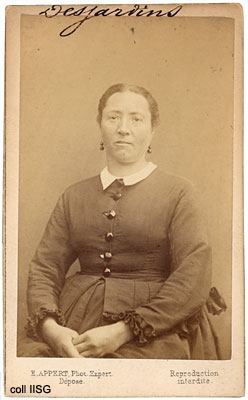

Louise Chilly Edith Thomas was 34 at the time of the Paris Commune. Sometimes described as a cook, and sometimes as a dayworker, her nickname ‘La Picarde’ was probably because she came from the Picadry region of France.
In respect of her charges, Edith Thomas states that she was:
…accused of having carried kerosene, under her skirts and in her pockets, to her lover, an unskilled labourer named François Bufferne, a National Guard in the 6th Company of the 184th Federal Battalion, in order to set the Prefecture of Police on fire.
After trial, she was sentenced to twenty years’ hard labour; her partner was exiled to New Caledonia where he died five years later.
Translation of excerpt from interrogation of Louise Chilly
I was very worried, and he did not return until ten o’clock in the evening, only to go out again, and he did not come back during the night.
Q. — Were you near the fire at the Prefecture of Police?
A. — Yes.
Q. — You are misleading us, because Buffetme says that on that day he was with his battalion at Place Jeanne-d’Arc?
A. — He was mistaken himself, because that day he went to his mother’s house.
Q. — Was he ill? Did you see him from time to time?
A. — On Sunday and Monday he slept at my house; on Tuesday he slept at his mother’s, because I left him there at about 11:30 or midnight.
Q. — Might he not have gone out afterwards?
A. — I do not think so, because he was continually feeling unwell and they had to put compresses on his head.
Q. — You are misleading us; he appeared on Tuesday precisely at the Prefecture of Police?
A. — That surprises me; he was very ill.
Q. — What did you do during those days when you went to see him at the Prefecture?
A. — Nothing in particular; I brought food and coffee in a bottle.
Q. — And petroleum?
A. — Never. I never carried petroleum and I never hid any in a room, as Madame Vassal did [or allegedly did], [with] someone who had stolen two hundred thousand francs from the Prefecture, the nephew of Madame Bellhomme. Madame Vassal told me that. I had indeed seen that man, who never left the room, but I did not know why. I know very well that people always listen to false witnesses, but never to good ones.
Q. — What rank did Buffetme hold?
A. — I never saw him wearing any rank during the Commune.
Q. — During the fire, Buffetme was not at his mother’s; he was with his battalion at Place Jeanne-d’Arc?
A. — I know that I went to see him at his mother’s; then after a while [unclear phrase].
Q. — What was he wearing on the day of the fire at the Prefecture?
A. — Civilian clothes.
Q. — He was in uniform and armed?
A. — He had no weapons; besides, I only saw him in the evening.
Q. — During an argument with Buffetme, did you threaten to denounce him as having set fire to the Prefecture of Police?
A. — That is completely false. But since he behaves maliciously, this is an act of revenge.
Procès-verbal d’interrogatoire de Louise Célestine Eugénie Chilly, femme Desjardins, Versailles, 4 juin 1872. © Service historique de la Défense, GR 8 J 128.
Interrogation of Jeanne Durivault

Jeanne Durivault was one of the women prosecuted after the Paris Commune for direct participation in the fighting. In her interrogation before the 4th Council of War on 27 July 1871, she admitted carrying a Chassepot rifle and firing several shots at Versailles troops near the Fort de Vanves, although she insisted she did not believe she had hit anyone.
Unlike many women accused primarily of incendiarism, Durivault openly acknowledged taking part in combat, explaining that “war has a great attraction for me” and that she had gone with the Federates in order to see a battle. Beyond the military proceedings, however, there is little more information about her background or sentence.
Translation of excerpt from interrogation of Jeanne Durivault
A. — Indeed, I had a Chassepot rifle slung over my shoulder, but that weapon did not belong to me; as for the sabre, it was Delcambre’s mistress who was carrying it.
Q. — Did you not go so far as to fire shots at the government troops when you were out on an expedition, or elsewhere?
A. — I acknowledge having fired several rifle shots through the loopholes in a wall behind which the National Guardsmen were positioned, but I can say with some confidence that I did no harm. I was using Commandant Ravaux’s rifle, and I aimed at the soldiers who were running across the exposed parts of the trenches.
Q. — In what direction did you fire?
A. — At the Versailles troops, above the Fort de Vanves.
Q. — What motives led you to act as you did?
A. — War has a great attraction for me, and it was in order to have a battle that I went off with the Federates.
Q. — Do you have anything to add?
A. — No.
The present record of interrogation having been read to Durivault, she declared that her answers had been faithfully transcribed, and she signed it together with us and the clerk.
Procès-verbal d’interrogatoire de Jeanne, femme Durivault, Versailles, 27 juillet 1871. © Service historique de la Défense, GR 8 J 106.
Interrogation de Marie-Jeanne Moussu, wife of Gourier


Marie-Jeanne Moussu, a 42 year old laundress, was a little different to the other petroleuses brought before the military tribunals. For one, she fully admitted to having set fire to a house. But La Gazette des Tribunaux noted that the crime had occurred a full month after Bloody Week began. That is to say, the fighting had been over for many weeks by the time Marie-Jeanne set fire to the house. What had happened?
In fact, Marie-Jeanne said that she had set fire to a house, not as a political statement, but because she had wanted to exact revenge on a lover, and thought it was his house that she was burning.
Despite the crime having nothing to do with the Commune, she was still sentenced to death as a petroleuse, with the same Gazette saying, according to Thomas:
The Moussu woman is the most perfect imaginable type of these unspeakable creatures from the slums who, it is known, provided the Commune with powerful auxiliaries for the purpose of burning Paris.”
The military tribunals thought the same thing, for was sentenced to death by the 4th Council of War as a petroleuse. Her sentence was subsequently commuted to forced labour for life, and she was transported to the Îles du Salut in French Guiana. Although she was amnestied in 1880, she remained in Guyana and died at the hospital of Saint-Laurent-du-Maroni on 24 July 1891 at the age of 62.
Translation of excerpt from interrogation of Marie-Jeanne Moussu, wife of Gourier
Q. — We urge you to tell the whole truth. Rather than having been driven by jealousy, was it not in fact in order to obey instructions you had received, or to fulfil promises made to you in return for a reward, that you attempted to set fire to the house in question?
A. — I have told the whole truth.
Q. — Why did you not first try to set fire to number 26, where the man named Vigneron was staying?
A. — Because the door was locked.
Q. — The man named Vigneron, who gave evidence under oath, states that he was not your lover and that he had not given you the slightest reason for jealousy?
A. — I repeat: it was out of jealousy, and in order to take revenge, that I set fire to the house at 22 Avenue d’Italie.
Q. — Various papers and copies of Le Père Duchêne seem to indicate that you were not uninvolved in politics and that you shared communist ideas?
A. — I found those papers while sweeping rooms.
Q. — Did you not have relations with certain National Guardsmen who lived in the same house as you?
A. — No.
Q. — A police report states that you have a very excitable, very violent character, that you often drank heavily and that, so to speak, you lived only from the proceeds of prostitution?
A. — I acknowledge that I have a hot temper and that on several occasions I drank to excess; but I did not engage in prostitution.
Q. — Why did you leave your husband?
A. — Because he ruined my prospects and caused us to lose eight thousand francs in the wine-merchant business we had undertaken when we arrived in Paris, at the end of 1860, in the Rue de Charenton, at the corner of Rue Saint-Nicolas.
Q. — Where did you go to live afterwards?
A. — At 14 Rue de la Gaîté, with Madame Bailliet, I believe. In 1862 we were living in Rue de l’Hôpital, at Les Deux-Moulins. In 1863, in Rue de Villejuif, with Madame Boissot, who was employed by the Orléans railway.
We left that place in July to take employment as concierges at 16 Passage de la Cité d’Orléans, with Mr Chevallier. At the end of 1866, we went to live at 36 Rue du Château-des-Rentiers, with Mr [Duguéive — surname uncertain]. I left my husband shortly afterwards and took a room with Mr Gérard.
Procès-verbal d’interrogatoire de Marie-Jeanne Moussu, Versailles, 19 août 1871. © Service historique de la Défense, GR 8 J 106.
Interrogation of Rosalie Victorine Chérelle


During this search, a gold toothpick mounted on ivory was taken from me. It had been given to me ten years earlier by a German man whom I knew only by sight. At that time this German man was living at 3 Rue Maubeuge.
Q. — What was your clothing, and were you carrying any weapons?
A. — I was wearing National Guard trousers, a black skirt edged in red, a black jacket likewise edged in red, and a sailor’s hat with a red cord and a black feather; I was carrying no weapons. My role, moreover, was to serve drinks to the Federates, and I did nothing else.
Q. — When you accompanied the man named Gabert on sorties against the government troops, how was Gabert dressed and armed? Did he often go into the trenches, and did he take part in the fighting?
A. — He was dressed as a National Guardsman and was armed with a rifle. When we went to the trenches, he carried his rifle slung over his shoulder so as not to fire at the soldiers. I affirm that he never fired a single rifle shot.
Q. — And what did you do in the trenches?
A. — I served drinks to the National Guardsmen.
Q. — Give us an account of how you spent your time from 21 to 28 May.
A. — I was staying with Madame Cayron, a wine merchant at 12 Rue Saint-Honoré; I was alone at her premises. Gabert was with the battalion — or rather, he had returned home, to 23 Rue de la Grande Truanderie.
I remained with Madame Cayron until Tuesday without concerning myself with what was happening in the street. By then I had exchanged my cantinière clothing for civilian clothes which Madame Cayron had given me.
I returned to my lodgings in the Rue de la Grande Truanderie on that Tuesday, 23 May, at about one o’clock in the afternoon. Since I did not concern myself with Gabert and left him free to do as he pleased, I could not say when he came to rejoin me.
Q. — Why did you separate yourself from Gabert and from the first Federal battalion?
A. — Because I wanted to go home.
Q. — Where were you when the Palais-Royal was set on fire?
A. — I was at Madame Cayron’s. I could not specify the day.
Q. — Gabert has been more frank than you. He told us that it was at the moment when they were about to set fire to the Palais-Royal that certain individuals informed you that the Versailles troops were approaching, and that you each fled in a different direction?
A. — I have nothing to say in reply.
Q. — How were you dressed when you presented yourself at Madame Cayron’s?
A. — I was dressed as a cantinière.
Q. — You have told us a lie, or rather you are in flagrant contradiction with Gabert when you claim that he returned to your home on 23 May; he himself states that he did not return there until Sunday, 28 May. How was he […]
Procès-verbal d’interrogatoire de Coralie Chérelle, Versailles, 7 octobre 1871. © Service historique de la Défense, GR 8 J 119.
Interrogation of Florence Vanderval

Q. — […] which we already discussed in your first interrogation?
A. — No, I never made any such remarks.
Q. — Nevertheless, witnesses state the contrary and claim to have seen you carrying weapons — a rifle, sabre and pistol?
A. — That is false.
Q. — Did [Pléd?] not fire a shot in the Passage Chausson?
A. — No.
Q. — Did you not have an altercation with a certain Mr Combes, and did you not try to have him arrested?
A. — No.
Q. — Did you not also make threats of arson against a man named Julien?
A. — No, I have never threatened anyone.
Q. — Where did you obtain the ball gown found at your home?
A. — It was given to me by a sailor for whom I had spent three francs. But since the dress was wrapped in a blanket, I did not know it was there and therefore cannot be held responsible for it.
Q. — Were there not other women with you during the days we discussed previously?
A. — Yes, there were three of us. One appeared to be about forty years old, a little shorter than me — that is, of average height — thin, with very dark hair and a sallow complexion. I no longer remember how she was dressed. The other, taller than me, was blonde. That is all the information I can give you. I know neither their names nor their addresses.
Her answers having been read back to the accused, she declared that she maintained them and signed together with us and the clerk.
Second interrogation — 4 April 1872
And on 4 April 1872, at three o’clock in the afternoon, in the registry office at Versailles, we continued the interrogation of Florence Vanderval, as follows:
Q. — Where were you at the time when the houses in the Rue Royale, Rue Saint-Florentin and Faubourg Saint-Honoré were set on fire?
A. — I did not see anyone set the fires. I remained throughout at the barricade by the Ministry of the Navy, or beneath the entrance to that Ministry on the Rue Saint-Florentin side. I was wounded on Tuesday afternoon in front of the Church of the Madeleine. I repeat that I saw no preparations for arson, nor anyone setting fire to the places you have just mentioned.
Q. — What you are saying is impossible. According to all the witnesses, it was on Tuesday afternoon that the Federates set fire to the Rue Royale and the Faubourg Saint-Honoré, and since you were there, you must have seen what was happening?
A. — I repeat that I saw nothing.
Q. — Do you recognise the dress we are showing you?
A. — Yes, that is the dress which was given to me by a sailor. I nevertheless maintain what I previously said regarding this garment, whose existence I did not know about, since it had been wrapped inside a blanket which had been used to allow a wounded man to rest.
Her answers and all the records and documents in the investigation having been read to the accused, she declared that she had nothing to add and signed together with us and the clerk.
Procès-verbal d’interrogatoire de Florence Vanderval, Versailles, 16 octobre 1871 et 4 avril 1872. © Service historique de la Défense, GR 8 J 120.
Interrogation of Henriette Pompon (Witness to Louise Michel)


[…] on the Versailles side. I do not know what part [Louise Michel] may have taken in the events that occurred at the Buttes and in the house in the Rue des Rosiers, but, in all conscience, I believe that she was involved in them, because she was highly excitable and always put herself at the head of everything.
Q. — If Michel spoke to you, as you have just told us, about Mr Clemenceau and about the crimes committed at the Buttes-Montmartre and in the Rue des Rosiers, it is impossible to believe that you did not ask her for some explanation?
A. — I asked her no questions. Besides, she never stayed still, and one could hardly think of having a conversation with her.
Q. — Did Michel not have habits of intemperance? Who were the people she habitually saw at her home? Was she not involved with Mr Ferré?
A. — I do not know whether she had habits of intemperance; however, I should say that she constantly drank black coffee. As for her social relations, she saw only the parents of her pupils, and I do not know whether she was involved with Mr Ferré.
I heard recently that her photograph was being sold as [that of] the mistress of this former member of the Commune.
Q. — Was she not the president of political clubs?
A. — Yes. She was president of the club which met at the Church of Saint-Bernard, at La Chapelle; besides, she attended all meetings of that kind.
She usually returned home at half past eleven or midnight.
Q. — Have you not heard it said that […]
Déposition d’Henriette Pompon concernant Louise Michel, Versailles, 12 novembre 1871. © Service historique de la Défense, GR 8 J 221, dossier 135.
Interrogation of Euphrasie Bertier (Witness to Eulalie Papavoine and Léontine Suétens)

RECORD OF EVIDENCE / WITNESS STATEMENT
(Article 102 of the Code of Military Justice)
4th Permanent Court Martial
1st Military Division, sitting at Versailles.
In the year eighteen hundred and seventy-one, on 8 August, at one o’clock in the afternoon,
Before us, Briot, deputy reporting officer attached to the 4th Court Martial of the 1st Military Division, assisted by Mr Delplanque, clerk of the said Council, in the registry office at Versailles, there appeared, pursuant to our summons dated 7 August 1871, the witness named below, who, outside the presence of the accused women and the other witnesses, after presenting the summons served upon her, having sworn to tell the whole truth and nothing but the truth, and having been questioned by us concerning her surname, given names, age, civil status, profession and residence, and as to whether she was a servant, relative or relation by marriage of the parties, and to what degree, replied that her name was Euphrasie Bertier, aged twenty-four, wife of Mr Rochais, [word unclear], a dressmaker residing in Paris at 64 Rue de Lille, neither a servant, relative nor relation by marriage of any of the parties.
Q. — Do you know the persons whom we are presenting to you?
(The women named Eulalie Papavoine and Léontine Suétens are brought in and placed before the witness.)
A. — Yes. I saw them on Monday and Tuesday, 22 and 23 May last, in the Hôtel de la Légion d’Honneur.
Both were armed with a Chassepot rifle, which they carried slung over the shoulder.
As far as I can remember, the taller one (the witness identifies Papavoine) was wearing a black dress or alpaca [cloth]; the other (the witness identifies Léontine Suétens) was wearing a black skirt, a white blouse with small spots, and a white apron.
I do not believe that I saw either of them wearing red belts or red sashes.
On Monday morning, between three and four o’clock, they entered the Rue de l’Université together to fetch a litre of brandy.
I did not see them again for the rest of the day.
On Tuesday, at about three or four o’clock in the afternoon, the shorter one (the witness identifies Suétens for a second time) went down the Rue de Lille dressed as a National Guardsman, with a rifle over her shoulder, accompanied by a male companion.
That is all I can say about these two women.
The statement having been read back to the witness, she declared that she maintained it and signed it together with us and the clerk.
Procès-verbal d’interrogatoire d’Euphrasie Bertier et confrontation, Versailles, 8 août 1871. © Service historique de la Défense, GR 8 J 105.
Interrogation of Marie-Clemence Ledoux (Witness to Anne-Marie Mendand)


4th Permanent Court Martial
1st Military Division, sitting at Versailles.
In the year eighteen hundred and seventy-two, on 11 March, at ten o’clock in the morning,
Before us, Briot, deputy reporting officer attached to the 4th Court Martial of the 1st Military Division, assisted by Mr Delplanque, clerk of the said Council, in the registry office at Versailles,
there appeared, pursuant to our summons of 9 March 1872, the witness named below, who, outside the presence of the accused woman and the other witnesses, having sworn to tell the whole truth and nothing but the truth, was questioned concerning her identity.
She stated that her name was:
Marie-Clémence Ledoux, aged fifty, wife of Louis Oger, a newspaper seller, residing at 24 Rue Royale, Paris, neither a servant nor a relative by blood or marriage of any of the accused.
Q. — Tell us everything you know about the events that took place in your neighbourhood from 21 to 24 May 1871.
A. — I have already given evidence before the Police Commissioner, and I maintain what I said.
On the day when the Madeleine was being looted, she said to me:
“Good! Let them loot that church; they thoroughly deserve it! They ought to set fire to the place.”
Then, pointing to 24 Rue Royale, she added: “And shoot everyone who is inside that shack!”
A National Guardsman was present during this conversation. I reproached her for what she had just said to me. She then called me: “Badinguette, filthy woman,” etc.
Then, striking a bottle she was holding in her hand, she said: “At least we’re going to drink this one, which isn’t costing me much.”
She then went back to [Bourgny?], where she was lodging, after saying to the Federate: “Go on, we shall be victorious, and we shall burn all the rich people’s shacks.”
I know nothing else.”
The statement having been read back to the witness, she declared that she maintained it.
Procès-verbal d’interrogatoire de Marie-Clémence Ledoux à propos d’Anne-Marie Ménand, Versailles, 11 mars 1872. © Service historique de la Défense, GR 8 J 120
The Closing Remarks of the Prosecution
PROSECUTION SPEECH
Mr. President,
Gentlemen of the Court,
The horrible campaign begun last March 18th against civilization by people who believe in neither God nor country, as proclaimed by Jules Vallès, one of their own, was bound to bring before you not only men forgetful of the most sacred duties, but also—and in great numbers, alas!—unworthy creatures who seem to have made it their mission to become the disgrace of their century and to renounce the immense and magnificent role of women in society.
Indeed, the legitimate woman, the object of our affections and respect, devoted entirely to the care of her family, is its guide and protector; her useful and beneficial influence extends over all, and man, whom nature destined to undergo this influence, is kept by her on the path of social duties. But if, deserting this holy mission, her changing influence serves only the demon of evil, she becomes a moral monstrosity; then woman becomes more dangerous than the most dangerous man: she leads him astray, she smothers in him what remains of commendable instincts.
History provides us with the proof: in 1793, the tricoteuses [knitters] of the clubs and the unfortunate women who earned the nickname “Furies of the Guillotine” terrified the world.
Could anyone have feared that this unworthy species would spread! By what terrible fate, in 1871, do we find examples? Those standing here before you are the daughters of the shrews of 1793.
There lies vice, brutality, and fury! If, at least, all of them were deprived of the gifts of intelligence, if all were illiterate, incapable of understanding the enormity of their guilty actions! Well, even while cursing them, perhaps one could pity them; but among these women—and I reproach myself for giving them that name—you will find those who cannot call upon the miserable resource of ignorance to aid them.
While enlightened minds—and we must fervently support them—demand this important benefit of public education, what a bitter disappointment for them, and for us! Among the accused, we will see female teachers. Those, Gentlemen, will not be able to pretend that the concept of right and wrong was unknown to them.
And that is where all dangerous utopias lead: the emancipation of women preached by doctors of law who did not know what power they were given to exercise, and who, at hours of upheaval and revolution, sought to recruit powerful auxiliaries.
Have they not, to entice these miserable creatures, dangled before their eyes the most incredible chimeras: female magistrates, members of the bar? Yes, female lawyers, deputies perhaps, and – who knows? – commanders, army generals!
It is certain that one feels like they are dreaming in the presence of such aberrations! These exaggerations, Gentlemen, as you will recall, originated in centers where women, some of them famous, were the authors. I will not inflict upon them the punishment of naming them.
But these doctors I spoke of earlier, all these apostles of the religion of disorder, seized upon them, and in Le Rappel, La Marseillaise, and L’Affranchi by Paschal Grousset, they opened a school from which emerged all these heroines of immorality, theft, and arson. Some, in the pulpit of our temples, replaced the word of the Gospel with the propaganda of crime. Others, profaning the purity of childhood, usurped the revered functions of the Sisters of Charity in schools.
The woman Michel, a schoolteacher – she will appear before you – transformed the Church of Saint-Sulpice into a Revolutionary club; she was its president. To her students, fifty young girls, she delivered the strangest maxims and replaced, for these poor little ones, the hymns to the Virgin Mary with the refrains of La Marseillaise and Le Chant du Départ. This trial, Gentlemen, will be of extreme importance among all those submitted to you.
The representative of the public prosecutor’s office, after painting a picture of the disorder these women cast into morals, religion, and public honesty, arrives at the statement of the facts of the prosecution.
Starting May 22nd, there were no more political men or insurgents: there were criminals, murderers.
Let us follow the 135th battalion and the Enfants perdus arriving on Rue de Lille at break of day.
The Legion of Honor was their hideout; that is where the kerosene was brought. All who refused to obey the orders of these battalions were taken away, like the concierge Thomé, to be shot. Everything was organized for looting and arson; these five women, they were seen everywhere; all witnesses say they were armed.
The Hôtel de Béthune, the Hôtel Chabrol, No. 8 Rue de Solférino, were subjected to looting. Who were the perpetrators? The 135th battalion and the Enfants perdus. To which corps did these women belong? To the 135th battalion and the Enfants perdus. Did you not see how the concierge Thomé was cowardly murdered by the companions of these unfortunate women?
However, as the army advances, the assassins have no other option than to set fire to the neighborhood to hide their murders and lootings. The Federates go to draw cans of kerosene from the sixty barrels that arrived in the courtyard of the Legion of Honor, and spread kerosene over the apartments and furniture.
Now, these women, except for the woman Bocquin, were seen in the neighborhood during the three days preceding the fire.
Do they deserve any leniency? You heard them respond: neither frankness nor repentance!
The representative of the public prosecutor’s office recalls the prior criminal records of the accused, records noted in the report, and requests for them a declaration of complicity in arson. They were not caught torch in hand? Ah! That is because it was difficult to meet witnesses then; everyone was hiding, fearing for their existence.
I request the application of the law against these women for all the crimes of which they are accused, and I demand from your justice the application of the sentence in all its rigor.


Source: Wikimedia Commons, Le Dossier de la Commune devant les conseils de guerre, Paris, Librairie des bibliophiles, 1871.