
The New Year’s Book – Little Stories, Tales and Legends for Children – by Louise Michel
The Inheritance of Grandfather Blaise
The Schoolmaster’s Legends: First Legend
The Third Legend: The Bogey Men, The Ogre, Gilles de Laval, Baron de Retz
The Fourth Legend: The Ogress Beatrix de Mauleon
The Fifth Legend: The Black Hunters, Robin of the Woods
The Sixth Legend: More Ogres, The Baron of Adrets
Cecile’s Letter for New Years’ Day
THE
NEW YEAR’S BOOK
Little Stories, Tales and Legends
FOR CHILDREN
by
LOUISE MICHEL
Children, you are the future.
Be just; everything depends on that.
(Louise Michel, Oct. 1872)
PARIS
Library of Childhood and Adolescence
J. Brare, Publisher
6, Place Saint-Michel, and 20, Rue de l’Hirondelle
1872
THE SNOW
The winter wind blows in the shadows,
The snow covers the paths;
Children, come, the night is dark,
Warm your hands by the hearth.
And while you sit quietly,
Take this book and these pictures,
They are memories from long ago.
Those we speak of were once your age,
But time passes quickly:
Like the tide that beats the shore,
The days rise and drift away.
We will speak of ancient ways,
Of faraway lands or rustic ones,
Or of the things one sees in dreams.
Listening to the tale and the story,
You will see joy and tears,
And how little glory weighs,
And what honours are truly worth.
Happy you will be, if fixing your thoughts
On all these things of the past,
You become a little better!
THE
NEW YEAR’S BOOK
Little Stories, Tales and Legends
FOR CHILDREN
MOTHER GUDULE’S ARITHMETIC
Jean Kerouin, a Breton tenant farmer, had a son who would not take to arithmetic.
It was the poor man’s despair; he cared little that Yvon could write a letter better than any other boy in the village to tell the uncles in Paris that the wheat harvest was strong that year, and that they wished la présente to find them likewise; no one was more skilled at chanting the Epistle, so loudly that the windowpanes trembled. Arithmetic alone would not enter his head, for the very simple reason that he did not want it to.
Yvon was stubborn as a Breton (or, if you prefer something more coarse, stubborn as a donkey).
He had said to himself: “I don’t need to calculate, since now my parents do all the calculating, and besides, it would only bore me. Later on, I will marry a woman who can count well, and I will work with all my strength during that time.”
Once this line of reasoning had settled in his mind, he would reply nothing to whatever one told him, and he did no more than that.
Pierre Kergnel, the schoolmaster, was in despair about it.
Mother Gudule, Yvon’s grandmother, who had so far said nothing, one day stopped her spindle and said, without shaking her head (which only happened in remarkable circumstances):
“I will take the boy in hand, and I guarantee that I will teach him, myself, in less than three days, the four rules of arithmetic.”
Jean Kerouin and Pierre Kergnel looked at the good woman, utterly astonished, for they thought she must be going mad or becoming a sorceress.
But the calm on her face, still fresh and always smiling beneath her neatly starched cap, reassured them.
They told her they would entrust Yvon entirely to her.
Now, Grandmother Gudule was a strong-minded woman; alone among the women of the village, she could read, write and count, and she had learned all this, no one quite knows how, almost without ever putting down the spindle she had used since the age of eight to spin the thread for the family’s clothes.
It appears that a dying old uncle, being a schoolmaster, had left a few books; at first, Gudule had spelled them out every Sunday, and then she had read them and ended up understanding them.
Thus, for several leagues around, people marvelled at her knowledge and came to consult her about all sorts of matters.
Being intelligent and above all fair, the good woman gave advice that one never regretted following, and that always surprised people who were not accustomed to thinking.
After this conversation with her son and the schoolmaster, Gudule took up her spindle again.
Around midday, as bread was being taken from the hollow table wrapped in a white cloth, and as they mixed the flour to make crêpes, the grandmother called her grandson and addressed him as follows:
“Listen, lad Yvon, this is not a punishment or the sign of any displeasure; I will explain the reason to you later. Today you would ask me in vain; but starting tomorrow morning you will stay for three days shut inside the little room in the attic.
“I will give you the provisions myself; they will be plentiful, and on the little mattress there will be a double layer of goose feathers (two quilts).”
Yvon said nothing; he was too proud to ask in vain for something that would not be told to him, and he respected his grandmother too much to try to resist her.
Jean Kerouin and Pierre Kergnel knew well enough what she meant to do; but they did not understand what connection Yvon’s retreat to the attic could possibly have with arithmetic.
During the night, the imagination of the little Breton began to work, and, I do not know how, the idea came to him that arithmetic was not entirely unrelated to his stay in the little room; but as for what would happen, he understood no more than the others.
Morning having come, Yvon got out of his closed bed, kissed his parents, and cheerfully asked Mother Gudule if she would kindly take him up to the attic, for he was greatly curious.
Mother Gudule gave him a hearty breakfast, then she took a huge piece of butter, a large loaf of still-warm buckwheat bread, more provisions than he could ever finish, cold bacon, honey, fruit, in short enough for his three days to feed ten other children for a whole week.
Only one thing troubled Yvon: Mother Gudule had thought of everything except the large lump of sugar without which, since his earliest childhood, he had never fallen asleep unless he had it in his mouth.
It was a little habit of gluttony, but it harmed no one, and besides the chubby Yvon was not yet ten years old.
The only hope he had left was in a small basket, carefully covered, whose contents he did not dare ask about.
His grandmother kissed him and closed the door, after which she remained for a long time at a little hole she had made in that door, and which Yvon did not suspect existed.
The boy, as they say in Brittany, went straight to the little basket, quickly lifted the lid, and seeing a great number of lumps of sugar, he first took a handful.
“Tomorrow, well tomorrow,” was his saying.
When he had chewed quite a few, the idea came to him to count the rest; it was an occupation like any other.
“Good thing Mother Gudule only put me here for three days,” he was saying to himself as he counted, “for I would not have as much to munch on the last day as I have today.”
His addition gave him a total of thirty sugar lumps remaining.
What wealth! He took nine more.
Then another curiosity seized him: he wanted to know whether he would have the same amount for each of the remaining days.
Knowing he had just eaten some again, he counted once more.
He now had only twenty-one lumps left.
Mother Gudule was at her observation post. She applauded herself, the good old woman, for she had used Yvon’s greed just as a good architect uses live rock in the absence of good stones.
The little glutton, having counted, and quite frightened by his new total, pondered for a long time before continuing his calculation.
How was he to go about it?
“I know well enough,” he thought, “that after taking away nine from thirty, there remain twenty-one; but how do I divide the rest?”
Then an inspiration came to him: he made three piles from the lumps that remained, then counted each pile again to see whether the total for one day did not exceed that of another; and, surprised to find pleasure in it, he looked for new calculations, his love of sweets always helping him along.
For example, how many would remain for the three days if he took a few more now?
Of course Yvon counted for three days, because whatever he ate in advance did not enter into the calculation; only the evening total mattered.
By what chance did Yvon find paper and a pencil on the table? He had no idea. Good Mother Gudule thought of everything.
Another idea had come to him: to redo in figures on the paper what he had just worked out.
But since numbers were still unfamiliar to him, he simply copied his various operations using roughly sketched sugar lumps.
Once made visible, everything became much easier to grasp.
Yvon took such delight in it that his half-eaten slices of bread cluttered the table, mixed with gnawed fruit.
Night came, quite inconveniently interrupting him, and he was forced to go to bed; for Mother Gudule would never have entrusted a lamp to a child of his age.
All the time he slept, Yvon dreamed that he was doing endless calculations with so many sugar lumps that they formed tall pyramids.
It is likely that he rewarded himself at the same time by biting off a few pieces from his pyramids.
Hardly had daylight come when he dressed and returned to his work from the day before, drawn back by that irresistible fascination children feel for anything they engage in for the first time.
And then, let us add, as Mother Gudule said, that the lad had a furious taste for sugar.
“…if his little sister, whom he loves so much, were made of sugar,” added the good woman, “I would not entrust her to him.”
The governors of besieged cities devise no more strategies for their flour than Yvon did for his sugar.
Having made his plans carefully, he realised he was munching at the same time from the right and from the left, and that he now had only six pieces left in total for his two evenings.
Six was still quite a lot, and to make new calculations he had to reduce the number again.
Yvon, still nibbling, took up his notebook once more, wrote down his operations as he had the day before, and only stopped when he had just one piece left for his two evenings.
One piece! Then he would be missing one for one of the evenings; and that evening, how would he fall asleep?
Having thought it over, he cut the piece in two and, taking up his notebook again, drew half-pieces.
Fractions had been discovered.
From time to time, Mother Gudule, spindle in hand, would take a little break at the hole in the door; and though she could not see the notebook, she applauded his work, for the boy, his head bent over his hands, was flushed with concentration.
He was looking for a way to eat much more than half while still having some left for the next day.
He found his solution.
He cut the piece again, first into four, then again into four.
Thus Master Yvon came to understand quarters, eighths, sixteenths; he went as far as thirty-seconds, always cutting each piece in two until nothing remained but a perceptible crumb.
The next morning, a little worried at having nothing left for the evening but that tiny morsel, he picked up his notebook again to amuse himself, and understood it from one end to the other. Stubborn Yvon had taken a bite of arithmetic.
He did not notice that midday had already come.
The door of the little room opened; Mother Gudule entered.
Before embracing Yvon, she cast a glance at the notebook — for she still read without spectacles, old as she was — and she took it in her hands.
Then, taking her grandson by the hand, she led him away. Before entering the room where everyone had gathered for luncheon, she carefully smoothed his blond hair, made him put on a fine new pair of blue gaiters, and entered with him.
Yvon was completely astonished; he was even more so when he saw his old uncles, his cousins, and some neighbours, not forgetting the schoolmaster, all with a festive air.
“Perhaps,” thought Yvon, “Mother Gudule is going to remarry,” for he could imagine no other explanation for such display of finery and such an abundance of pancakes that the very thought made his mouth water.
Yvon was indeed very fond of sweets.
When he had kissed all his parents and had wished the schoolmaster good morning, Mother Gudule began to speak.
“Up until now,” she said, “our lad Yvon never wanted to concern himself with arithmetic. For the past three days he has done nothing else. I hope he will continue to study, for the love of his father, what he has learned through gluttony. We are celebrating this happy change.”
The good old woman lowered her voice a little as she gave her grandson this wholesome lesson.
Yvon burst into tears, threw himself into his grandmother’s arms, and promised her he would continue.
His heart was so full that he could only console himself by seeing how much joy his notebook brought to his parents and friends.
She had to explain everything at length in front of the schoolmaster, who was delighted to see that Yvon had understood arithmetic.
From that time on he applied himself, as he did to other subjects, becoming one of the best pupils in his class; and the memory of the preference he had given to his gluttony over the happiness of pleasing his family was so keen that for a long time he could not bring himself to bite into a single lump of sugar.
⸻
THE LITTLE EAR OF CORN
IROQUOIS LEGEND
This, dear children, is no truer than Bluebeard or Tom Thumb. It is a tale that is passed from mouth to mouth in the land of the Mingwés, whom we call the Iroquois.
They take even more pleasure in hearing it than in the tale they love most; for they believe it as you would believe in Tom Thumb, if no one had ever told you he does not exist, or if your good sense had not naturally judged otherwise.
This said, here is the legend:
A warrior of the Great-Turtle family had a sister whom he loved very much.
She was called Little-Ear-of-Corn. It was her brother who had raised her, their parents having died of a great sickness that had swept over their village. She was all he had left in the world, and he loved her both as a sister and as a daughter.
After some years, the same sickness returned. The great black bird of death hovered once more over the tribe.
The wind from its wings made fall the old men, the warriors, and the warrior children.
Little-Ear-of-Corn became ill. In vain Oulawaï, her brother, sought for her elk meat from the mountain.
She fell asleep, and her spirit flew away toward the west, to Eskenane, the land of Souls.
Oulawaï laid his sister’s body in the grave, placing beside her jewels as though for ten tribes; then he went to find the Oki, so that he might give him the means to meet her again, for without her he could not live on earth.
The Oki sent him to the solitary man with long hair, Sonoukwiretri, so that he might teach him the road to the land of Souls.
He showed him the path and gave him a marten, so that he might release it when the dogs who guard the Bridge of Spirits tried to leap upon him.
So Oulawaï set out toward the west, carrying gifts for the chiefs of the Land of Souls, so that they might allow him to bring back the spirit of Little-Ear-of-Corn.
When he arrived at the Bridge of Spirits, the great black dogs came toward him; but he released the marten, and while they pursued it, he crossed the river on the liana that served as a bridge, and found himself in the Land of Souls.
The dogs pursued the marten for a long time, but it had run back, by a path only it knew, to Sonoukwiretri, the solitary man. He thus lent it to those who were going into the Land of Souls.
Oulawaï had walked many days, and the land before him was so full of shadow that it invited him to rest.
He watched the great hunt of the dead pass by, and he would have liked to follow it.
But more than anything else, he loved his sister Little-Ear-of-Corn.
He walked straight ahead until he heard the drum and the chichikowe. Having recognised the songs of his tribe, he went to find the chief.
The chief, who was one of his forefathers, embraced him and led him to the royal lodge.
There sat the king of the Souls, Toroniawagou. His lodge was hung with necklaces brought by the dead.
Oulawaï, on the way, had recounted to his ancestor that he had come to seek the spirit of Little-Ear-of-Corn, and the ancestor had become thoughtful.
Having offered the king a pelican for the guardian of the Souls, and jewels for the queen, he explained how the great black bird of death had carried off Little-Ear-of-Corn, and how he had come to find his sister again, unable to live without her.
And since the king seemed well-disposed, Oulawaï ended by offering him necklaces for his neck, his arms and his ankles — which entirely inclined him to allow Oulawaï to take Little-Ear-of-Corn back.
Oulawaï gave the king a fourth Ear-of-Corn to console him for the departure of his sister, whom he seemed to regret, and left with his ancestor in search of Little-Ear-of-Corn.
On the way, he noticed that his ancestor appeared much larger than before, and that his face had become like a light.
They found Little-Ear-of-Corn with other young girls in a great prairie where a river shaded by palm trees flowed; they were dancing the Dance of Souls.
At the sight of her brother, Little-Ear-of-Corn uttered a loud cry; and, without his knowing how, she pulled him into the dance.
It was an immense round that spread across the whole plain.
It was reflected in the river like in a mirror and in the clouds like in a painting.
One might have said that the water of the river and the clouds were also dancing.
Oulawaï felt that he would never again dance upon the earth.
When he had danced for a long time, his sister led him to the lodges of their tribe. The ancestors explained to him the whole land of the Souls; and the forefather whom he had first seen could not leave him, for he had seen him as a very small child before dying.
Oulawaï stayed for a long time in the lodges; then sleep came over him and he fell asleep beside the ancestor.
Long he slept, and during his sleep he saw in a dream the land of the Souls.
There, no wars, no quarrels; the tribes are sisters; and when a spirit arrives from the sorrowful land of the Living, a great celebration is held for him, for he is delivered forever.
When Oulawaï awoke, he felt extremely light; one would have said that a great weight had been lifted from him.
Little-Ear-of-Corn and her companions surrounded him; he saw among them the warriors and the young girls of his tribe, who smiled at him.
They had died since his journey, for more than eight hundred moons had passed during his sleep.
Oulawaï then realised that he too had left his body while sleeping, and that he would never return to the sorrowful land of the Living.
This legend, which greatly resembles the German legend of Eternity, shows that the peoples of the land of the Mingwés, despite their childhood state, are aware of a moral perfection in which the tribes are sisters and have neither wars nor quarrels among them.
THE OATHS
Feudal Legend
In the time when peasants, like the flocks, were bound to the glebe — that is, to the land — when lords bought them, sold them, or received them as inheritance along with oxen and sheep, for farming or for butchery, there lived in those days a wicked lord, as there were so many.
He was called Guillaume of the Bloody Shield; his father, his mother, his wife had died of fright at the crimes he committed, and on their tomb he had not even shed a tear.
His son Robert, entrusted to his nurse, was growing up far from him, in a cottage, under the care of this good woman and her children, of whom the eldest, Jehan, was about to turn sixteen.
Robert the young noble and his foster-brother Hubert were not yet ten years old.
A very learned cleric, of that time, went every day to give lessons to Robert; he had promised Robert’s mother before her death, for the poor woman believed, rightly, that Guillaume’s ignorance had helped to make him so ferocious, and she did not want the same fate for her son.
Sir Guillaume of the Bloody Shield was among those fierce lords who, priding themselves on their ignorance, would sign a parchment by dipping into ink the iron gauntlet they wore.
They might just as well have dipped it in the blood they shed with impunity.
One day, after a hunt in which he had bravely driven his spear into the throat of a wild boar, Guillaume of the Bloody Shield decided to enter the cottage of Madeleine, the nurse, to see whether his heir looked proud and strong.
He found Madeleine kneading, with the finest flour, the bread for Robert and for Hubert, who until then had shared the same food, just as they had both drunk the same milk.
The old cleric, seated at a table, with Robert, Hubert, and Jehan gathered around him — Jehan having just returned from his field work — was having them read a carefully illuminated manuscript.
Jehan spelled tolerably well; but the two little ones, having begun at a very young age, read and wrote almost as well as the cleric, which delighted the good man.
The entrance of Sir Guillaume into the cottage was a true disruption of the peaceful scene.
Madeleine stepped forward respectfully to present his son to him. But the lord, pushing her aside brutally, cried out that the peasant-clerk and all who were there would pay dearly for their audacity in having raised his son in such foolishness.
As he spoke thus, he slashed the manuscript with a stroke of his sword.
All fell silent; but Robert, who combined his father’s boldness with his mother’s goodness, lifted his head proudly.
“It is my mother’s will,” he said, with a firmness beyond his years.
Guillaume turned pale with anger.
“Bring this young lordling to the castle,” he said to his squires.
Without giving Robert a moment to bid farewell to his nurse, he made him pass before him.
But the child, while obeying his father as was his duty, kept his firmness.
On the threshold of the cottage he turned around:
“Farewell, mother-nurse,” he said; “farewell, Jehan and Hubert; farewell, Master Nicolas. I swear to you, if anyone harms you, he will have to answer to me, and I will avenge you; I swear it by my mother.”
As he spoke, Robert extended his hand, as is customary when one gives an oath.
Three years passed; the son of Sir Guillaume had grown; his firmness had strengthened yet more. He was a handsome and proud youth as he awaited the day he would become a bold knight.
He accompanied his father into the forest when they hunted the wolf or the wild boar, but Guillaume despaired of overcoming his resistance to pursuing hare, roe deer, stag — all noble game.
Never did he appear at the night feasts; people had even lost the habit of inviting him.
During the early days of his stay at the castle, Robert would sometimes slip away to visit his nurse and his friends Jehan, Hubert, and Master Nicolas.
Then Sir Guillaume began, during three or four days, to shut his son in the dungeon of the tower. The child submitted without saying a word; and a few days later, slipping away again, he endured with the same silence the same punishment.
Whether the castellan grew tired of it, or whether he gave it no more thought, there came a day when the punishments were forgotten; and since they needed one more man-at-arms, Jehan, who was very strong, was chosen.
This separated him from his mother, but he still had Hubert; and since he could see her from time to time and found himself near Robert, Jehan considered himself fortunate.
Robert was well loved by the vassals, but greatly hated by the people of the castle, accustomed as they were to live as slaves; and if it had not been for the old squire Gontran, who had known his mother, he would have been surrounded only by traitors.
Soon these wicked people grew jealous of Jehan and resolved to destroy him completely in the mind of Sir Guillaume.
It was not difficult: “A rabid dog is always ready to bite,” says the Lorrain proverb.
The worst of these vile slaves, named Frank, told Guillaume that his son preferred the company of the new man-at-arms to all others, and assured him that as long as Robert frequented his nurse’s cottage, he would scorn the feasts.
That was enough, and circumstances, moreover, aligned with the betrayal.
The castellan became desirous, in order to better watch Robert, to take Jehan with him to a dwelling he had just inherited, which was situated a few leagues from the castle.
It was the end of autumn, and as this was a hunting retreat and he was at peace with all his neighbours, Guillaume took no offence at bringing there a great pack of dogs and hunters.
When he passed through the forest at nightfall, those who met him believed they were seeing the hunt of the grand huntsman himself.
This lasted for several days; and as the forest had not been hunted in for a long time, wolves were so abundant that Robert enjoyed himself and Sir Guillaume no longer thought of what Frank had told him.
One evening, Jehan received a message from his mother, struck by a sudden illness; she asked for him immediately, and Hubert added the recommendation not to delay.
Jehan therefore wished to leave with the messenger, but Guillaume expressly forbade it, for on the following night there was to be a torchlit hunt.
Jehan said nothing to the lord. “I will be there sooner than you,” he simply told the messenger, and Guillaume let him go.
Then he went to find Robert: “Noble young lord,” he said, “I give you my word that tomorrow evening, at the first sound of the horn, I will be there. If during the day any order is given in my name, please say that you know where I am, and that I will return in time for the hunt.”
Robert promised. They embraced, and Jehan set off along the forest path that was the shortest route.
Even taking that path, it was twelve leagues; it was eight o’clock in the evening, so he had to go very quickly.
He had been gone a long time when Robert realised he would have arrived sooner had he lent Jehan his own horse.
Knowing the route Jehan must have taken, the young lord, who also wished to see his nurse and regretted not having thought to ease his friend’s hardship, untied his horse, took with him another fully saddled and bridled, and galloped into the forest road.
The horses flew; the child caught up with Jehan, who, drenched in sweat, had just covered six leagues in a short time.
Day was breaking when they reached the cottage; as for the messenger, he had taken the ordinary road. Indeed, Madeleine was very ill; but she recognised her children.
That joy revived her, and although her agony had begun, she regained strength and smiles, so much so that the poor young people believed her condition to be improving.
The old cleric did not dare disillusion them, though he saw clearly.
Robert then, after embracing his good nurse, mounted his horse again, his heart full of hope, leaving the other steed for Jehan’s return.
Around midday, he was back; the wicked Frank saw him return cautiously with his horse, and informed Sir Guillaume.
Guillaume asked for his son.
“Where do you come from like this?” he said to Robert.
The poor child was covered in sweat and pale with emotion.
“Father,” he said, “I have just been to see my good nurse, who is in danger of dying.”
“And where is that peasant Jehan?” continued the lord.
“Father,” Robert replied, “he is, by my order, in a place from which he will return this evening at the first sound of the horn.”
Guillaume leapt in anger and had his son taken to the dungeon.
Meanwhile Madeleine, revived at first, breathed her last in the arms of Jehan and Hubert.
They wept for a long time; then Jehan remembered the promise Robert had made on his behalf.
He embraced his mother one last time and, unable to believe she was truly dead, though she was already cold, he knelt again and wept a long while at her bedside.
“Jehan, my brother,” Hubert said to him, “you gave your word to Robert. You must go.”
Jehan rose; there were only two hours left before sunset.
He mounted the horse Robert had left for him; it was a proud steed that could have raced the wind.
At the first sound of the horn, he was in the courtyard.
As he spoke these words, Robert ran himself through,
with a firm hand.
His blood covered the flagstones.
Sir Guillaume à l’Écu sanglant no longer had an heir.
A few years later, a renowned mercenary captain,
Hubert the Black, came boldly to lay siege to the castle.
Guillaume perished by his hand; he was the son of Madeleine,
who in turn avenged her brother and Robert.
It is with such terrible scenes that the history of the Middle Ages is sown.
⸻
THE TEN SOUS OF MARTHE
How many things people wish for! how many things are told about New Year’s Day.
Here is one of those stories; as for the wishes one might make, here is one too: live and die in peace with your conscience.
Little Marthe had received a great number of toys and an extraordinary quantity of sweets.
Since she was only six years old, it was not yet midday when she was already tired of the toys and full of sweets.
Marthe then asked her great-aunt, who spoiled her greatly, to come take a little walk with her.
The good old lady took little money, for she knew she would refuse Marthe nothing, as long as she had any money left, and she did not want to teach her to be wasteful for the sake of her whims.
The weather was fine, but very cold; Marthe pushed her arms as far as she could into a muff almost as big as she was.
The boulevards were lined with shops, and Marthe made so many purchases, to begin with, that soon her great-aunt had nothing left but a ten-sou coin.
The little girl’s arms and her muff were full of very shiny objects, costing very little and worth no more.
Realising she did not have much left to spend, she thought of the little children who had passed their New Year’s Day without toys and without sweets.
It was rather bad to think of it so late, but Marthe was only six years old, and deep down, she did not have a bad heart. Besides, her aunt spoiled her far too much, and in a manner that was not always wise.
Just as she was beginning to think of others, rather late, two children, younger than she was, caught her attention; they were pale and looked so sad that the good aunt was struck by it as well.
The older one, neatly dressed in black, but in a way too light for the season, was stopped as he tried to tie around his brother’s neck a small woollen scarf — the poor child’s little neck was violet with cold, though he was dressed more warmly.
“Where are you going, my little friends?” asked the aunt.
“We are coming back, madam,” replied the older boy, “from a lady who is a friend of our mother. We did not find her at home, so we are going back to our house.”
“Yes,” added the little one with that naïve confidence of childhood, “we were going to Madame Paul’s so she would give us a bit of sewing work for Mama and so we could buy some bread.”
And as the older boy cast him a sideways look to stop his chatter, the last ten-sou coin was already in the little one’s hand, and Marthe and her aunt hurried away so that the older boy would not return it to them.
Once they were far away, Marthe began to cry.
“Oh my aunt!” she said, “how I regret having bought so many toys! We could have given so much more to those poor children!”
Ten years later, Marthe, now a young girl of sixteen, working as a junior teacher for a few months, had already learned some of life’s harsh lessons, of which she had once been unaware.
Her parents had not succeeded in their business, and for lack of a small sum of five to six hundred francs, they risked a very bad situation.
Marthe had just begun working as an assistant teacher in a day school. She was to earn eight hundred francs by the end of the year; but being paid only monthly, it was impossible for her to immediately offer her father the sum he needed for merchandise still unsold.
If the payment was not made on time, his promissory note would be protested. If he returned the merchandise and could not pay, he would have to close his shop.
An idea came to Marthe, and she shared it with her great-aunt, who was then eighty years old and loved her just as dearly as in the past.
She would have spoiled her even more had Marthe not been reasonable.
“My aunt,” said the young girl, “it seems to me that we could obtain an arrangement with my father’s creditor. Since I earn eight hundred francs a year, I can give him fifty francs every month, on the day I receive my wages. Perhaps he will agree.”
The good old woman approved of the idea and wanted to accompany her little girl.
When they arrived at the shop of the brothers Marcel, they were both very surprised to see, on the merchant’s sign, a piece of silver sculpted in relief with this inscription: (To those fifty centimes of New Year’s Day).
They remembered the fifty centimes from Marthe and, not daring to share the same thought aloud, they stepped into the shop.
The elder of the Marcel brothers was seated at the desk, acting as cashier; the younger was working as a shop boy; a woman, appearing more ill than old, alternately replaced one son or the other.
Marthe, whom her great-aunt adored hearing speak, explained the purpose of their visit very simply, but with an energy that showed one could rely on her word.
Marcel, the elder brother to whom she had spoken, called his mother and his brother.
He had recognised not Marthe, who had grown a great deal, but the good old woman, who had barely changed in ten years.
“We have,” he said, “the honour of seeing again those who were the cause of our good fortune.”
And as his mother and brother had hurried to greet the two visitors, he explained that after Marthe and the old lady had left, they had searched for them for a long time, for neither he nor his brother wanted to accept alms.
When they returned home, just as the elder boy could not console himself, the friend at whose house he had found no one finally came to their door; she brought needlework and a bit of money.
They were therefore able to buy bread without touching the little coin that had weighed so heavily on the older boy’s heart.
He was completely consoled in his pride when his mother said to him: “Perhaps, when your turn comes, you too will be able to render, through your work, services to others without offending them.”
Félix Marcel, after thinking it over, asked for the ten-sou coin so that he might use it as he wished. He announced that he would not return home until evening, and taking his little brother by the hand, whom he never left, he stepped out with an air of resolve, as though he were setting out to conquer the world.
The two friends, after letting him leave with a smile, for he was a good child one could trust, amused themselves by following him from a distance.
Félix, still holding his little brother’s hand, went to a seller of penny goods and asked her if she could sell him items worth ten sous at wholesale price, for he was going into business!
The shopkeeper burst into an endless fit of laughter; but since it was precisely at that same spot that the child had once searched so long for the lady who needed the ten sous, she suspected some brave project.
Not only did she add a large extra quantity of items, saying, “You will pay me for these when you have earned something,” but she took the two brothers under her protection and set up for them a very small table in front of her own.
By evening, all three were such good friends that they could no longer part from one another. That day they earned three times their investment. The kind shopkeeper had no children. When the time of the next New Year arrived, she took them into her tiny shop to help her, pretending they would be of great use to her, for Félix would never have agreed otherwise.
The business prospered; in ten years the shop of Mother Hortense had become a large store where the two widows and the two brothers lived.
All this, thanks to Marthe’s ten sous!
Félix was finishing his story when Mother Hortense, who had gone out to do some errands, returned.
I leave it to you, dear children, to imagine the welcome given to Marthe and her great-aunt.
Félix insisted that the six hundred francs not be given back to him until four years had passed.
By that time, Marthe’s father, having done better in business, and the shop of the Marcel brothers continuing to prosper, everyone agreed that for the feast day of the good great-aunt, they would each lend one hundred francs to six orphans, some of whom had to support their mother, others their little brothers.
The good old woman, that day, wept with joy, and this act brought good fortune to all, for she lived many more years, and the six businesses continued to prosper.
⸻
THE LEGEND OF THE BLOWER
At the time when chemistry, still in its infancy, was nothing but darkness, though darkness filled with stars — a strange art called alchemy, whose devotees, passionate for science, “blew” (as people said then) their wealth and their lives into it — Raymond Hortensius lived in Great Britain. He was one of those who, seeking the secret of the great work (as the elixir of life and the philosopher’s stone were called), found along their path a multitude of things they were not looking for.
When the road is long, what things one may discover!
Will the secret of transmutation be found of metals? Perhaps, but it will certainly be only in an age when, thanks to the development of science and morals, gold will matter very little. It will be useful, however, among other purposes, to replace in cooking the instruments in which, mixed into the food, are found oxides of copper and lead. That is no more unbelievable than galvanism.
Unheard-of errors were mixed into these early researches of science. People searched valiantly and in good faith, but mistook glowing worms for little suns.
The alchemists were proud; one of them replied to the envoys of Rudolph II who urged him to come to the court of Prague: “Either I am an adept, or I am not; if I am, I have no need of the emperor, and if I am not, the emperor has no need of me.”
At the time of Raymond Hortensius, King Henry VI was in great need of money; it was a few years before his death, which occurred in 1471.
No one knew the age of Hortensius; the oldest men had always known him with hair just as white.
It was known that he had travelled widely, but no one knew the place of his birth.
He said that he had worked in Germany more than a hundred years earlier with Schwartz, the inventor of gunpowder, and even with Collinique on Greek fire, at the time of the wars of the Byzantine Empire.
He had seen Paris at the time when it was called Lutetia and was contained within the Île de la Cité.
People attributed to him a multitude of ancient professions, judging by the quantity of objects and strange costumes glimpsed in his laboratory through the little grated window, for no one was allowed to enter.
It was marvellous that such things, so ancient as they were, existed at all. There were Moorish guitars with six strings, Italian theorbos, ancient lyres, all heaped together with strange costumes; garments of animal skin from the earliest ages of the world, Greek chlamyses, the boots of Alcibiades’ soldiers, sandals of broom and rush from the companions of Romulus, Jewish tunics without seams, the crwth of Ossian, the cup of Cambresius Vergobret from Cambrai.
The list would be interminable.
If you had seen all that, dear children, you would have said: “he is an antiquarian, and so am I”; but in those days people preferred to believe that he had been successively a bard, a warrior, a scholar, and many other things as well.
Besides, it was also the old man’s manner, and perhaps he had ended by believing it himself, like the others.
Thus King Henry VI was in great need of money, “so much so,” says Evelyn, “that he sought to fill his coffers by the help of alchemy.”
A royal decree was published condemning all previous prohibitions.
And as a multitude of adepts, true or false, presented themselves to make gold, a second royal edict announced that the hour was near when by means of the philosopher’s stone, His Majesty would pay all the State’s debts in coined gold and silver.
However, Raymond Hortensius had not gone to see the king; and as he was considered very skilful, they sent him a messenger who, peering through the little window, was greatly astonished — not only at the things we have already mentioned, but also at the glow of the fiery crucibles shining in the darkness, and the great number of retorts, fantastical animals, horns, skeletons, etc., with which the retreat was swarming.
It was the appearance of science in that age.
The messenger, having asked for the twentieth time why Hortensius had not gone to see the king, cried out so loudly that the alchemist finally raised his head.
Having the question repeated — the one he had not understood — he replied: “I have nothing to do with King Henry VI,” and he lowered his eyes again to his crucibles.
The messenger, having tried in vain to get anything more, delivered that reply to the king.
Hortensius was a strange man; no one knew where he slept or whether he ate; these marvels only increased the confidence people had in him.
Henry VI, pricked by curiosity, went himself to the little window.
But as he tried to begin a conversation, Hortensius flew into a rage.
“You profane wretch!” he cried.
It was because the forty days had now elapsed.
Since his mixture had been on the sand-fire, he expected to see appear the black sail that foretold the success of the work.
Now, what people then called the black sail of the ship of Theseus, or the raven’s head, was supposed — according to the alchemists — to signal the transmutation of metals.
Faced with the anger of the scholar, the king felt both regret and hope; for he understood well that Hortensius would begin again whatever he had failed to achieve.
“Master,” he said, “if you lack anything whatsoever, speak to King Henry VI.”
But Hortensius did not reply; the king had to leave just as he had come. He returned, pensive, to his palace, searching for some way to obtain from the scholar the secret of making gold.
During the night, a terrible explosion was heard.
In place of the tower where Raymond Hortensius had lived, there was now nothing but a heap of ruins.
In attempting to repair his mixture, Hortensius had found what he was not looking for: an explosive preparation.
Henry VI had the rubble searched so that, with the help of the scholar’s books, others might obtain his secrets; but they had all been consumed.
Only a single manuscript, half burnt, remained: it was the hand of Hortensius, who had tried to save it from the flames by lifting it above his head.
That hand, still attached to a charred forearm, was all that was ever found of him.
All the alchemists of Great Britain tried in vain to decipher the manuscript whose lines were half burned, and as they no more succeeded in making gold than before, King Henry VI was forced to break his promise. This did not trouble him greatly, for he needed money for many other things than paying the State’s debts in coined gold and silver.
⸻
THE INHERITANCE OF GRANDFATHER BLAISE
Father Blaise was the richest farmer in the region. In addition to the fields he cultivated for others, either by halves or on other terms, he owned considerable property of his own.
His daughter had been educated in the best school in the town, and his son had just left college with a prize assignment that all his classmates envied.
Margot, his housekeeper, was a very pleasant person; she never lost her temper, even when a downpour ruined the freshly cut grain.
The servants were happy on the farm; yet Father Blaise was sad, so sad that one feared he might die of it, all the more because both his father and grandfather had also died of sorrow, without anyone ever knowing why.
Often the two children, Rose and André, would talk with their mother.
“You, who are said to be so clever,” Margot would say to her son, “try, then, to cure your father of his sadness.”
André did everything he could, but he made little progress.
He could have spent ten years recounting all his best college pranks, and Blaise would have listened gravely, for the boy told them well, but he would not have smiled in the least.
In despair, Rose went, without saying a word, to find old Jeannette.
She was a peasant woman nearly a hundred years old.
Having seen fathers, children, and grandchildren born and die many times, and knowing the history of every family, she sometimes gave excellent advice, which made her pass for very wise.
Rose therefore went to consult Jeannette about her father’s sadness.
“My lady, my child,” said the old woman, “I know well enough why; but it would not be prudent to tell you.”
Rose insisted so much, she promised so faithfully to keep the secret, and deep down old Jeannette so wished to tell the little girl everything she knew and to look together for ways to cure her father, that she finally consented.
“My grandfather told me,” she said, “that there was a time when famine in this village was so severe that those who had even a little bit of land would give, when children were born, the whole field in exchange for a sack of wheat, or even barley or buckwheat.”
Rose shivered. Jeannette’s grandfather, who had been a hundred years old, must have lived a very long time ago. But she did not know why the beginning of that story frightened her.
“Then,” continued the old woman, “your father’s great-grandfather, whose name was François Blaise, began to buy many small fields from those who did not want to let their children or their elderly parents die of hunger.”
Rose burst into tears.
“My lady, my child,” said the old woman, “you wanted to know.”
“Yes, my good Jeannette,” said the young girl, “I must know, so that my father may be cured.” And drying her tears, she listened attentively.
Jeannette continued: “François Blaise, already rich, married richly; but there were in the village several ruined families. He took their misfortune to heart, and he died of sadness.
“His son, to whom he had no doubt recommended something on his deathbed, but who had not dared to do it, fell into the same sorrow at the same age, and he also died.
“Your father is the fifth.”
Rose had found a solution, but she would have to tell her father that she knew the secret.
“What would you do in my place, Jeannette?” she asked.
“My lady, young miss, it’s delicate!” said the old woman.
“But surely,” said the poor young girl, clasping her hands, “how can we give back those cursed fields without bringing shame upon our father?”
The old woman let these words escape her, quite thoughtlessly:
“It’s been a long time that the two of us, Jean Claude and I, have been thinking about it; for it is a great pity to let a poor good man die who will be so mourned.”
“My father, has he never tried,” said Rose, “to give something back?”
“Indeed, young lady, ever since his great-grandfathers, they have always supported, quietly, the families; but it did not yet satisfy their conscience, and your father, it is the same with him.”
Both began to cry, so deeply had Rose’s confidence and pain moved the good woman. She then had a second moment of confusion, she who otherwise had such a firm mind, as they said in the village.
“We shall see with Jean Claude!”
Hardly had these words been spoken when Rose exclaimed, “I understand, Jeannette; you and Jean Claude are descended from the families who made these sad bargains.”
The old woman did not reply.
Rose continued: “Do not refuse what I am about to ask you. You and Jean Claude, you are very old, though he is the youngest of your nephews; you will come live with us; my father will suffer less, and you will be cherished, well cared for, very happy!”
As she spoke, the poor girl blushed, for deep down, the land, so strangely bought by her ancestor, belonged largely to Jeannette. The latter took pity on the child.
“Well, yes,” she said, “since there is no other way!” Rose did not sleep all night. It was truly a fortunate inspiration that had led her to Jeannette.
The next day, Rose brought to her father the centenarian and her nephew Jean Claude, the old shepherd.
“Father,” said Rose, “here are some companions who will cheer you up. From now on, these good old folks will live with us.”
Blaise blushed and grew pale, and then his heart broke, as they say in the village. He began to weep, and told them, also in tears, how from father to son, having received each time the fatal story, and all held back by a painful sense of shame, they had only helped the descendants of those unfortunate people with whom his ancestor had made those fateful bargains, and the terrible sufferings that each of them had endured.
Jean Claude wept with emotion.
“Let it be so, Father Blaise,” said Jeannette, “since only we two, Jean Claude and I, come from those families, and we have come to live with you forever. To prove it, I give André and Rose everything you think belongs to us, even though you gave us little for its value; but I don’t know why that did not satisfy you.”
Everything turned out just as Jeannette had said. That is why Blaise did not die of sadness, like his father and grandfathers.
And that is why Jeannette, dressed in her finest clothes — that is to say, a headdress such as one wore in the days of her youth, and a fine a pointed red bodice over a striped skirt, attended the wedding of Rose and André with the children of Nicolas Garoui, the Breton, who, like them, had good hearts and had been well brought up.
⸻
A SCENE FROM OLD PARIS
In the days when Paris was full of narrow, dark streets, when at night one could hear the sinister voice of the town crier calling, “Wake up, you who sleep, pray God for the departed,” the city was not safe an hour after sunset, and only students, swordsmen, and even beggars and rogues dared to venture there boldly.
That evening there had been great festivities. It was the year 1313; the King of Navarre, son of Philip the Fair, had just been knighted, and on the Île de la Cité, then surrounded by a curtain of green poplars, they had held jousts, mysteries, and I do not know what else besides; so much so that one was bewildered simply by watching all these entertainments.
Two young students, Guillaume and Carle, had spent the day in high spirits and were returning to their lodgings with empty purses and a song on their lips.
They looked so proud and were so well dressed that three thieves, turning a corner, suddenly sprang upon them, and left Guillaume for dead on the ground.
Carle, inflamed with anger at the death of his friend, put two of the bandits out of action and was pursuing the third when the city watch happened to pass by.
“Help! Help!” cried the bandit, and as the watchmen came toward him, he pointed out the young man who was chasing him. “He has already killed other passers-by,” he said, with great alarm; and while the watch seized Carle, the bandit disappeared.
Students, in those days, were thought capable of anything, and some indeed were.
Without even wanting to listen to the young man who begged them to check whether his friend was still alive, the watchmen placed the three bodies on a kind of stretcher and paid no further attention to it until they had delivered Carle into the hands of justice.
However diligent they were in returning, they found only two corpses; Guillaume had vanished.
These men, having taken part rather freely in the celebration, did not have their minds entirely clear. “The culprit will be a little less burdened,” they said, “that is all.”
Besides, their memory that night was so clouded that they could only recall these details when they were later reminded of them.
The statement of the watchmen was further confirmed by a respectable townsman who, while taking the air at his window on Rue Mauconseil, had heard someone shouting for help and had at the same moment seen the young man, whom he recognised perfectly well as the pursuer.
How could one admit that someone other than the pursued man had cried for help, and someone other than the pursuer had been the murderer?
Besides, the bourgeois had seen nothing more; for, seeing the chase and hearing the cries for help, he had promptly shut his window again and slipped back into bed, pulling the covers over his head.
His wife, Pierrette, had for eight days been treating him for a great stomach upset that the fright had caused him.
This case, thoroughly confused though it was, appeared perfectly clear to a certain famous judge of the time, the same man who had unravelled — quite correctly, in those days — the affair of the Templars, which concluded on 18 March 1314 with the death of the Grand Master, Jacques Molay, and of fifty-four knights burned alive behind the Abbey of Saint-Antoine.
Thus, since Carle’s case appeared no clearer, he was condemned to be broken on the wheel.
In vain did the clerks and scholars try to testify to his good conduct.
The morals of a student in those days! People laughed at the idea.
Guillaume and Carle were orphans; they were among those studious young men who, through all privations, rise honourably to become useful men. No one, therefore, concerned themselves with Carle except the scholars: poor surety.
In desperation, it was resolved, in a great assembly, held at night in the Pré-aux-Clercs, that on the day of the execution they would seize Carle.
When he was brought to the Parvis, to make honorable amends with a yellow wax taper in his hand, he was heard to cry out in a loud voice:
“I am innocent.”
And then, not another word; the scholars were already beginning to feel for the hilts of their daggers, when the crowd suddenly parted in great agitation.
A young man, pale as a spectre, was arriving in all haste. “Stop!” he cried.
“Guillaume! Guillaume!” people were saying with both fear and hope.
The scholars, who feared nothing in this world, rejoiced greatly.
A great silence followed; then Guillaume told how, having been surprised, he had fallen under the first blow when he saw Carle bravely drawing his dagger.
How, in the place where the watchmen, half drunk, had laid him down, a good old woman, seeing that he was not dead but merely unconscious, had carried him away and tended to him until that moment; and how, when she told him the news of the honorable amends and of the execution to follow, he had risen from his bed and rushed there.
A stay of execution was granted; but this did not yet fully prove Carle’s innocence, since the watchmen had made no mention of him.
The watchmen were sought out that very night. The trial began again, but this time, from the details given by Guillaume, they remembered everything and did not even hesitate to admit that they had reported one corpse fewer, thinking that this would diminish the accused’s guilt and that they themselves would incur no reproach.
This time everything became clear, and the clerks and scholars, greatly rejoicing, escorted Carle and Guillaume back to their lodgings, making such a clamour that all the townsfolk shut their doors long before curfew.
⸻
THE SCHOOLMASTER’S LEGENDS
FIRST LEGEND
The good old Anselme, the schoolmaster, had the habit of telling his pupils all sorts of things in the form of amusing tales; he often made the poor man, who found such things very tedious, pass for something else.
In one way or another, he always made them swallow a few crumbs of knowledge, not to make pedants of them, but to prevent them from remaining narrow-minded.
“What good is it to waste time,” he would say, “when one can use it well?”
One might have said, seeing Father Anselme, that he aspired only to rest, so calm did his face appear. But those who know how to judge recognise that calm itself belongs to active minds; the scatter-brained, ordinarily, make a great deal of noise to hide the fact that they accomplish nothing.
Anselme’s pupils, accustomed to being somewhat indulged, one day decided to ask him where the tales of Croquemitaine, of the ogre, of fairies and other such things came from — tales they were too sensible to believe, but which offered, like any other pretext, an opportunity to hear stories.
He told them then that fairies were simply women more intelligent, more energetic and more learned than others, to whom, under the names of Pythonesses, Sibyls, Druidesses and a thousand more, people had first attributed great power and then supernatural qualities.
How the lord of Carnoël, in Finistère, having slain his three wives, was killed and had his castle demolished when he refused to lower the drawbridge before the brother of the fourth, who was, rightly, anxious about his sister’s fate.
How the word ogre, whose type goes back among the ancients to Lycaon, derives from Humigours, which became oigours and then ogres, who were the Huns, spreading terror when they arrived mounted on their black horses like a swarm of monstrous beasts of prey.
He had to explain how the imagination of every people has painted itself in the fantastic beings with which it has populated everything, from the vast prairies to the very air.
He told them of all these graceful or terrible fictions: Holda, the good spinner, who in Germany is believed to twist the distaff of good housewives.
The Karikel ancou, who, in Lower Brittany, is believed to be heard running, laden with ghosts and led by Death.
The owl, which the Athenians and Romans believed to be a good omen, but which French peasants believe instead to be a sinister one.
The courils, whom people in Finistère say they have seen dancing in the moonlight.
The dwarfs to whom it was so convenient to attribute the guarding of a treasure, so that no one would venture into such a place.
The Nocke, who played the harp upon the waters.
The Sehoumnus, those fairies of the Kalmyks, who feed on the battlefield on the flesh and blood of the dead.
And all these suppositions that the noise of the wind, echoes, will-o’-the-wisps, the spectacle of nature — sometimes frightening, sometimes charming — have given birth to.
The children then wished, the curious little ones, to have more details about all the bogeymen of ancient and modern times.
Father Anselme said then that one of the ogres of antiquity, called Cacus, was simply — though not very pleasantly — a brigand named Cacus who, far from being half-man and half-goat and eating passers-by in his cave, cut their throats to rob them, like an ordinary bandit.
That the Moine-Bourru, who in old Paris before Louis XI ran through the streets at night, twisting the neck of anyone found outside, was likewise nothing more than another brigand.
That the lamies of Scotland and Flanders were nothing more than wicked old women who, in former times, kidnapped children to make them little acrobats — the serf’s child and the lord’s child alike. They lured them in Scotland with ballads, and in Flanders with sweets, throwing them into their wagon covered with a scarlet cloth that sped off at a gallop.
In Swabia, Croque-Mitaine is called Old André.
It is Kelpic, the Devil’s horse, in Scandinavia and in Scotland, and again the little black goblins Doks, and in Flanders once more Pierre-Jean Klaes, as they named that poor brave man of the Punchinello type.
The Croque-Mitaine of Aigues-Mortes is extremely dramatic: he is called the draped wolf.
“It is,” say old women to their grandchildren, “a phantom horse whose rump lengthens so prodigiously that it can hold as many naughty children as there are in a town, however large it may be.”
Father Anselme then explained how the name Bonnes had been given to those who watched over the cradle of young children by the inhabitants of certain provinces of France, who even named their queen Abondia.
These tales, passed from mouth to mouth, first grew stronger and then changed form, until only a name remained, whose origin is now almost forgotten.
All these things are nothing; but like historical characters whose clothing becomes more meaningful with each era, they are part of the great tapestry of the centuries.
The Carmantes, to whom meals were offered at the birth of a child in ancient Rome; the fairies of Brittany, who were invited for the same purpose to feasts from which they were absent every time a bold person failed to play their part — all of this belongs to ancient customs.
As for legendary figures, there is almost always a true story behind the wildest ones.
“Monsieur Anselme, please,” said a chorus of little voices, “tell us the craziest ones. Just one, if you like.”
The good man then began the story of Naglefare, the doomed ship of the Celts, which they said was made from the fingernails of the dead. But since there were all sorts of long stories of which the Celts had made only one, he set them aside for a long evening and began instead the tale of David John, the evil spirit whom English sailors believe they see in the storm.
This one was too short, since the origin of this belief is simply a corsair, otherwise known as a pirate, who found no better way to escape the punishment he deserved than to pretend to be a ghost.
Becoming a ghost in those days was an easy thing.
How many unfortunate souls would not have been safer in the forests than in the towns, had they not clothed themselves in the skins of wolves or other animals.
From this came the werewolves, of whom people were long terribly afraid.
People asked Father Anselme, on that topic, about the hunt of the Great Huntsman, but he put it off to another time yet again.
And pulling his cotton cap down over his eyes, to protect himself from the cold, placing warm cinders inside his wooden clogs, and taking his lantern in hand, he found no way to escape the demanding voices asking for the Great Huntsman, the Dutch Voltigeur, the fairy Morgane, and a multitude of other tales. So they escorted the children back home and went themselves to spend the evening at Jean Perrin’s, the tenant farmer, where there was always a big fire and a cheerful welcome.
SECOND LEGEND
THE NEW YEAR
A few days later, when the pupils were at recess, they said:
“Monsieur Anselme, please, tomorrow is New Year’s Day, tell us a fine story about it.”
Such was the request, repeated endlessly, that the pupils of Father Anselme, the schoolmaster we have already mentioned, made to him.
The good man had no choice but to oblige.
He began by telling them that New Year’s Day does not fall at the same time of the year for all peoples.
The Jews followed, as their calendars, their sacred books; the Pentateuch had the year begin around the spring equinox, and the Talmud at the new moon of the autumn equinox; it is this latter date that is now in use.
Among the Jews, therefore, on the 1st of Tishri (September–October) they celebrate the new moon or the festival of the New Year.
Among the Greeks, the 1st day of the calendar was the first month of summer; it was called Hecatombaeon; and the first day, or new moon, was consecrated to sacrifices offered to Hecate.
Among the ancient Romans, New Year’s Day was in January, a month consecrated to Juno.
Among the Muslims, whose year is lunar, the first month, Mohanem, has its first ten days devoted to commemorating the death of Ossaïn, grandson of Mohammed.
Among the Hindus, the year is half lunar and half solar and begins in March, which they call tehait.
Among the Japanese and the Tibetans, it begins in the first month of spring.
“But this isn’t a story, Monsieur Anselme,” cried little Mathurin, “it’s an explanation.” The others did not ask for anything better and agreed with him.
“Here,” said the old man, “the ceremonies of New Year’s Day; perhaps you will like this better.”
He then told them that, among the Persians, a young man, bringing gifts to the king, would say: “I bring you the new year.”
In former times, in Gaul, New Year’s Day was celebrated through the gathering of oak mistletoe, which was called the mistletoe of the new year.
There still exist today in parts of Brittany children who walk around carrying branches and shouting, as in the days of the Gauls: “Mistletoe of the new year!”
In those times, the chief of the Druids would go, followed by the people, into the forests.
There, they chose the tallest of the oaks, and after having erected at the foot of the tree an altar of turf, they wrote upon the trunk the names of the powers venerated by the Gauls: Teutates, Hésus, Taranis, Belenus.
Teutates was the Pluto of the Gauls, whom they worshipped especially in the forests.
Taranis was the Gaulish Jupiter, god of thunder.
Hésus was their national god; a representation of him has been found under the ruins in the Cité, from the time of old Paris. He wore the Gallic blouse and stood at the foot of an oak; his head was crowned with oak leaves.
Belenus was the Gaulish Apollo. He was depicted with a radiant head, like the sun, and with his mouth open.
Having written these names on the oak, the high priest, dressed in a white robe, gathered with a golden sickle the oak mistletoe and laid it on a linen cloth.
It was then dipped in pure water, to which the Gauls attributed the same virtue that the Romans attributed to lustral water.
“But Monsieur Anselme,” said incorrigible Mathurin again, “this isn’t a story, it’s history.” And all the others repeated after him: “It’s history.”
But the good man was no longer lively; it was too cold.
Handing out waffles to the children as thanks for their wishes, as is the custom in the villages, he sent them back to their parents promising the story for the day after next; and then he went off, according to his habit, to warm himself at the home of his friend Jean Perrin.
THIRD LEGEND
THE BOGEY-MEN
I
THE OGRE, GILLES DE LAVAL, BARON DE RETZ
Among the most remarkable types of ogres, here is Gilles de Laval, Baron de Retz.
He was a high and powerful lord, allied to the kings of France and the dukes of Brittany, and owning in Maine and Anjou a great number of castles.
At first, he was, like so many others, only proud and brutal; then the habit of seeing everyone bow before him and imagining himself great because he was strong took away what little heart he had and clouded what little mind he possessed.
It was a time when, with a bit of daring, clever schemers could easily deceive people less vain and less ignorant than Gilles de Retz. He therefore gave little trouble to the two men who took control of him.
One was a doctor from Poitou, the other a Florentine named Frelati, whom a friend of Gilles de Retz presented to him as a learned alchemist encountered near the sources of the Euphrates.
The steward of the lord of Retz, named Sille, conspired with them and even played, when needed, a legendary character decked with a pair of horns and adorned with a tail.
All these wretches encouraged one another to deceive Gilles de Retz in order to swindle money from him; and he, who sought only opportunities to commit countless crimes, made them his assistants and often his slaves.
It was during the full Middle Ages, before 1440, for he was executed on the 25th of October of that same year.
His castles of Machecoul and Champtocé became places of terror. Each night, one heard songs of feasting, and often horrible cries, as if small children were being slaughtered.
And in fact, that is what was happening. The Florentine, seeking at first to deceive the lord, and then, as he began to believe in it himself, the secret of the philosopher’s stone and the elixir of life, undertook monstrous experiments that revolted both humanity and reason.
The moment came when, after a thousand foolish expenses, for the marshal of Retz lived like a king, the money in his coffers was exhausted, and all the serfs on his lands were so impoverished that nothing remained to take from them except their very lives.
In Brittany, people were greatly afraid of Gilles de Retz. But since he had received from the good king Charles VII the baton of marshal of France for having led companies of free archers, and because he was related to the Duke of Brittany, no one dared to speak out.
Now, here is the source of the cries that were heard during the night; it was that these wretches had imagined that the slaughtered children concealed within their still-palpitating entrails the greatest secrets, and, like certain savages, they searched the heart torn from the chest, or sought the future in the human liver, as the Roman sacrificers did in that of bulls.
And finding nothing in this horrible error, they continued nonetheless. Nearly three hundred children disappeared.
Believing himself entirely immune from punishment, Gilles de Laval sought refuge in a place more secure than Machecoul or Champtocé.
It was the château of Tiffauges, which he held by his wife, a noble Angevin lady.
It was built in a sombre fashion: on two sides, there were no windows; beneath the deep cellars, there were further underground passages, and beyond that, an immense forest sheltered it.
This building was said to have already been old in the time of the Druids, and the fountain in the centre, shaded by ancient oaks, had often provided them with lustral water.
It was there that they were preparing to carry out their abominable sacrifices; and although the blood of the children spurted, in vain, upon their faces, they found nothing.
Just as with the children, some young girls had been slaughtered. Public rumour, at first distant, was drawing nearer, growing louder, until at last the towers of all his castles could no longer guarantee the safety of master Gilles de Retz, marshal of France, however allied he was with the lords of Brittany, and the kings of France.
He therefore thought it wise to spread the rumour that he was about to depart for Palestine.
At this news, everything calmed down; first, people revered Palestine; next, they would be rid of messire de Retz; and thirdly, many hoped that, one way or another, if he left he would not return.
Thus he gained a few more months and committed several further crimes.
When murmurs began anew, he mounted his palfrey, announced his departure for Palestine, and set off by the road to Nantes, where he believed he would find victims, for his accomplices no longer wished to accompany him.
Someone having noticed that, for a lord who ordinarily travelled with such a grand equipage, it was very strange that he should go off alone and secretly to such a distance, they followed messire Gilles de Retz; and it became clear that he had no intention whatsoever of going to the Holy Land.
On public accusation, the Parliament of Brittany ordered his arrest on the charge of homicide.
His trial was surrounded by all the marvellous circumstances that alchemy, which was mixed into the affair, could lend at that time.
Gilles de Retz and his accomplices confessed their crimes.
But as the judges, who also believed in supernatural interventions, pressed him with questions, he replied that he had enough of it to kill ten thousand men, or, according to some said that the aim of making gold was enough to kill ten thousand men, and that he would say no more.
Fully convinced of his homicide, Gilles de Retz was condemned to be burned alive while tied to a gallows. The punishments of that time were horribly cruel.
In the meadow of La Madeleine or of Bière, near Nantes, there can still be seen, it is said, an iron cross marking the place of his execution and the date of 25 October 1440.
Being cowardly, like all wicked men, he trembled before the preparations for the pyre, and his family obtained that he would be strangled first. Nothing, moreover, justifies the tortures inflicted on anyone, and they refrained from them even in the case of this monster.
Such was one of the high and powerful lords whose legend and tale have so completely seized upon his memory that they have made him one of the ogres.
⸻
FOURTH LEGEND
II
THE OGRESSE, BÉATRIX DE MAULÉON
We have all read the tale of this queen-ogress who wished to eat, served with Sauce Robert, her daughter-in-law and her grandchildren.
This wicked woman, whose story is told throughout all the surroundings of La Roche-sur-Yon, was none other than Béatrix de Mauléon.
Everything in the tale is found in the legend, down to the household steward and the little dogs in the story.
Béatrix’s husband, Guillaume de Mauléon, had departed for Palestine. As no news had been received from him for a long time, everyone believed he would not return, and people began to grow greatly afraid, for Béatrix was horribly wicked.
Contrary to her usual ways, when her husband was away, the lady of Mauléon made no great commotion and, also contrary to her usual ways, she reflected—something that did not bode well.
For every time she made no noise, she was engaged in some wicked work, and every time she reflected, misfortune befell someone.
Now here is what the lady of Mauléon was thinking about: her daughter-in-law, who lived with her, Marguerite de Sivry, was a widow. Her husband, son of Béatrix, having died at twenty, his two young children could not govern the castle; the elder was not yet three years old. The lady of Mauléon could therefore seize authority, which she regarded as the supreme happiness.
She was greatly astonished that this thought did not fill her with joy; for remorse often begins, without our realising it, with the thought of a crime, and once it bites a heart, it never lets go.
The lady of Mauléon, not knowing why she suffered in the midst of her hope of becoming lady and mistress, she imagined it was because her supreme authority was not yet recognised by all. As for believing it was the sorrow of losing her husband, she knew very well she was not thinking of it in that way.
So she had it announced that she had received from a messenger the news that the lord of Mauléon had been dead for a year already, and she began to observe deep mourning.
The vassals were very sorrowful; they regretted Guillaume and were greatly afraid of his wife, and since she seemed sad upon receiving this news, one reasonably feared she was contemplating some evil deed.
One evening, the dowager lady of Mauléon summoned an old woman of the region, who passed for a sorceress, and after very little preamble — for she believed she had the right to do anything — she said to her:
“Dame Marguerite, my daughter-in-law has gravely offended me, and besides, I know she harbours wicked intentions against me. I need a poison to kill her.”
They did not look too closely into such matters in the manors of that time, and these things were common. A great number of lords who were departing for Palestine had crimes of this sort on their consciences.
Had not Foulques-le-Noir of Anjou slain by his own hand Conan-le-Tors, count of Rennes; Hugues de Beauvais, the king’s leude, and others besides?
Did not Robert-le-Diable of Normandy scruple little to send his enemies to their deaths?
The lady of Mauléon regarded Marguerite and her two little children as her enemies.
The old woman hid her fear, for she knew well that if she did not comply, she would never leave alive; she asked for three days to prepare a powder that would unfailingly send the young woman into a deep sleep.
The lady of Mauléon, having promised her death if she lied and death if she revealed the secret, let her out through a hidden passage.
Now, the old woman, like all the shepherds of that time who spent their lives studying plants and often received from their elders certain remedies as hereditary knowledge, had in truth a real talent for healing both animals and men. She resolved to save Marguerite.
Barely had she returned to her hut when this old woman, whose name was Wilfride, sent her nephew Jehan to fetch the steward of the castle, in whom she had confidence; for he was known as a very honest man, and Lord Guillaume had once held him in high esteem.
After closing even the hole of her chimney, for she was terribly afraid, the old woman said to the steward:
“I do not believe that the lady of Mauléon is innocent of her son’s death, who, they say, fell into some ravine but whose body was never found.
“Today she mourns her husband, and I learned from a pilgrim that Guillaume is still alive.
“Moreover, she wants to get rid of her daughter-in-law, and no doubt afterwards of the two little children. It is you and I must save these poor people.”
He turned very pale, as much from joy in knowing Guillaume was alive as from fear that misfortune might befall Marguerite.
The old woman handed him a white powder enclosed in a small box.
“If Béatrix gives you a box like this one,” she said, “you will burn it, and instead of the powder it contains, you will put this one into Marguerite’s food. She will only fall asleep, and then, since you know where the tombs are, you will save her.”
Both of them, speaking thus, trembled from head to toe.
Wilfride continued: “In case the lady of Mauléon decides to do the deed herself — for we must foresee everything — warn Marguerite that she must accept no food other than what you have prepared.
“Then, when you take Marguerite out of the tomb, bring her to me.”
Having agreed on everything, the steward returned to the castle. When the three days had passed, Wilfride went to the lady of Mauléon. She handed her a box of white powder identical to the one she had given the steward.
“Here is the powder,” she said, and as the old woman was about to leave, Béatrix held her back. She wanted to test it before her, so that she could kill her if she failed.
The old woman had expected this perfectly.
The lady of Mauléon called a large white greyhound that followed her everywhere.
She stroked him while smiling, passed her hand over his head, and, having prepared a small bit of meat mixed with some of the white powder, she made the greyhound eat this morsel from her hand.
The poor animal, little accustomed to caresses from its mistress, looked at her with large moist eyes and wagged its tail in a sign of joy. Then it uttered a howl, writhed, and died while licking the feet of the lady of Mauléon.
“Good!” said she. “You may go;” and her smile completely lifted her lips and revealed her teeth.
Wilfride, who had expected a test, would never have believed that the lady of Mauléon could be so coldly cruel.
Meanwhile, the steward had warned Marguerite, recommending that she be very cautious in order to preserve her life for her poor parents.
On the morning of the next day, Béatrix invited her daughter-in-law to share a meal with her.
When Marguerite excused herself, saying she had a terrible headache, Béatrix, pretending to be offended, told her to remain in her room and that she would be served there.
The steward kept good watch. He saw the wicked woman furtively place her own poisonous powder upon a roasted kid’s thigh he had prepared for Marguerite. He immediately threw it into the fire, replaced it with another piece on which he had put his own powder, and carried it to Marguerite.
Everything happened just as the old woman had foreseen; Marguerite fell asleep.
Everyone believed her dead, and she was, with great ceremony, carried down to the vault where the ancestors slept, in the repose of death.
The little children were crying. Béatrix, wishing to console them, told them with a smile, as she had already done: “You will see her again! Do not cry.”
The steward understood that she intended to kill them as well, and he became vigilant.
The brave man never left the children, and he had even managed to steal the remaining powder from the box.
As for Marguerite, he had taken her completely asleep from the tomb and carried her to Wilfride.
Having noticed that the lady of Mauléon was even more pensive than usual, he resolved to save the poor little children at any cost; for at any moment she might harm them.
He therefore took them into the woods with him and, following a hidden path, placed them safely in their mother’s arms, at the home of old Wilfride. The two women wept with joy.
“Now,” said the old woman, “here is what you must do: this morning two dogs were crushed by a rockslide. You will take their bodies, skin them, dress them in the children’s clothes, and after crushing them as much as you can under stones until nothing can be recognised, you will say that it is the children who this accident has happened, and you will show them this bloody mash in the children’s clothes.”
Everything was done exactly as the old woman had said, but the lady of Mauléon, surprised that the misfortune had occurred naturally at the very instant she wanted it to happen otherwise, feared that her intentions had been discovered.
She claimed to have been insulted by the steward, and had him thrown into a deep dungeon while she decided how to have him killed.
Since she had secured the help of two men suited to the work of executioners, she was about to have him put to death when the sound of a horn was heard, signalling the charge of the Mauléon household!
A large troop of armed men stood before the castle, and because they were being refused the lowering of the drawbridge, a herald called out three times: “Open for the lords of Mauléon!”
Béatrix trembled with fear; she was forced to obey.
Guillaume and his companions entered the castle. Everyone was astonished to recognise the young Mauléon whom the pilgrims had found at the bottom of the ravine, where the lady, his mother, had caused him to fall, and whom they had carried away, still breathing, with them. After healing him, they had returned him in Palestine to his own father, and now they were all coming back together.
The first thing the two knights saw was the bloody mash filling the clothes of the small children, spread out on a bier.
“See,” said the lady of Mauléon, “what your wicked steward has done to those poor little ones.”
The two knights would hear no more; they were greatly astonished that a man who had always seemed so good could be guilty of such a crime, yet the evidence was right before their eyes.
In their fury, they would have run him through with their swords had he been present; but they had to go and find him in his dungeon, and by chance, the key to it had gone missing.
Meanwhile, Wilfride arrived with Marguerite, each carrying one of the children in her arms.
Great was the astonishment and the joy.
As for the lady of Mauléon, she fainted.
When she came to, they promised to spare her life if she would reveal the dungeon where the steward was imprisoned, a place that could only be identified by the mark attached to the key.
The wicked woman then not only gave the indication, but also the key that she had hidden.
This is why her life was spared; but as everyone held her in horror, Guillaume demanded that she be shut away in a convent, which he had built expressly for that purpose in the surroundings of La Roche-sur-Yon.
Such is the story of the ogress Béatrix de Mauléon.
FIFTH LEGEND
THE BLACK HUNTERS
ROBIN OF THE WOODS
Imaginations, struck by the sound of the horn and the barking of the packs, in the silence of the forest, shaped their impressions under the name of Barbatos, Duke of the Abyss.
He hears, the legend says, the singing of birds, the howling of wolves; he understands the stag’s bellow and the leaf that cracks as it detaches and goes to join its sisters in the dances of the wind.
He knows buried treasures, caverns, and nests.
Before him, four kings sound their horns, and he leads from one end of the world to the other the hunt of shadows.
It is from Barbatos that one made the robins of the woods, the black hunters, the great huntsmen, and all the fantastic chases believed to be heard at night in the forest.
Does the wind blow strongly? Is the storm in the woods? The little children of the villages still believe, as their grandmothers did, that it is the hunt of the great huntsman passing with great noise.
Sometimes the storm howls like wolves, resounds like hunting horns; then people say, under the great chimneys where the whole family warms itself at once, that it is Robin-of-the-Woods hunting.
This belief served, a few years ago, to bring an old miserly peasant back to his senses. Having buried his treasure at the foot of an oak tree, he imagined that one builds up a fortune by putting money into an old stocking, sealed inside a pot, buried in the earth, which might better serve to relieve others.
When I say that it brought him back to himself, that does not mean that he became much better: for the interior of a miser is never good. But at last he performed, thanks to fear, a good deed.
Fear! It is a shameful motive! What more can one expect from a miser?
Father Mathieu was rich; how could it have been otherwise? It was said that when he spent a sou, he always put aside another half-sou.
How did he do it? I do not know. How had he gained his lands and all the money that he hid in the woods at the foot of an old oak? I know no more of it than that.
In any case, his money hidden there was not even good for feeding worms or for making truffles grow.
Each time Father Mathieu had a gold coin to add to his treasure, he would wait for a dark night and go to the foot of the oak where by the dim light of a shuttered lantern, he would count his money, trembling with fear and also with affection, for he loved this treasure as one loves one’s family, one’s country, one’s mother, all that is dearest in the world.
One evening, then, kneeling at the foot of the oak, he had just finished counting, trembling, his gold; stroking it with his hand as one might caress a child, and thinking that if he had married, his wife would have spent much on food and clothing; that he would have had to raise children, that it would all have cost horribly, and that by remaining alone he had been able to save everything. He regretted only that he could not live without eating.
But he did not regret having remained an orphan from a very young age; he preferred his treasure to a family.
One thing alone troubled him: that no one would ever bury him with his gold; and it was to this he kept returning in his thoughts, beyond the fear he had of being discovered.
He therefore took great care to turn his lantern’s light back toward himself, and the slightest rustling of wind in the leaves made him shudder.
Suddenly a red glow appeared at the end of a covered path, and at the same moment a great hunt, a fantastic hunt like those of legend, rushed toward his side; the dogs did not utter a single bark, they sniffed out the trail; the mounted hunters gave no fanfare: it was the hunt of the great huntsman, but with the silence of death — a true ghost hunt.
Father Mathieu believed in all ghostly huntsmen far more firmly than he had ever believed in his own conscience. He clutched his treasure against his heart, under his smock, and hid behind the tree, in a very thick thicket where he had arranged an entryway for himself in case of surprise.
He saw the hunters stop, and by the light of the resin torches, the miser, terrified, made out the horribly bristling hair along the dogs’ backs; their eyes seemed filled with terror, and they kept sniffing ceaselessly in every direction. The horses, too, had their manes standing on end.
At that moment, a distant horn sounded the hallali; horses, dogs, and hunters all rushed toward that side.
Mathieu heard the branches crack and the hooves strike the ground in a terrifying gallop.
It really was, he thought, the Great Huntsman or Robin-des-Bois.
The old miser was so frightened that he believed he was dying.
To die, for him, meant abandoning his treasure. But, contrary to his habit, he was as frightened for his life as for his gold; for the danger was imminent.
When the woods became silent again, he ventured to leave his hiding place, carrying his gold, which he no longer wanted to part with, no matter the danger he believed he risked by keeping it with him.
When he returned to his house, a kind of hovel in ruins, a true dwelling place for owls and the miserly, he lay down, frozen with terror, still holding in his arms the old pot that contained his hoard full of gold coins.
Fear had broken him; no longer sustained by the need to flee, he remained unconscious in his bed.
For two days no one had seen Father Mathieu; as he was already old, people thought he might be ill or dead, and some neighbours came to knock at his door, which he had solidly barricaded upon returning home.
Receiving no answer, the neighbours went to find the mayor.
The mayor put on his sash, which was much too short for him because his predecessor had been extremely thin while he was extremely fat; but with the help of a bit of string he managed to tie it securely. They brought the locksmith to open the door, and the members of the council came to serve as witnesses, and they proceeded to the opening.
It was not enough to turn a key in the lock; behind the door was a barricade of furniture. They thought that Mathieu had gone mad, and, hearing nothing, that he had hanged himself.
An hour was spent shifting the old chests he had piled behind the door, after which they discovered Mathieu, lying down, pale and cold.
They then thought they would have to fetch the doctor; but while they were going to fetch him, the mayor lifted the blanket to check whether Mathieu’s heart was still beating, and his hand made the pot move; a groan came from the miser’s throat.
They had indeed touched his heart.
Then everything was discovered; Mathieu returned to life.
He took great care not to recount his adventure in the woods; but people had seen his treasure. Since he could no longer keep it at his home, he decided to place it where it would bring him the most, and most safely.
So the man went to find the mayor. The mayor, who was a good man, resolved to make Mathieu perform a good deed. This would astonish the whole countryside!
“Father Mathieu,” he said to him, “before placing all that, you should do something that will bring you good fortune. There is old Mother Nicole here, a widow with seven children; a rabid wolf has bitten her cow, and the poor people have nothing left. You should buy her a young heifer; it costs very little and would bring you good luck.”
Then, being a talkative man, the mayor told Mathieu about the fine hunt that had been organised for that wolf which had troubled the whole district; all the wolf-hunters from the department had been there, they had split into two bands and had ended up killing the wolf during the night. The horses and the dogs had been so terrified that their manes and their fur stood on end. The dogs had not uttered a cry, which proved that the animal had truly been rabid.
Father Mathieu understood that this had been his own Robin-des-Bois hunt, during which he had thought he would lose his life and his money; without quite knowing what he was doing, he counted out one hundred francs for Mother Nicole’s heifer, as if he were paying for something of his own.
When he changed his mind, it was already too late. Nicole had her cow, and the mayor helped the old miser find a safe place to deposit his treasure; he had in his stocking one hundred thousand francs in gold and banknotes.
––––––––––––––––
SIXTH LEGEND
MORE OGRES
THE BARON OF ADRETS
In the sixteenth century, my dear children, people were still almost in the Middle Ages, at that very time when those accused, to be declared innocent or guilty, were often subjected to a host of cruel and senseless trials; such as plunging the hand, without being burned, into boiling water; handling red-hot iron bars, etc.
All struggles, even those of thought, were decided by combat.
Sometimes the men most steeped in crimes were used as instruments of struggle by various factions; they were exactly what a club is in the hands of savages.
In another age, and especially if they had been brought up differently, these men might have possessed great qualities and might have been useful, for they were very brave.
Such were the Duke of Alba and the Baron des Adrets.
They were born only a few years apart, the baron in 1513 at the Château de la Frette, the other, Ferdinand Alvarez, Duke of Alba, in Toledo in 1508.
François de Beaumont, Baron des Adrets, had a face marked with blood-coloured blotches, a wild eye, and a hooked nose; one might have said he was destined to become one of the types of the ogre.
He did indeed become so. The Baron des Adrets was, in France, the leader of the Protestants whom the Duke of Alba fought in the Low Countries on behalf of Spain.
The latter, less disagreeable in appearance, prouder, also more ferocious, had the temperament of a tiger, while the Baron des Adrets had that of a bear.
In short, they were both such unpleasant men that they were turned into ogres.
As for their motives, for the duke it was the pleasure of parading triumphantly. For the baron, it was sheer brutality, and for both of them, that foolish desire to dominate others, much like the way small children climb onto a chair to make their short height equal that of their parents.
Such was the Baron des Adrets: dominating war through his fierce strength and savage courage, he sometimes won the admiration of his faction through some daring action; at other times he shocked them by some cruelty worthy of a wild beast.
François de Beaumont fought mostly out of resentment against the Duke of Guise.
In 1562, he took Vienne, Grenoble, Lyon, then, on the rocks of Mornas near the Rhône, and at Montbrison, he amused himself, after dinner, by making the defeated garrison’s soldiers leap, one after another, from the top of a rock or the platform of the towers, into ravines or onto pikes.
One of these soldiers, less proud than the others or perhaps thinking of his old mother somewhere, kept backing up and trying again several times, always falling almost exactly in the same spot.
“Come now,” said the baron, “I have no time to waste, and that’s already twice you’ve started over.”
“Monsieur le baron,” replied the soldier, “I will give it to you in ten.”
Against his usual habit, the Baron des Adrets spared the soldier.
Fortunately, François de Beaumont had no grandchildren; his children, whom he had in vain attempted to accustom to blood, might well have produced among them a little monster whose first steps Monsieur des Adrets would have guided with great success.
The barons des Adrets, who later bore his name, were the descendants of his son-in-law, César de Vaussète. They were therefore not entirely ogres by blood.
Do not believe, dear children, that the Duke of Guise, of whom we have spoken, was worth much more. He too was a man of his time; but far more than the others, he might, in other times and with another upbringing, have been worth much more than many men.
For if the Guises were in reality only birds of prey like the others, they were greater and prouder than anyone else.
In the meantime, these powerful and ignorant men caused great harm. What they could not achieve with present-day customs, ideas, and education – although it is not yet perfect – they certainly could not have achieved before.
⸻
LA VIEILLE CHÉCHETTE
(The Old Chechette)
There are beings so unfortunate in nature, so strange to see or to hear, that their very appearance is a subject for sad study for some, and wild mockery for others.
Several such beings have not always been this way: some have had an accident of mind or body; others, by yielding too easily to fatigue or laziness, have descended little by little once one begins to slip down that slope, there is no longer any reason to stop.
Others still (which is dreadful for humanity) became this way under the pressure of persecution. It is not the greatest number who are struck from birth.
Chéchette was a poor woman who had always been seen as old and always seen as mad. Two unfortunate recommendations for little children who are far from respecting one or the other.
Chéchette’s home was the woods; her storeroom was the woods; the nest of her childhood, the refuge of her old age, was always the woods.
Where had she come from? No one knew, not even she. The first time one saw her, already old, she was coming out of another wood where her mother had raised her and died.
Chéchette loved her mother in her own way. She left for another village and settled in the middle of the forest.
She was a strange creature, the last offshoot no doubt of some nomadic race.
As long as summer lasted, she lived on wild fruits; and during winter she had her storeroom, where she kept piles of red rowan berries, oily beech nuts, acorns, all the riches of the forest.
Sometimes squirrels, wild boars, rats would visit her storeroom; for the rock that sheltered her was covered over… If, upon returning from some long walk, she found nothing left, Chéchette would begin her provisions. When this misfortune occurred in winter, she went all the way to the village and asked for bread.
Some people took pity on the poor madwoman and generously filled the rag that served her as an apron. They gave her other clothes; to those people, she wished, in her own language, an infinity of beautiful things.
Others mocked her. Then Chéchette would let out a very expressive growl; it was perhaps her way of wishing them ill.
The food people gave her, a little less coarse than her own, seemed to her like a continuous feast for as long as it lasted. Sometimes, having eaten a great deal at first, she would fall asleep for a long time, in the manner of snakes and lizards.
The shape of the clothing was indifferent to her, whether for a man or a woman—it mattered little; but she loved trimmings very much, especially when there were shiny things.
Naughty children sometimes offered her garments decorated with little bells or other ridiculous things; but if they were unfortunate enough to laugh, Chéchette would throw their gift back in their faces. Often she even guessed their bad intentions without their needing to laugh, for she had a very keen instinct.
Those who have seen the grimacing statuettes of the Middle Ages can form an idea of Chéchette.
She was horribly lame, and so blind in one eye that her left eye had almost disappeared.
Her mouth, wide open, showed all her teeth, in the manner of an orangutan or a gorilla.
Her hands, enormous, knotted and hairy; her large feet, the thick mane of red hair that fell almost to her eyebrows — everything about her recalled the ugliest gnomes, the most hideous apes.
This creature grew attached; she loved like a dog. Indeed, it was true she might have bitten in the same way.
She never went back on her sympathies or her dislikes.
As for wild animals, they had never attacked Chéchette, no doubt taking her for a member of their family.
The person to whom she had shown the most affection up until then was a poor widow, mother of three small children.
When Madeleine Germain went to gather dead wood, Chéchette was always ready to help her make her bundles — or rather, to make enormous ones for her, which she carried to her house with incredible ease.
The forest was her domain; she felt entirely different there than in the village. There, Chéchette seemed more like a supernatural being than a grotesque creature.
The mischievous villagers teased Madeleine a great deal about this friendship; they especially laughed when she allowed the horrible old woman to rock the little children in her long arms. They played with her as they might with a faithful dog.
The children laughed no less joyfully, and Madeleine cared very little for the villagers’ teasing.
One summer night, while the whole village slept deeply after the fatigue of a hot day spent working in the fields, a single cry was heard — the one cry that makes everyone in the countryside leap to their feet: fire! fire!
Why is it that all other dangers that can strike one’s neighbours leave the inhabitants of the countryside indifferent?
It would be horrible to think it is out of selfishness, because during a fire each fears only for their own home. Yet it is true that many unfortunate people have cried for help for a long time and died without rescue.
That night, as the fire was shouted, everyone was immediately up.
Madeleine’s house was burning like a torch — one of her children, while playing, had lit a small fire near a door, and during the night the poor wooden and thatched hut had caught and burst into flames.
A chain was formed to keep the pumps supplied, but the fire would not slow.
Madeleine held two of her children in her arms and struggled, desperate, against those who wanted to prevent her from running into the flames to fetch the third.
Everyone believed the child lost.
Suddenly someone was seen entering resolutely into the midst of the flames — it was Chéchette. She had noticed that one of the children was missing. The charred beams were collapsing with a crash The flame swirled, proud and triumphant, shooting its thousand tongues toward the sky.
A few moments passed. Chéchette reappeared, holding the child in her arms, and laid him unconscious before his mother.
She was beautiful like that, the poor madwoman, in that act of devotion that would cost her her life.
Her hair, her face, her entire body were covered in large burns; her eye shone with an infinite joy.
Chéchette, exhausted, collapsed never to rise again. As for the child, he quickly returned from his fainting, for she had wrapped him in her rags and shielded him with her own body.
Even today, Madeleine and her children often go to the cemetery, placing on the grass that covers the poor madwoman flowers from the forest that she had loved so much.
Never mock mad people nor the elderly.
⸻
THE BAD ADVICE
Marthe took a very special pleasure in giving bad advice to her companions.
In short, she was a naughty little girl.
It is true that she did not think before acting, which is a very great fault; but still she was so wildly scatterbrained that it lessened the odiousness of her behaviour.
One day she decided to play a trick on her friends using little Mathilde, who was only seven years old. This child, very lively and fairly intelligent, thought to herself that Mademoiselle Marthe was no more sacred than the others and resolved that she would receive her share of mischief.
Mathilde was not wrong.
What Marthe had advised her amounted to nothing less than spreading among her companions one of those stories that first cause excitement and then disappointment.
Since Mademoiselle Marthe was no longer believed by anyone, she had set her sights on little Mathilde.
“Your aunt came this morning,” she had told her. “Go and tell those two great chatterboxes, Blanche and Flore, that your aunt is giving next Sunday a little party to which she will invite the whole boarding school; that everyone will run through the fields, pick cherries from the trees, and spend the whole day playing. They will think about this all week, their work will get neglected, they will chatter, they will be scolded, and finally they will be caught off guard when it doesn’t happen. It will be really amusing!” added the wicked girl with a crocodile smile.
“Yes,” cried little Mathilde, splitting her mouth from ear to ear with laughter, “that will be really amusing!”
Now, this is what made Mathilde laugh with all her heart, while Mademoiselle Marthe was far from suspecting that the mischievous little one wanted to turn the wicked trick back against the wicked girl herself.
“It’s not even worth talking about it with both of them,” continued Marthe. “It’s quite enough to tell Flore so she can spread the news.”
“Yes,” said Mathilde, laughing even harder, “I like that better!”
The little one knew perfectly well that Flore understood mischief, for she was a great jokester, though that did not stop her from working.
Mathilde therefore went to find Flore and told her the story; not to betray Marthe, but to have fun as well at the expense of the one who never stopped teasing others.
As for Flore, much older than her companion, she told herself it was time to give Marthe a good lesson, and that at the same time they might have some fun.
She found a way to explain her plan to all her companions, and she won everyone’s approval.
Marthe truly deserved a lesson.
As for the teacher, having seen and heard everything without saying a word, she resolved to turn events toward the general good.
It was agreed among the young girls that they would pretend to believe the famous news, but instead of chatting and wasting time, they would redouble their zeal for study, taking care to repeat things often enough that Marthe’s ears would be thoroughly struck by it.
“We must be very reasonable, so that we may enjoy Sunday all the better!”
First disappointment. Seeing the perfect work, the teacher could not do otherwise than express her full satisfaction. Marthe was furious.
Moreover, a few mischievous pupils would say each time Marthe could hear them: “Such a good Marthe, how kind she is to her companions!”
The spiteful girl blushed to the tips of her ears. What is more, because she was so worried, her own assignments were the only ones poorly done.
Saturday arrived; that day, Flore had arranged everything to crown her plan, and the teacher to give a moral lesson to all, one and the other alike.
At recreation time, Marthe saw her companions gather solemnly in a circle (she felt her heart tighten, not knowing why). They handed an enormous bouquet to little Marguerite, who looked like a big white butterfly, and as she was the youngest of all, she did not understand that it was malicious to send this bouquet to Marthe, and she went off quite happily to give it to her.
The bouquet bore the inscription: “To the kindest, to the most honest, to the most sincere, to the best adviser of the school.”
Marthe burst into tears; it was mostly from shame and anger, but there was already a little remorse too.
In the face of her tears, the young girls no longer felt like laughing at all.
The teacher then spoke: “My poor children,” she said, “you are all guilty. Marthe, for a long time, has been pushing others to do wrong, which is even more cowardly than doing it oneself, since one does not bear the consequences. Mathilde, instead of answering bravely to her companion that she did not want to lie or commit a bad action, acted with indiscretion, for she could have stopped the whole thing by simply refusing. Flore, and all of you who did not sense this indiscretion and shared in it, you are therefore all guilty.
“But what you did that was worst of all was choosing that poor little Marguerite, who had no idea what she was doing, to carry the bouquet.
“Promise me, all of you, to behave better in the future.
“To correct the faults of others, one must never use unworthy means, not for this nor for any circumstance in life.
“Today, to reward the most reasonable girl, I intended to ask her to present, in the name of all her companions, the little dresses we have sewn for the shelter; this pleasure rightfully belongs to that poor little Marguerite whom you had involved in your mischief.”
All the children were crying.
From that day on, Marthe no longer gave bad advice.
Mathilde frankly refused anything that seemed wrong to her, and Flore, who had considerable influence over her companions, knew very well how to prevent the others wicked deeds without committing one at the same time.
THE POUFFARD FAMILY
Madame Pouffard was very rich. She wore the most expensive outfits imaginable and had found nothing better, to increase their splendour, than to add a de to her name.
It was not wise to forget, when writing to her, to put Madame de Pouffard, Chatelaine of the Château des Hulottes.
That de and that title of chatelaine made her blush with pleasure each time someone addressed her with them, and with anger each time someone dared to omit them.
As for Monsieur Pouffard, wiser than his wife, he had the idea of buying noble titles.
The inhabitants of Hulottes therefore began calling him Monsieur le Marquis and his wife Madame la Marquise de Pouffard.
They had coats of arms painted by an artist who secretly mocked them, and they bought from antique dealers a multitude of objects which were to compose the museum of their ancestors.
The coat of arms bore a thistle of azure on a field of gules, in other words, a blue thistle on a red background. The supporters had the long ears, lion as they were, one could still see the donkey beneath the mane of the wild beasts.
“These are lions from Arcadia,” said the painter, laughing; and since Monsieur le marquis de Pouffard wished to pay him generously, he excused himself, saying that he had been too happy to render a service to so eminent a personage. In truth, he very much wanted to mock him, but he did not wish to rob him, which would have been quite different.
The obliging painter also offered to paint Monsieur le marquis’s coat of arms everywhere, which he conscientiously did, from the door of the château to the rabbit hutch.
Monsieur le marquis and Madame la marquise were radiant.
As for the armour and other objects of their “ancestors” purchased from the antique dealers, it was quite another matter; there was a bit of everything.
A long brooch had been sold to him as an antique sword; he claimed it had belonged to the bravest of his ancestors.
He had old crusty paintings, done in oil around the end of the sixteenth century, which he claimed were portraits of his great-great-grandmothers made during the Crusades. Yet at that time, Jean de Bruges, who invented oil painting in the fifteenth century, was far from existing.
The villagers did have some dealings with Jean, the valet of Monsieur’s bedchamber, and with Madame Brindavoine, the woman who tended Madame’s room; but the servants were as foolish as their masters, and the curiosity of the townsfolk had no better satisfaction than to learn this—much to their great surprise
But that mattered little to our characters, provided they had ancestors!
Mademoiselle Euphrsine Pouffard deserves particular attention. She was a great simpleton, vain as a peacock and foolish as a goose.
She believed she made herself extremely interesting by constantly breathing in perfumes or flower scents, and by loading herself with every piece of jewellery she owned, to the point that she sometimes wore three or four rings on each finger. People had even seen her with two pairs of earrings at once, and as for necklaces, it was not rare to see her wearing as many as her neck could hold.
The little donkey carrying relics, of whom La Fontaine speaks, did not walk with more majesty than Mademoiselle Euphrsine de Pouffard.
For six months now, the respectable family had been living in the château des Hulottes, yet no one in the whole region had yet been found worthy of forming their social circle.
The villagers did have some dealings with Jean, the valet of Monsieur’s bedchamber, and with Madame Brindavoine, the woman who tended Madame’s room; but the servants were as foolish as their masters, and the curiosity of the townsfolk had no better satisfaction than to learn this—much to their great surprise Jean, Monsieur had not changed in the least in his person on the day he became a marquis!
As for Mademoiselle Sylvie, Mademoiselle’s lady’s maid, she was far too delicate ever to speak with people of common rank.
The rest of the household occupied themselves with nothing but drinking, eating and sleeping; what they called “living the château life.”
There was only one thing lacking to complete the household of Pouffard: a governess for Mademoiselle Euphrsine.
A young orphan girl was summoned from Paris, one who had passed her examinations that year with considerable distinction.
Rose André was intelligent, devoted, proud and firm; she therefore had no difficulty recognising the situation into which she had fallen, and even less in choosing her course of action.
As she never recoiled from difficulties when there was good to be done, she resolved to rescue Euphrsine from stupidity, and perhaps to diminish that of her parents; though she was quite determined, should she fail, to return to Paris where she would be more useful in public education than she could ever be here, in private instruction.
The undertaking was a risky one. It was necessary to begin immediately, so as not to lose time.
One had to make them see reason or seize the occasion to disillusion them, and to disgust them, through some bitter experience, with their own prejudices.
This is the method used for very young children.
“Water wets,” one says to them; “fire burns;” and one dips their little hand in cold water, or brings it close to heat.
One could easily say the same of the Pouffard family: vanity exposes one to many ridiculous situations.
The opportunity was not long in coming.
Rose André had received a charming letter from one of her pupils in Paris.
She let it lie about on purpose. The child was not yet ten years old.
She wrote with the naïveté of early youth, but also with a reasoning already strong for her age, speaking of her life of study and cheerful spirits.
Madame de Pouffard, excessively curious, picked up the letter, read it, and asked Rose when she thought her own daughter might be able to write as well.
“I do not know, Madame,” she replied, “since you have strictly instructed me to let her work only when she feels like it.”
“And how old is your pupil?”
“Ten years old, Madame!”
“That is no doubt,” said Madame de Pouffard, “some girl of high nobility?”
“Her father is simply a locksmith,” Rose answered.
Madame de Pouffard fled the room, loudly slamming the door.
When her first wave of anger had passed, she called Euphronsine and said to her, “My dear treasure, you ought to work a little; there are girls of working families who are more advanced than you.”
It was the first time she had ever spoken to her about work; Euphronsine looked at her mother with astonishment.
“Work,” she said, “is that not what I have a governess for, to teach me everything?”
Madame de Pouffard, foolish as she was, clearly felt that with such reasoning her daughter would not make much progress; but she believed she had moralised her enough for the day, and vaguely imagined that by continually tormenting Rose André, the latter would invent some means to make learning come instantly.
Euphronsine certainly deserved that such efforts be made on her behalf.
For several days, the Marquise de Pouffard spoke of the prodigious discoveries that had been made and were still being made; she confused steam with electricity; attributed the invention of printing to Christopher Columbus; the discovery of America to Gutenberg; but this eloquence was wasted, for Rose stated coldly that all these things had been discovered simply through the near-certain probability of their existence, whereas others had at first been deemed impossible by common sense.
Madame de Pouffard, dissatisfied, buried herself in reading a fashion newspaper she greatly enjoyed (La Feuille des Grâces).
Monsieur de Pouffard resumed the inspection of his properties, for which he had had carefully coloured plans drawn.
Rose returned to an educational manual, on which she worked, while warning Mademoiselle Euphrosine that this book might perhaps amuse her, and that she would gladly explain the first pages to her whenever she wished to study.
“I used to tell my pupils in Paris,” she continued, making sure Madame de Pouffard could hear her, “that study is as obligatory as honesty; which is why, thanks to their goodwill, they learned rather quickly.”
Then she added in a firmer tone: “If it had been otherwise, I should not have had to concern myself with them any further.”
Euphrosine continued stringing glass beads, and Madame de Pouffard became confused by a phrase in the Feuille des Grâces, which resulted in this: having read that “some madwomen decorate their hairstyles with garbes folles” instead of herbes folles, the chatelaine of the Hulottes had made, for the following Sunday, six large artificial sheaves with which she adorned her hat.
However, she was beginning to wonder when it would be appropriate for Euphrosine to work, and she grew very impatient with Rose André.
The latter, having warned her pupil that if in eight days she had not decided to work, it would be her duty to return to those who could make better use of her help, went to see Madame de Pouffard and told her that this decision was not a threat meant to force the child to study, but an irrevocable resolution.
She concluded by advising Madame la Marquise to find for Euphrosine a very elderly governess who needed rest; for all those who love an active life could not grow accustomed to a pupil whose principal occupation was stringing beads.
Madame de Pouffard, suffocating with astonishment and anger, replied that she would think it over and, as was her habit, left the room, slamming the door loudly.
It was her strongest argument.
When questioned, the Marquis de Pouffard replied that in all great families the education of the daughters concerned the mother; thus he had nothing to do with it.
And to avoid his wife’s importunities, he took his gun and went off hunting on his estates.
The Marquis de Pouffard was a fairly good shot; he liked shooting the bird that flies, greedy for space for its wings; the cries from the nest mattered little to him.
Many people do not understand, and they are right, that lead should be used for something other than destroying harmful animals.
The Marquis de Pouffard had other things on his mind. He was beginning to grow bored of solitude and was planning festivities and hunts that would have people talking about him for a long time throughout the whole region.
Indeed, one must not forget this, for he was still laughing.
The Marquis therefore sought fresh information; and having learned with certainty that he alone held a noble title in the entire district, he decided to choose the finest of this pomp and to send out invitations into the high society of Paris.
Rose worked while warning Mademoiselle Euphrosine that this book might perhaps amuse her, and that she would gladly explain the first pages to her whenever she wished to study.
“I used to tell my pupils in Paris,” she continued, making sure Madame de Pouffard could hear her, “that study is as obligatory as honesty; which is why, thanks to their goodwill, they learned rather quickly.”
Then she added in a firmer tone: “If it had been otherwise, I should not have had to concern myself with them any further.”
Euphrosine continued stringing glass beads, and Madame de Pouffard became confused by a phrase in the Feuille des Grâces, which resulted in this: having read that “some madwomen decorate their hairstyles with garbes folles” instead of herbes folles, the chatelaine of the Hulottes had made, for the following Sunday, six large artificial sheaves with which she adorned her hat.
However, she was beginning to wonder when it would be appropriate for Euphrosine to work, and she grew very impatient with Rose André.
The latter, having warned her pupil that if in eight days she had not decided to work, it would be her duty to return to those who could make better use of her help, went to see Madame de Pouffard and told her that this decision was not a threat meant to force the child to study, but an irrevocable resolution.
She concluded by advising Madame la Marquise to find for Euphrosine a very elderly governess who needed rest; for all those who enjoy an active life could never grow accustomed to a pupil whose main occupation is threading beads.
Madame de Pouffard, suffocating with astonishment and anger, replied that she would think it over and, as usual, left the room, slamming the door loudly.
It was her strongest argument.
When questioned, the Marquis de Pouffard answered that in all great families the education of the daughters was the concern of the mother; he therefore had nothing to do with it.
And to escape the importunities of his wife, he took his gun and went off to hunt on his lands.
The Marquis de Pouffard was a fairly good shot; he liked shooting birds that flew, eager for the space their wings provided. The wailing from the nest mattered little to him.
Many people do not understand, and they are quite right, that lead should serve some purpose other than destroying harmless animals.
But the Marquis de Pouffard had other things on his mind. He was beginning to grow weary of solitude and was planning feasts and hunts so grand that people would speak of him for a long time throughout the land.
Indeed, one must not forget, for he still laughed.
The Marquis therefore gathered new information; and, having learned for certain that he alone bore a title throughout the region, he resolved to choose the best of this rabble and send out invitations to the great society of Paris.
It was precisely autumn, the hunting season, and for eight days they were to explore the woods, and every evening there would be amusements at the château, where the table would be served sumptuously.
They asked Rose André about the timing of the festivities, and the opportunity seemed favourable to her for either making Euphrrosine change her ways or abandoning her altogether.
These matters settled, they turned to the invitations.
In the region, the invitations were spread widely, yet the guests could not all attend, having other things to do, and then a few errors occurred.
Thus, for the doctor’s invitation, since there was no indication whether it was intended for the father or the son, and as the latter had just received his doctorate as well, it was he who yielded to curiosity and went to meet the château’s residents.
He was a young man who worked with all his strength, yet laughed all the same: bad luck for the marquis and his family.
This young man’s name was Paul Martin.
Realising that the invitation might indeed have been meant for his father, he had the idea of adding a few similar mistakes.
It was easy: the judge’s son, the schoolmaster’s brother and two or three other young men found themselves substituted for their parents in this way.
While Paul Martin directed this little plot, the invitations to the Parisian elite made their way.
Rose was consulted, but as for people from high society she could scarcely indicate more than the names. It was quite another matter when it came to a matter of assembling a small group for Mademoiselle Euphrrosine.
Very few children of noble title were among those known to Rose.
Madame de Pouffard, who was very curious, agreed to make an exception in favour of Céline, the little girl who wrote the letter, but Euphrrosine’s companions amounted in all to only four or five.
The great day arrived.
As the Pouffard family had scarcely considered that children never travel alone, they had forgotten to arrange matters accordingly. All the little guests therefore stayed at home.
Céline alone, having been expressly requested by Rose, was brought by her mother and handed over to the governess. Her mother said she had guessed there was a small service to render, had not wished to refuse it, and returned home.
The Marquise de Pouffard was somewhat embarrassed by the absence of the little girls and by Céline’s departure, but she thought she had made no further blunders. She was fortunate, moreover, that her own circle – the young ladies de la Truffardière and Mesdames Piquador de Bétenville, who never had anything to do – came to see what this invitation falling upon them from the château des Hulottes might mean.
That morning, they had learned that the doctor had a daughter of eleven years, Noémi Martin. Rose therefore wrote, in her pupil’s name, a pretty little letter explaining to her that at that very moment they had just to learn of the arrival of the little neighbour for the holidays, and that she was urgently requested to come at once with Madame Martin.
Since Paul and Noémi were being invited, it became all the clearer that the lord of the Hulottes was organising holiday parties for some son or nephew at the same time as for his daughter.
“We shall have such fun and laugh so nicely,” said the big river of a boy, Paul, taking his plump little sister by the hand.
Great was the disappointment of Monsieur le Marquis when Paul and his friends, furnished with their invitations, presented themselves along with Noémi, wearing her large straw hat crowned with poppies and dressed in her freshest muslin gown.
Madame Martin had been careless, being too provincial like the other women of the region, and they were somewhat accomplices to their sons.
Paul and his friends were hardly the sort of company to offer to Messieurs Ganachon de Volembois and Pompilius d’Écorchoison; but the blunder had been made and had to be endured.
These gentlemen were invited, to begin the day, to visit the Hall of the Ancestors: that was what they called the museum.
Meanwhile, Mesdames de la Truffardière and de Bétenville had followed the Marquise to the drawing room, where she had them admire the piano inlays, the gilding of the frames, and a multitude of other beautiful objects.
Others would have been bored to death; but Mesdames de la Truffardière and de Bétenville knew that they were enthroned in a château, but they had not yet had time to notice anything else.
Rose André had taken Céline, Noémi, and Euphrosine out to the garden.
The latter, despite her foolishness, amused herself almost as merrily as her two companions, for the two children immediately became very good friends. They swept Euphrosine into the frank joy of their conversation, and although she was rather dazed to hear any other discourse than that of her mother and Sylvie, she was delighted.
This first hour was the beginning of a triumph.
Dinner arrived; the dishes were piled up with such profusion that it took four hours for them to pass before the guests and for part of them to be eaten.
The young people felt a little pity for the masters of the house and behaved in such a way that they themselves believed they were being agreeable; as for Messieurs Ganachon de Volembois and Pompilius d’Écorchoison, they ate a great deal.
Mesdames de la Truffardière and de Bétenville simpered in the company of the marquise and played with bouquets of field flowers, reciting sugary verses about flowers and beauty.
Even if they had been beautiful, their foolishness would have disfigured them, and, when one must draw comparisons with flowers, it is better to resemble something less fragile and more intelligent.
The little girls, seated near Rose, made as little noise as possible so as not to disturb anyone. As for Euphrosine, having no habit of paying attention to others, she kept very much to herself, although Rose reminded her from time to time.
One of her most remarkable remarks, which made her parents blush up to the whites of their eyes, following a comment by M. Ganachon de Volembois, was this:
“Look, papa! I thought that becoming a princess could be bought just like you bought your title of marquis! But I suppose it must cost even more!” Rose felt that she had only to let her go on speaking to change her parents’ minds about her education.
A rather embarrassed silence followed this outburst. They had just been speaking about the Crusades, and Monsieur le marquis had been recounting how his ancestor, Stanislas de Pouffard, had received the cross of Saint Louis from the hands of Charlemagne himself, a story which had created a lively sensation among the guests. Indeed, it was enough to impress anyone.
Monsieur de Pouffard, pleased with the effect he was producing, added that his great-grandmother, Hémiltrude de Paillenvall, lady-in-waiting to Isabeau of Bavaria, had earned the confidence and special esteem of that virtuous princess, when she became regent for her son, Louis IX. And this monstrous jumble of historical impossibilities made Céline’s and Noémi’s eyes open wide, while an uncontrollable urge to laugh twisted every mouth.
The suffering of the poor marquis, after his daughter left the room, suppressed the general hilarity.
They found a way to change the subject.
But Mademoiselle Euphrosine was not used to her questions remaining unanswered; she did not lose heart and began again, raising her voice:
“Why won’t you answer me? If it can be bought, I want you to make me a princess for my birthday. Tell me, papa, you did buy grandmother’s diamonds for me; you know you said: ‘they have to look like old jewels!’”
The marquis and his wife were going mad.
There were still eight days left, and it was only the first!
They began to feel truly sorry for them, and someone found a way to suggest, so as to put an end to Euphrosine’s incessant demands, that from the garden one could see all the peasants of the village returning from the fair, which greatly interested her because of the variety of goods they brought back with them.
Rose and the two little girls led Euphrosine away.
There, they tried to make her understand that her parents must have had a reason for not answering her, that they needed to be left in peace, and besides, it was impossible to buy her a princess’s title. But no reasoning had any effect on her; they had to divert her attention by showing her the wild chase of big Mathieu, who, wanting to lead his pig by a rope tied to its leg, he found himself rather being dragged along by it.
Fortunately for her parents, Euphrosine became distracted.
When the young girls returned to the drawing room, Mesdames de Bétenville, de Pouffard and de la Truffardière were playing innocent games.
All the gentlemen were out hunting.
The young men were beginning to find that anything which suffers, even in a ridiculous way, can no longer make them laugh. Paul and his friends were not amused in the least, and they firmly resolved to find very polite excuses not to return the next day.
One was to be called to the bedside of a sick person.
Another, to be struck by a sudden illness.
A third, obliged, much to his regret, to undertake a journey.
But things were to turn out differently.
In the drawing room, once the innocent games were exhausted, once the ladies had simpered enough, taken their turn “on the stool,” and sufficiently pretended to make mistakes when playing pigeon-volé or corbillon in order to act like children, the conversation turned to literature.
Madame de Pouffard was decidedly in good form, and her guests were also subscribers to the Feuille des Grâces.
They praised the charming way in which the journal bore its name.
Nothing, indeed, was more graceful and fresh.
Right up to the title vignette, which depicted a garland of pink camellias; right up to to the feuilleton, always surrounded by a delicate vignette, and that one was forbidden to sign with any name other than that of one of the three Graces: Aglaé, Chloé, Euphrosine.
Euphrosine, a dear name, so prettily carried by Mademoiselle Pouffard.
Madame de la Truffardière, who passed for a deep thinker, hinted that she also sometimes read the Papillon d’Or, l’Oiseau-Mouche, le Nuage, and a host of other fine publications. But it was unanimously declared, after sound judgement, that the Feuille des Grâces surpassed them all.
One of these ladies then recited, in her most fluted little voice, the most recent piece of verse from the journal; it was La Chenille harmonieuse.
How had the author managed to make a caterpillar harmonious?
That is something I would rather not concern myself with; all that we were able to learn is that the first line was:
“Magnificent caterpillar, hear my tones.”
The author’s name was Hyacinthe d’Hélicou.
After all, he was quite entitled to dedicate his works to caterpillars just as others dedicated theirs elsewhere, and he was not lacking admirers.
After literature, they spoke of music; all three agreed in adoring the piano. As for the violin, it gave them attacks of nerves; the cello, one must not speak of it; the organ gave them a headache; but the flageolet, for example, now that was a fine instrument!
Their choice of music was indifferent, provided it made either noise or tender warblings; however, they did not like the German masters. Some old airs by Jadin, which they had once heard, seemed preferable to them above all Weber, Meyerbeer, etc., and they hoped that this pretty style would return. They understood nothing of Wagner, but they detested him instinctively, because in him everything is a veiled, rapid, unheard-of creation, thrown with full hands into his notes, and because they preferred what is empty.
In painting, they wondered how anyone could look at any pictures other than those of Boucher, and whether the lovely things on old fans were not far superior to the great ugly canvases full of shadow that oppressed their delicate nerves.
To hear them reason in this way, one felt tempted to throw at their heads every gilded frame in the room, and the piano as well for good measure; but this would not have given them more feeling, and it was not really their fault if the foolish education they had received had prevented them from developing.
Suddenly Madame de Pouffard had the idea of making Rose André sit at the piano; he would certainly have said that one should play only polkas, mazurkas, a few schottisches, and a waltz which she had begun made them, as they put it, feel dizzy; it gave them a headache; but the flageolet, for example, now that was a fine instrument!
Since one must not throw people out the window, even when they are of that sort, Rose André resolutely continued her ordeal for nearly two hours.
Tired at last, she thought of playing them her impressions. There were ironic cadences, rolls of great anger, notes struck suddenly as though the harmony itself wanted to break the instrument; sequences of chords that were outright threats.
The ladies found all this delightful, especially the cadences and trills that laughed at them to their very faces.
Madame de la Truffardière asked if the little girls were musicians.
Céline was already fairly competent; Noémi, though much less so, could manage all the same.
Another disappointment for Euphrosine, whose vanity was at that very moment being punished by laziness.
Understanding that Euphrosine had suffered enough to reflect a little on the consequences of her idleness, Rose suggested that the children sing together the rounds they knew, while she accompanied them on the piano.
This amused everyone.
She was far from supposing that Euphrosine did not even know a single round!
Yet it was true; Mademoiselle de Pouffard had spent her life languishing in her rich idleness, like a lizard in the sun.
What did she know? Neither how to work, nor to play, nor to think; nothing!
Evening had come; the hunters returned, having rather explored the surroundings as sightseeing spots than pursued the poor animals, to the great regret of Monsieur le marquis de Pouffard, who shot well, and of Messieurs Ganachon de Volenbois and Pompilius d’Écorchoison, who, fortunately, shot badly.
Although he had not been able to display his skill before his guests, the marquis was radiant.
He had encountered, in the main path through the woods, a prince, a true prince travelling incognito, and had brought him back to the château. The prince had kindly agreed to stay a few days, despite the many obligations calling him to Paris.
He was a Russian prince; his name was Oscar, Duke of Sadoga, and since he was to spend only a short time in France, he was intent on completing immense literary and scientific works for which he was to confer with large numbers of authors and scholars.
Prince Oscar, Duke of Sadoga, was already of a certain age; he had a bald forehead, very intelligent grey eyes which cast a peculiar glow; instead of reading thought in them, one saw a brightness that shone greatly, that was all.
His manners were easy and polite; his attire somewhat negligent, as one might expect from someone travelling for the first time without attendants. His clothes were impeccable; but his shoes left much to be desired.
This did nothing but distress the marquis, who was very fond of princes; but the means of offering a pair of boots to so exalted a person!
The marquis hoped that a good inspiration would come to him, and meanwhile he presented his guest to Madame de Pouffard, who nearly fell over backwards.
Paul and his friends laughed this time with all their hearts; they no longer spoke of sending their excuses the next day.
Messieurs Ganachon de Volenbois and Pompilius d’Écorchoison competed in zeal around the prince.
Mesdames de Bétenville and de la Truffardière displayed their most agreeable smiles.
Rose André, Noémi, and Céline found that Duke Oscar of Sodoga looked sufficiently like a second-hand prince that one might indeed consider offering him a pair of boots.
In short, the prince was pleasant, witty; the reasons he gave for his travels seemed plausible, and to the physiognomists he could not possibly be a thief. The dominant feature of his face was honesty.
Paul Martin claimed that in the subject — which is how he irreverently referred to the prince — the mania for travel had grown excessively; he also observed that his title of doctor of medicine pleased the Duke of Sadoga only moderately.
Nevertheless, the entire household had been turned upside down; the drawing room was hung with tapestries; the kitchen looked as though it contained two or three ovens, so full it was of roasters. All the servants went back and forth with even greater activity than the day before.
Mademoiselle Euphrosine de Pouffard came, with her lovely hands, to offer the prince a pair of shoes, the finest that could possibly be found, to ease the fatigue of his journey, and the marquis saw with joy that his highness had deigned to accept them; for he had found nothing better than to send his daughter, to whom, he thought, one could refuse nothing.
Mademoiselle de Pouffard, who fully intended to ask the Duke of Sadoga how one became a prince, was delightful with him.
After supper, since the prince had said that he loved rustic entertainments, the whole village was invited to come refresh themselves and dance beneath the trees.
The schoolmaster’s brother, a bit of a musician, sent for his violin and played, with great enthusiasm, old French dances: the Provençal farandole; the shepherdess-dance of the troubadours; the mountain gavots; the Spanish sarabande.
They were about to begin the bourrée of Auvergne, against which Madame la Marquise de Pouffard would certainly have cried out, if the prince had not declared that he loved the folk dances of the provinces. There was nothing to say against such a lofty opinion.
Mesdames de la Truffardière and de Bétenville, Messieurs Ganachon de Volenbois and Pompilius d’Écorchoison danced with fury.
Mademoiselle Euphrosine danced. Paul and his friends pretended to dance; but it was really to hide how wildly they were laughing.
The schoolmaster’s violin was so merry that it seemed to laugh as well.
A cry of surprise suddenly burst from every mouth.
An armed troop had invaded the park.
They had found the trail of a poor madman who had escaped from a nursing home a few days earlier, thanks to a garment belonging to one of the inmates that he had managed to procure for himself.
This man, usually quite calm despite his mania for travelling and his belief that he was a prince, was nevertheless prone to fits of extreme violence.
It was His Highness the Duke Oscar of Sadoga, who was now taken back to his nursing home.
What a dramatic twist.
Madame de Pouffard suddenly fell ill; society therefore had no excuse to prolong the evening’s festivities.
Everyone was discontented, except the laughers.
Madame de Pouffard recovered, but remained sorrowful for a long time. Monsieur the marquis abandoned hunting and the museum of his ancestors, and Rose André was obliged, in order to console them, to say that they had lost nothing in this adventure.
For Mademoiselle Euphrosine, a little ashamed, greatly disappointed, and drawn along by the example of Céline, whom Rose had kept for a few days, and by little Noémi who had come to work with her; Mademoiselle Euphrosine, let us say, began to educate herself, and she succeeded; for one can always do well, and there is no caterpillar so ugly that it cannot become a pretty butterfly.
⸻
THE LITTLE PRETENDER
Some children like to put on airs, to play characters, to pretend to be little models, attach great importance to their small actions, and act as if everything they do has significance. This is what we call posing.
There are great idlers who pose as hard workers; their slowness is taken for careful reflection.
There are infamous cowards who pose as brave. “I am afraid of nothing!” they say in the same tone that the fearful use to sing in order to reassure themselves when they walk at night.
There are unworthy liars who pose as honest.
These children, when they grow up, will be more dangerous in society than the wildest beasts of the woods.
This is why we must make great efforts to correct them while they are young; afterwards, it would be too late, for they would never have the intelligence and the willpower to overcome their vices.
Alfred posed as courageous! He was twelve years old, already quite tall, with strong arms and legs that could run fast when it came to escaping — especially when no one was watching.
During the holidays, Alfred was sent to his uncle’s home, a good farmer living near Paris.
This uncle had two sons a few years younger than Alfred, who quite naturally were at first completely taken in by their older cousin.
Jacques and Robert imagined that their cousin was a kind of Bertrand Du Guesclin, and that with him they had nothing to fear.
This belief nearly cost them dearly, for the little pretender did everything to make them maintain that opinion, and nothing to justify it.
One evening, as the three children were talking together, Alfred suddenly asked why they never went walking near the great walnut trees.
“That’s because Papa forbade it,” replied Jacques, “and we never thought to ask him why, since there are plenty of other lovely places.”
“Yes,” said Robert, “the little wood, for instance, is much nicer than the walnut trees; we go there often, there are sheltered paths, and the birds make a loud noise in the branches when they settle down to sleep.”
Alfred sensed that the walnut trees were far less dangerous than the wood, and that this was his chance to show off. He was mistaken. “No matter,” he said, “I very much want to go see what’s over there, and with me you have nothing to fear,” he added, straightening up.
“That’s true,” said the children, convinced that their father himself would feel reassured knowing them in the company of a brave fellow like Alfred.
They set off in the direction of the tall walnut trees – and since Alfred imagined he was certain to encounter nothing alarming, he had armed himself with a big stick – which looked impressive!
The uncle, who had heard everything, followed them from a distance, taking care not to be seen.
Evening was approaching; large shadows stretched under the branches, the cricket sang in the grass; the air was soft, nature so beautiful, that the children felt happy to be together on this lovely evening.
As for Monsieur Alfred, he was happy to be thought brave – that was all.
Seeing and believing that nothing would happen, he decided to make his cousins throw away the sticks they had taken after seeing his example.
“It is enough that I am armed,” he said with an air of majesty.
The little ones, as usual, thought he was right, and the uncle on his side felt it was wise to keep following them.
They had already reached the first of the walnut trees when Robert let out a terrible cry!
While picking up some walnuts that had fallen onto the remains of an old wall, he had awakened a large grass snake, which at once coiled itself around his leg.
“A snake, a snake!” the little one cried.
Alfred was already far away. In fleeing, he had thrown down his stick and was running at full speed, the danger seeming to him much greater than his famous reputation.
Germain had enough presence of mind for his age; he picked up the stick and flew to his brother’s aid; but before he arrived, their father was already there.
He seized the grass snake close to its head, the only place one could grip it without being unable to pull it away otherwise, and held it firmly, as if caught in a vice.
The poor little boy was rescued without worrying about the blows from the creature’s tail. The farmer, with his free hand, crushed its head between two stones; then he ordered his two sons to return home, for on the road there was no danger – those nasty reptiles lived only among the ruins under the walnut trees – and he set out to look for his nephew.
Alfred was still running, shouting like a donkey. Since he could not be made to understand anything, his uncle caught up with him, took him in his arms, and carried him back home.
The little poseur fell ill for a few days from the fright he had had; afterward he felt deeply ashamed of the double cowardice he had displayed by abandoning his cousins in danger after making them believe he was capable of protecting them. But his uncle told him that at his age he could be forgiven if he corrected himself.
Alfred not only felt that one must not pretend to be what one is not; but even more, the memory of the danger into which he had dragged and abandoned his cousins made him truly brave.
⸻
CECILE’S LETTER
FOR NEW YEAR’S DAY
Cécile had to write to her parents for New Year’s Day. She wanted it to be very beautiful, and for it to come from her entirely. No one was to know her secret, there were still fifteen days ahead of her, and already she thought of it constantly.
Cécile had a splendid notebook full of neat drawings; she even knew a piece of verse, a song about New Year’s Day; but all that had been learned at school. She needed a letter composed by herself.
To inspire herself, she bought one of those little volumes of letters that are supposed to be models. She was certainly taking the road toward inspiration!
After reading and rereading the volume, without finding anything in it that pleased her very much, she decided to rely instead on the taste of one of her little friends. This friend, whose judgement was considered very reliable, pointed out two letters in particular; one began as follows:
“Dear Parents,
I take pen in hand, etc.”
The other contained, in connection with New Year’s Day, the description of the sun, the moon, and the stars.
Her little friend pointed out to Cécile how beautiful these things were, how such descriptions must flatter the hearts of the people to whom they were addressed, and how happy those must be who are gifted with such magnificent style!
Cécile now placed even more trust in her friend, for time was running short. The fifteen days had passed in reflections, many things had been neglected in order to think better about the famous letter, yet everything else was ready and the letter had not been begun. She had to make up her mind.
Cécile bought a lovely sheet bordered with delicate patterns and decorated with a rose the colour of redcurrant jelly; she chose a brand-new pen and created this masterpiece:
“Dear Parents,
Since the brilliant star of day causes the new year to rise like a shining dawn, I take pen in hand and write to you to say that just as the pale moon, etc.”
The rest was written in the same style. The next morning, when the drawings and notebooks had been presented, when the piece of verse had been recited, after the cheerful song had been sung, Cécile’s parents were truly pleased, for everything was very good for her age. The little girl wanted to crown their joy by finishing with the famous letter.
Her heart was beating fast, for she imagined it was a masterpiece. She slowly drew it from her pocket and, blushing with pride, handed it to her father.
After reading the “masterpiece” to himself, he began to read it aloud again.
And… the father, the mother, the older brother burst out laughing.
Cécile was stunned.
She had to explain how she had composed her “masterpiece.”
They laughed even harder; poor Cécile had tears in her eyes.
Her older brother took her hand.
“How would you have written, little sister, if you had written without those awful models?” he asked her.
“I actually began several letters,” replied the little girl, “but I tore them all up because they seemed too simple. I told myself I could never express to our parents all the affection and gratitude I feel for them, except by making an effort to prove it to them.”
“That was much better,” said the older brother. “The best master of style is the heart.”
Cécile began to feel comforted; her parents completed restoring her cheerfulness by assuring her that they were happy with her good intentions, as if she had been happier in her own style.
But in the future she was careful never again to copy from books what she could find in her own heart, nor anything else either, for anyone who copies the words or actions of others is always ridiculous, and never fulfils the purpose he sets for himself.
Another little girl had written to her uncle a letter of this kind, also copied from a book.
Her uncle replied to her:
“My dear niece, you will find my answer on page 40 of your book…”
LOUISE MICHEL.
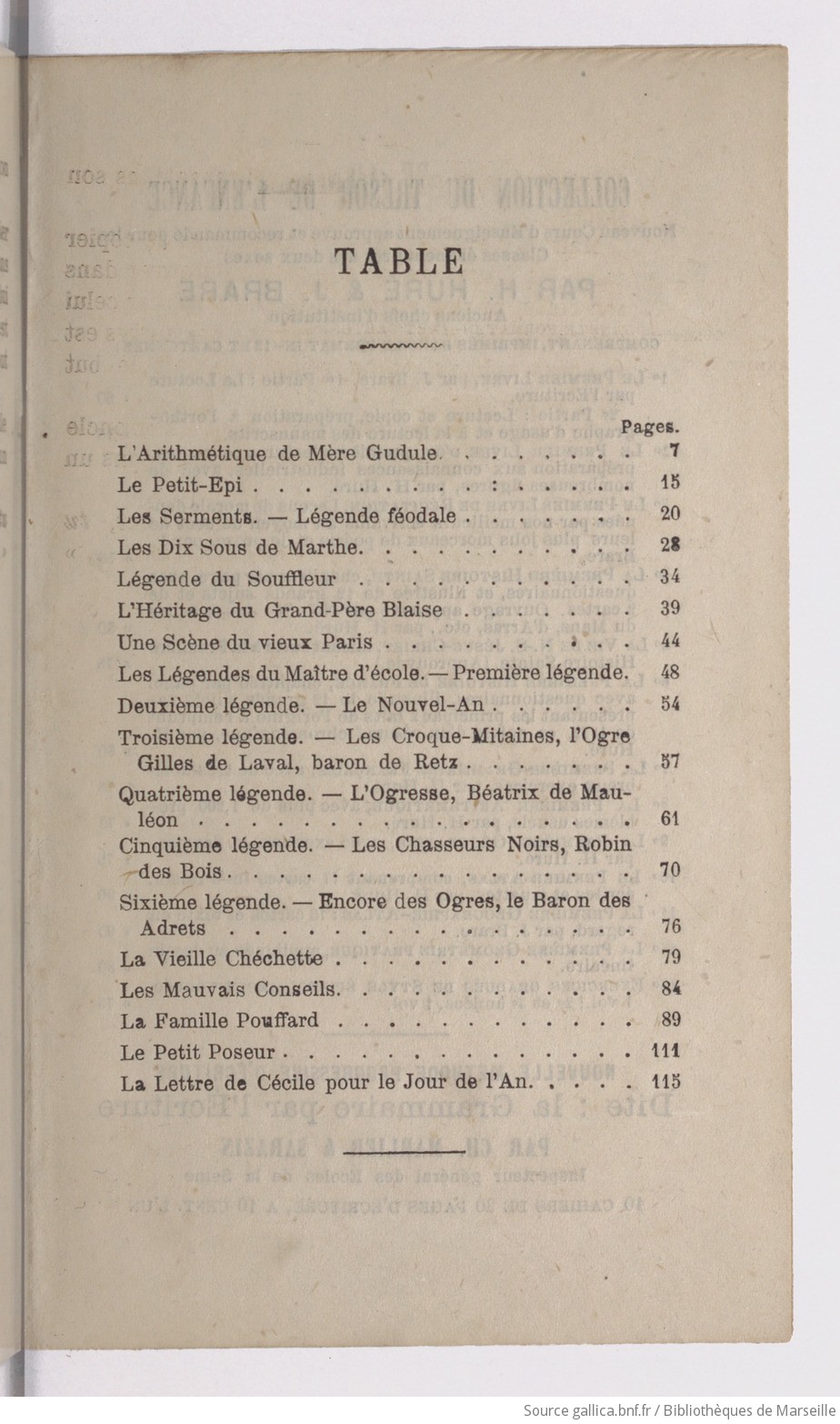
Original document source: gallica.bnf.fr / BnF (link at top)