
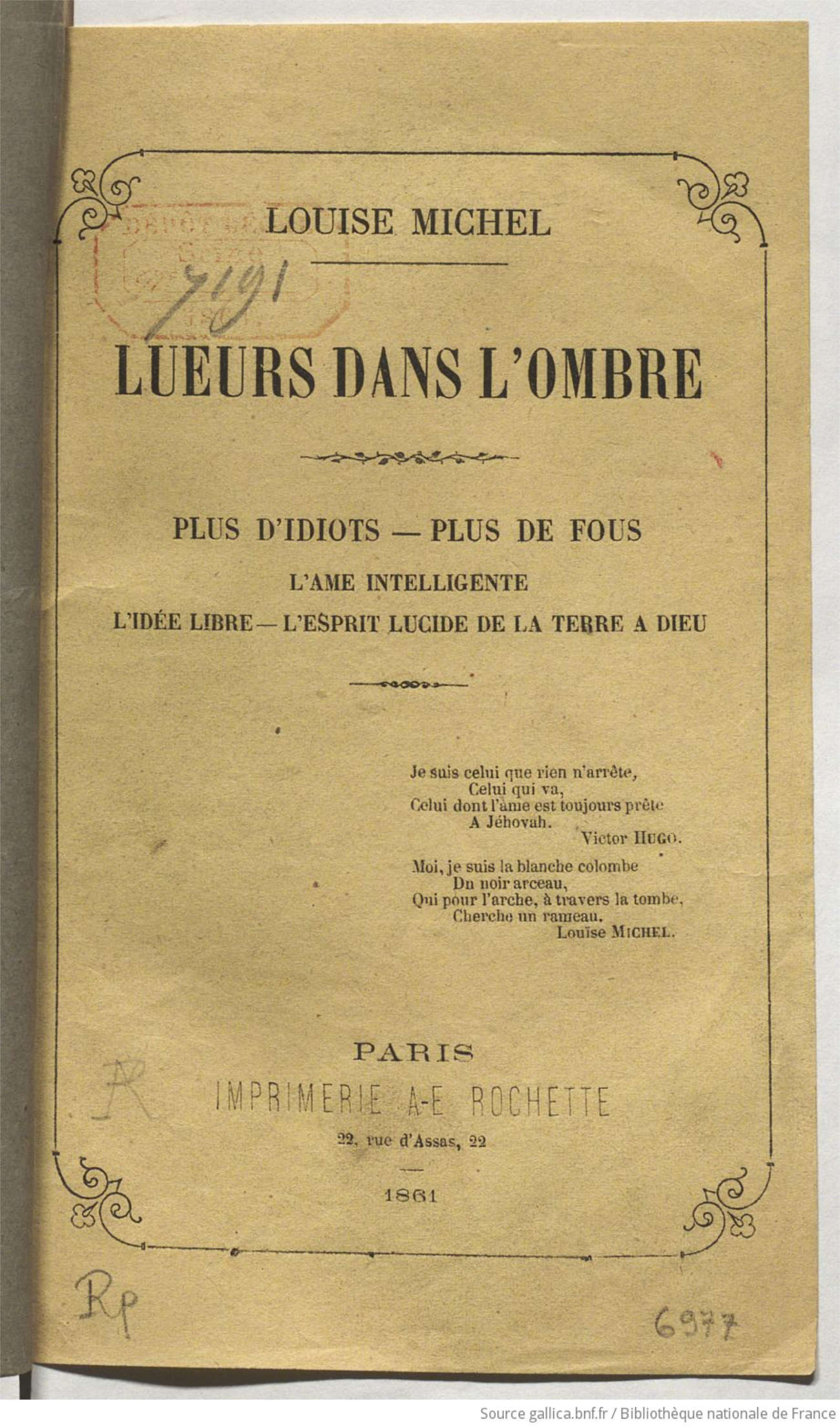
Glimmers in the Shadow. No More Idiots, No More Fools. The Intelligent Soul. The Free Idea. The Lucid Spirit, From Earth to God.
Glimmers in the Shadow. No More Idiots, No More Fools. The Intelligent Soul. The Free Idea. The Lucid Spirit, From Earth to God.
FOREWORD
I am the one whom nothing stops,
The one who goes,
The one whose soul is always ready
For Jehovah.
Victor Hugo.
I am the white dove
From the dark ark,
Who, for the Ark, across the tomb,
Seeks a branch.
Louise Michel.
Do you hear, over there, the muffled hoofbeats of horses
In the depths of night? Do you see the banners unfurling?
Is it the road, or the sail that appears white
On the mysterious horizon?
Listen, listen again, and you will hear other footsteps; you will see other banners and other stars, for we live in a time when the Infinite, leaning over the fiery craters, prepares revolutions in its mysterious crucibles.
Those footsteps your ear barely perceives are the cohort of visions, a flight of doves passing through the darkness.
Those colours that seem pale to you from afar are the immense azure.
Those distant lights you glimpse are glimmers of God.
For what you hear is the unknown; what you behold is the mystery; and those voices calling out to one another through space are the voices of dreamers leaning over all the chasms of death and life; they are the Prometheuses who are about to seize the fire of heaven.
And their step does not tremble, their heart does not fail, no brightness blinds their eyes; for they are clothed in the very splendour of God, in the triple radiance of all-powerful might: faith, hope, love.
They know the word that opens the well of the abyss and makes the wall of bronze crumble: to believe, to hope, to love.
They are the great priests to whom the Spirit reads the great apocalypse, to whom Jehovah gives the keys of the tabernacles.
They hear the endless hymn of the stars of harmony, the perfumes and the souls rising from every point of the infinite.
The tomb keeps no laws against them, and the city of God opens its gates; for they belong to those dreamers whose gaze sees farther than the vast heavens.
And from all the summits they proclaim, these apostles and prophets: Suffering is a dream, the impossible is a vision, faith is the immense vessel sailing through eternity; charity fills its sails, hope is its guiding light. Ibo! Ibo!
And our dazzled eyes perceive it — a sublime vision — the universe made peaceful, moving toward a single goal, the beautiful, the great, under the gaze of God.
O you who believe, pity those who deny; you who love, pity those who hate; you who hope, set the lantern upon the shadowed shore.
Go through the reefs, through the storm; let the beacon of salvation shine into the anxious eyes of the helmsman; seek for all the balm that soothes the wound, the song that charms sorrow, all that heals the body, all that raises the soul.
Go, and fear not. Dreamers are the poets, and poets are the prophets.
Who among us, in those moments of enthusiasm when the soul rises so high and plunges so deeply, has not asked by what means one might restore reason to those who have lost it, awaken a few glimmers in those who lack them, make vibrate like the strings of a lute the dormant faculties of poor souls imprisoned by matter or fleeing into the darkness?
Would it not be a sublime discovery, and would not the one who could kindle a glimmer in that night be happy?
This is not about any particular psychological system.
What does it matter if, according to Leibniz, God has from all eternity arranged body and soul for one another?
What does it matter if, according to Euler, the soul sits at the centre of the nerves and the brain like a spider at the centre of its web?
What concern have we for Cudworth’s plastic mediator, or Euler’s physical influx?
Without troubling ourselves with different systems — or rather, taking from them whatever we wish — it is acknowledged, whatever Descartes or Malebranche may have said, that a mysterious bond unites body and soul, and that they act upon one another like the instrument and the musician.
From this principle, admitted by every philosophical system, one arrives by different roads at the same point, the single pole where all meridians of the infinite inevitably meet, where the scattered pathways of space converge. It is that the human soul, the breath of God, is a power that acts on another soul in direct proportion to its strength, its intelligence, its charity, and also in direct proportion to the square of its will.
It follows from this that the more a soul is illuminated, loving, luminous, ardent, the more powerful its will becomes, and the more that soul is capable of accomplishing the sacred work of educating the idiot, of healing the madman.
“Dreams!” people will say. It is possible; the same might have been said of someone who, in the shadows of thought, had glimpsed the electric thread at the time when Galileo scarcely sensed the earth turning. Yes, the spirit acts upon the spirit, and there is nothing astonishing in this.
And then, what does it matter? These pages written in one night are but an idea, yet the idea is the mysterious seed that the Eternal Sower casts into infinity, and from which strong generations and great hearts arise.
Let the idea germinate, then; let the grain become a sheaf; let the obscure stone transform into a keystone, and let the sheaf or the edifice blaze with the glimmers of God.
The soul has three principal faculties: sensibility, intelligence, activity; they are the three strings that one can make vibrate — through intelligence as light, through will as force, through charity as warmth.
The different degrees of idiocy or madness cannot all be treated in the same way; sometimes one must complete the chord, sometimes mute the dissonant note, or, if one may say so, sharpen or flatten such a faculty. In the madman, reason must be balanced with imagination; in the idiot, everything must be awakened: sensibility, intelligence, will; sometimes, in the same individual, both are necessary. Those few glimmers that appear here and there and shine falsely must be illuminated and guided; one must be the lever and the torch.
Like the madman, the idiot sees and feels; faintly, he is real, but enough that one can make use of sight when it is strong enough, of sensation when it dominates, in order to give birth to an idea that, with the aid of sight, can then be continued through imitation. The sensation becomes a memory, and, developed and almost grasped again through imitation, engraved by memory, it transforms under this double power into imagination — a triple result.
For the soul to be intelligent, it must be free, even though it is chained to matter; it is the bird that walks, yet feels itself lifted by its wings.
In the madman, the soul — poor dove, its wings broken by the birdcatcher — flies and flees, pursued by its own reason which escapes before it like a will-o’-the-wisp; in the idiot, the soul, slave to matter and as if mired in that mud, is sometimes so confused that soul and matter form nothing more than a horrible mixture, which is the final degree of idiocy.
Thus one must illuminate the reason of the madman by one’s own reason, dominate and direct one’s own will by an energetic will.
One must slowly exercise the paralysed or sleeping intelligence of the idiot, so that it reaches the level of effortless exercise, of habitual lucidity, of strength, of voluntary activity — though to a lesser degree than in ordinary constitutions.
For this, one must try every motive that can influence the idiot or the madman; judge, test every cog, set into motion all the springs of that defective organisation; know the strength of each gear, calculate its speed.
For this, every starting point is valid. Whether one uses phrenology or magnetism, or any other system; whether one proceeds by analysis or by synthesis — what does it matter? We do not ask a victor which weapon he used; it is the same for everything. Besides, nothing could be precisely fixed: it is a struggle, and what works on one ground may be useless on another.
It is a work of science, of study, of energetic will, of profound intelligence, but above all of boundless devotion. Success lies in faith, in love for humanity. Forward, and let us fear nothing. The darkness is deep, the road is full of reefs; the goal sometimes seems to flee before us; forward! What we want is the impossible. The conquest will be beautiful.
Listen: when God places us in the world, he sets between body and soul a dark equation that remains until the soul can resist no longer the force that calls it into infinity, when everything transforms, when neither the body follows the pull toward earth nor the soul the pull toward heaven, when everything germinates.
O mystery! There they are, both of them: body and soul; one a spectre, the other a vision; the soul like the worker, the body sometimes like a machine and sometimes like a slave.
The machine, often faulty but always docile; the slave, often rebellious yet always subdued; the worker, sometimes so careless that the master calls him back before his task is finished, sometimes so powerful that the machine transforms amid its rays and clothes itself in eternal beauty — O Moses!
In the idiot, the forces of the body are not proportional to those of the soul: sometimes the body is strong like the barren tree, sometimes it is weak like the plant deprived of air and daylight, unable to bloom in darkness; but the soul, without impetus, the will without energy, cannot carry along that obscure intelligence, just as the body, strong yet lacking generous blood, cannot hold it captive. No effort to live, no struggle to die. The equation is preserved.
This is why, if the first attempts made with an idiot are not undertaken wisely, carried out with caution, one risks overwhelming this poor being with supreme torrents: it would be like a sparrow swept away by the storm in which the eagle feels at ease.
If the work carried out upon the idiot is well directed, if one increases his will while mastering it, if the equilibrium is preserved, then there is no danger.
Let us summarise: to strengthen and enlighten the soul of the madman or the idiot, one must teach him to see, to feel, to will; one then succeeds in making him reason about what he wants; with the help of that will and that reasoning, could one not then give him the habit of understanding for himself, acting for himself, reasoning for himself?
But above all, in order to make the soul of the idiot loving, active, intelligent, the one who teaches him must himself have seen the triangle of fire shine, must believe, must breathe, and must love.
(Extract from the work Glimmers in the Shadow.)
Every book, however obscure it may be, carries the perfume of a soul: thoughts have blossomed there, the heart has opened itself there. Although this one is only a fragment, I shall therefore say to my mother: May these pages bring you, from afar, the tenderest of memories.
I shall also say to Madame Adèle Esquiros: Let this be a handshake for you who made me glimpse a hope, at a time when there was in my soul so much death and so much night.
I shall say further: Please see in this, Madame Vollier, a testimony of respect and affection.
I should wait until the work is finished in order to offer it, but who can be certain of completing one’s work? Who can say: I shall be there tomorrow?
Louise Michel.
Paris, 20 August 1861.
(17) — Paris — Imprimerie A.-E. Rochette, 22, rue d’Assas.


Original French document source: gallica.bnf.fr / BnF