
Affiches during the Paris Commune
During the Paris Commune of 1871, both the French Government at Versailles and the Commune in Paris relied heavily on printed posters, or affiches, as their primary instrument of mass political communication.
These large-format broadsides were pasted on walls, official buildings, and street corners to announce decrees, justify military actions, issue threats or reassurances, and frame events in moral and political terms.
In a city with limited access to rapid mass media beyond newspapers, affiches functioned as immediate, visible proclamations of authority: Versailles used them to assert legality, denounce “insurrection,” and justify repression, while the Commune used them to declare sovereignty, mobilise citizens, expose Versailles’ actions such as blockades or bombardments, and articulate social reforms.
The poster became both a legal document and a political weapon, transforming urban walls into a battleground of competing legitimacy, where each side sought to claim the voice of the Republic and the mandate of the people.
You can view some of these posters in the gallery below, or click on the links to go directly to the English translation and explanations of each.
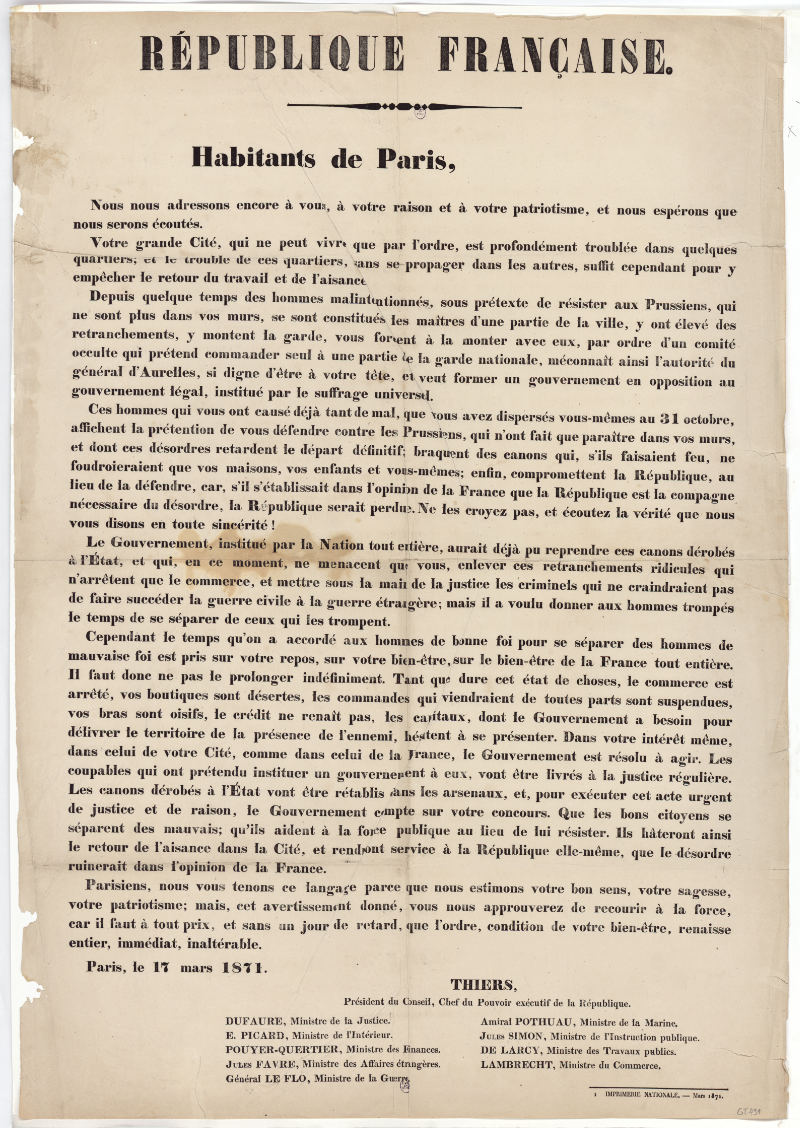
17 March 1871 – Thiers’ Letter to the People of Paris
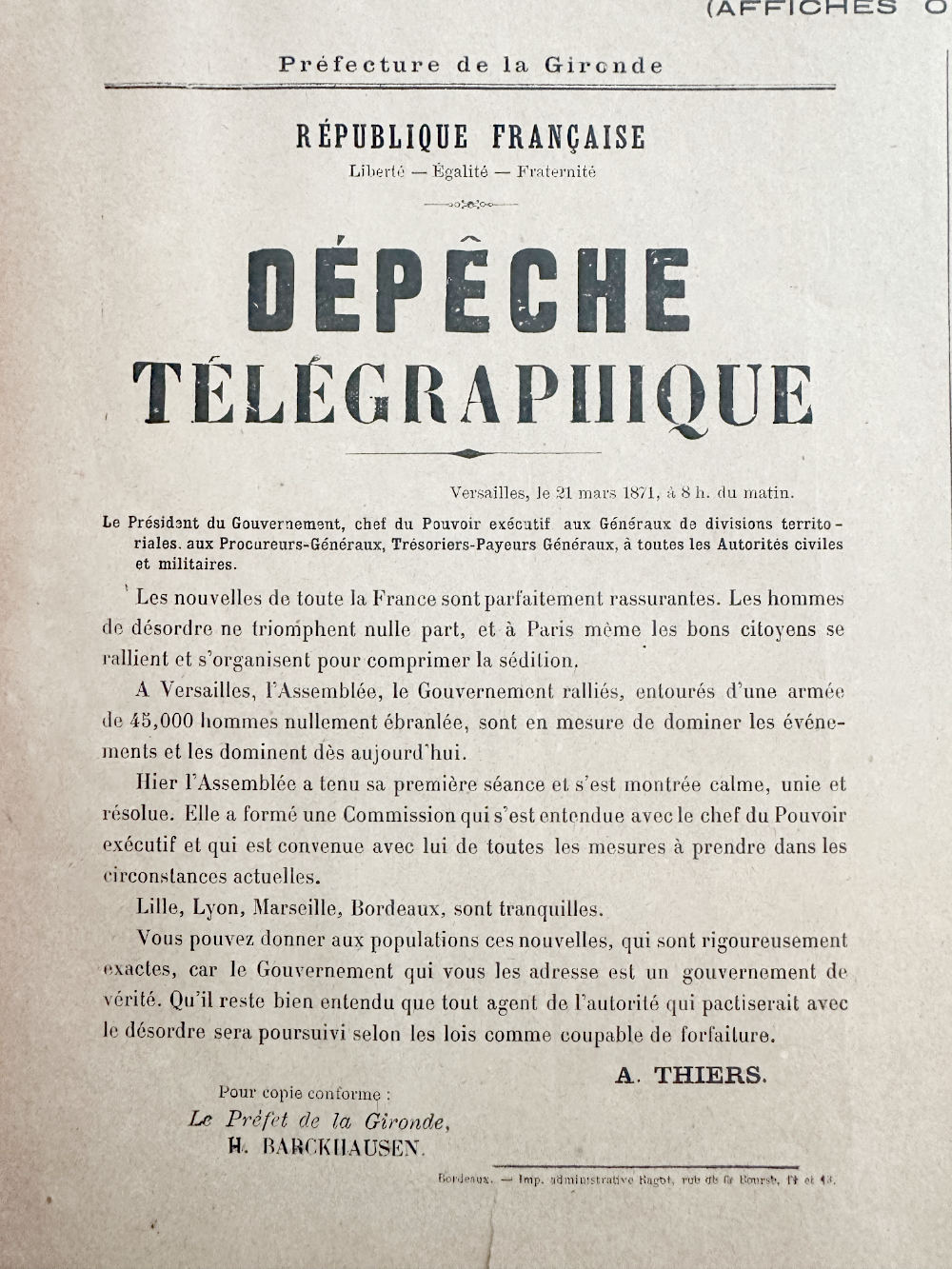
21 March 1871 – Telegraphic Dispatch
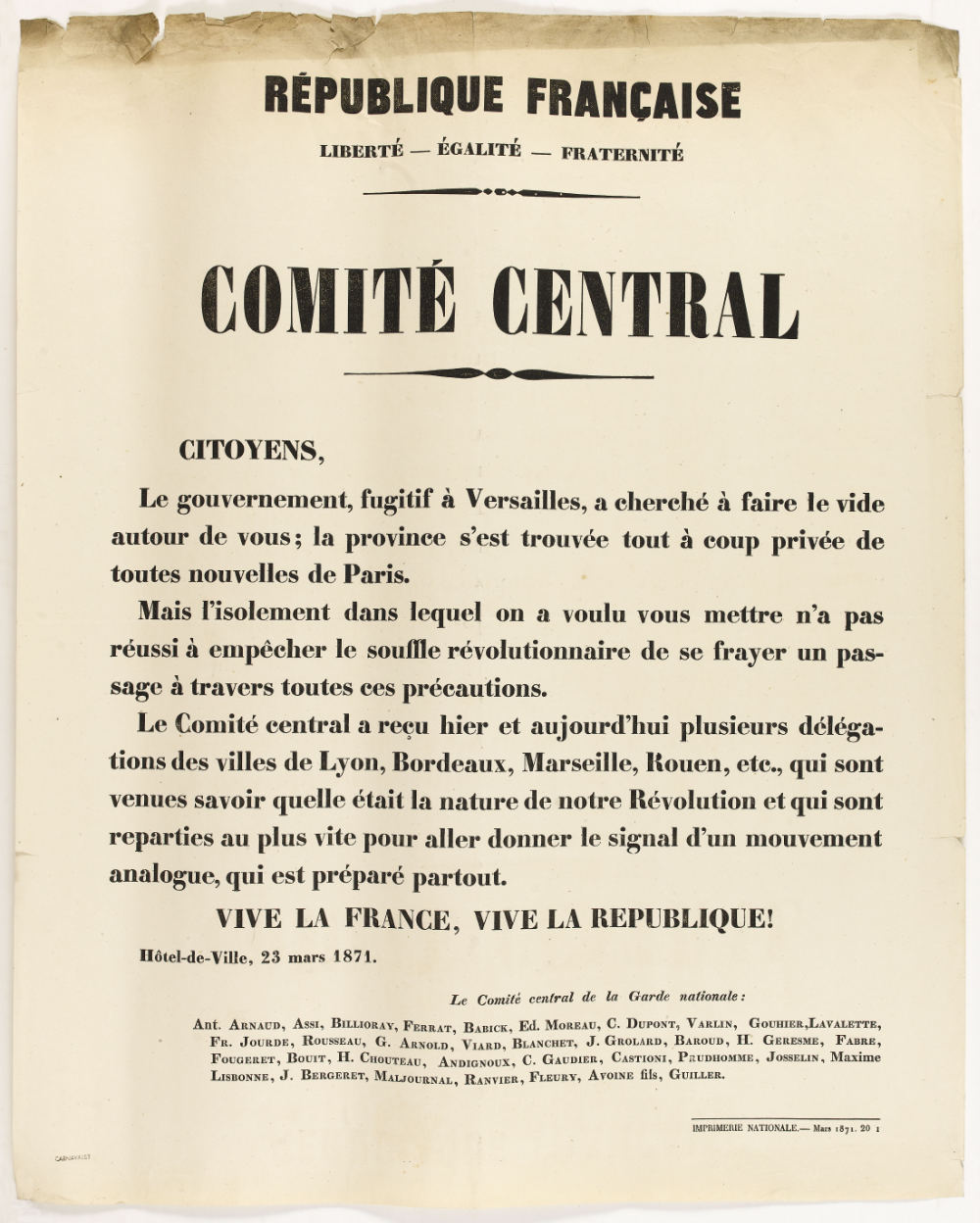
23 March 1871 – Central Committee Proclamation
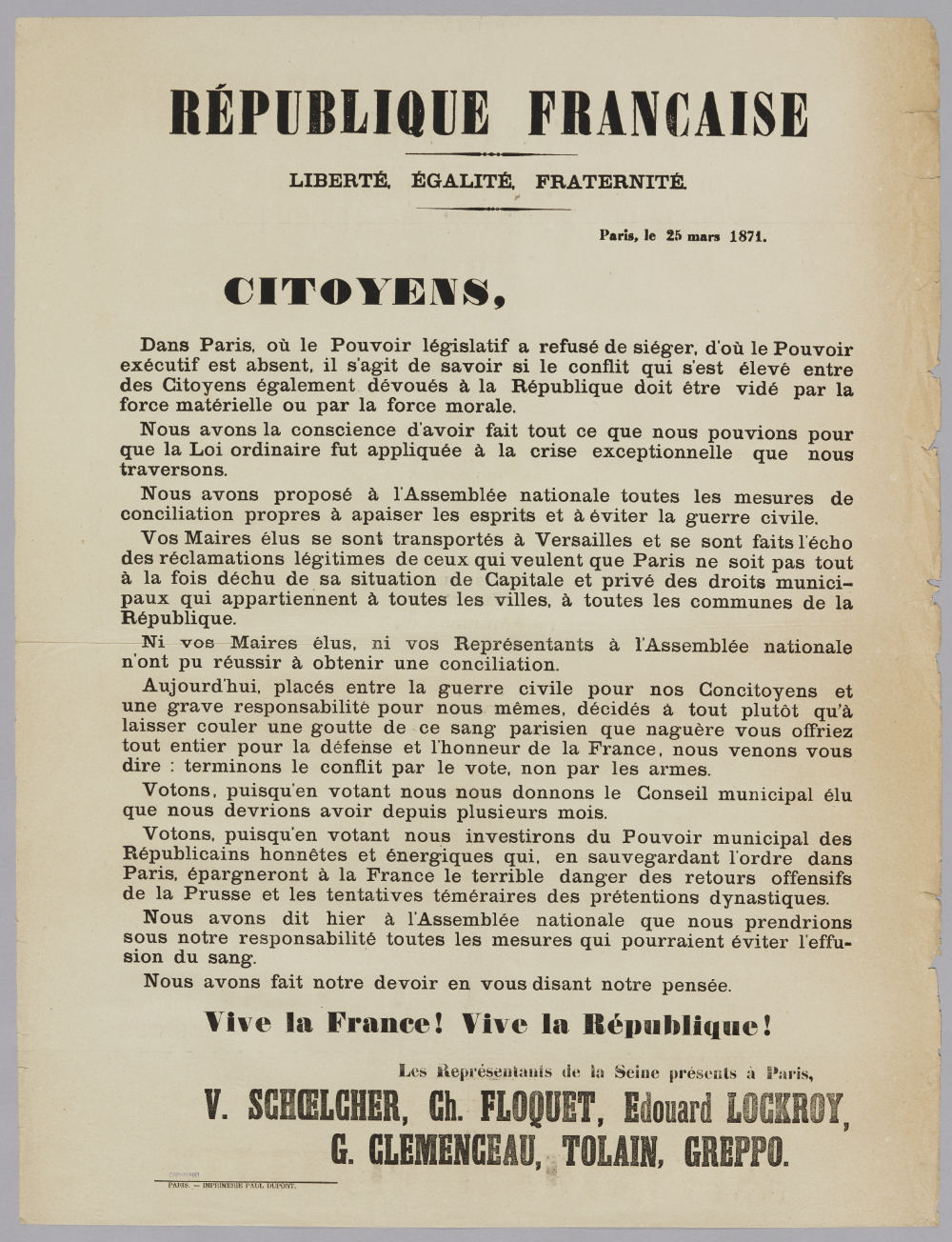
23 March 1871 – The Declaration of the Representatives of the Seine
23 March 1871 – Ministerial Directive
24 March 1871 – To Our Adversaries
25 March 1871 – Elections of the Commune
28 March 1871 – Proclamation
29 March 1871 – Proclamation of the Commune
2 April 1871 – Versailles Attacks
3 April 1871 – Separation of Church and State
5 April 1871 – Statement of the Paris Commune
6 April 1871 – Hostages Declaration
7 April 1871 – Statement of the Commune
10 April 1871 – Establishment of Pensions for War Widows and Orphans
16 April 1871 – Telegraphic Dispatch
19 April 1871 – The Paris Commune’s Declaration to the French People
27 April 1871 – Decree on Wages
April 1871 – Commune Statement on Humanitarian Measures
20 May 1871 – Statement of the Commune
23 May 1871 – Decree of the Commission of Public Safety
25 May 1871 – Telegraphic Dispatch



Thiers’ Letter to the People of Paris, 17 March 1871
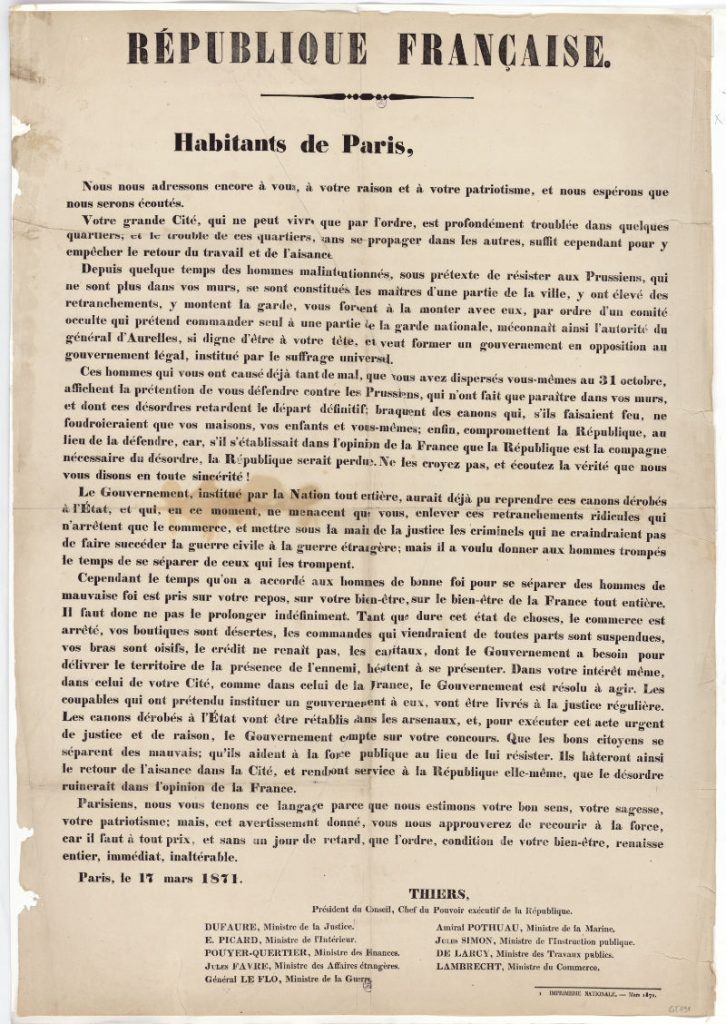
The proclamation of 17 March 1871, issued by Adolphe Thiers on behalf of the Government of National Defence, represents the Versailles government’s final attempt to reassert moral and political authority over Paris on the eve of the insurrection. Its significance lies in its framing of the crisis not as a revolutionary moment but as a breakdown of public order engineered by a minority of “ill-intentioned men.” By invoking universal suffrage, national unity, and the necessity of order for work and prosperity, the document sought to detach the broader Parisian population from the radical National Guard committees controlling the artillery. It constructed a stark opposition between legitimate, nationally elected authority and localised disorder, warning that the Republic itself would be discredited if associated with insurrection. In doing so, the proclamation reveals Versailles’ strategy: to present the coming confrontation as a defence of law, commerce, and national recovery after the Prussian siege. Historically, the document is significant because its demand for the return of the cannons and its implicit threat of force directly precipitated the events of 18 March, making it the last rhetorical gesture before civil war became irreversible.
English Translation
FRENCH REPUBLIC
Inhabitants of Paris,
We address you once again, appealing to your reason and your patriotism, and we hope you will listen to us.
Your great City, which can only live through order, is profoundly troubled in some districts; and the disorder in these districts, even without yet spreading to the others, is enough to prevent the return of work and subsistence.
For some time now, ill-intentioned men, on the pretext of resisting the Prussians—who are no longer in your walls—have made themselves masters of part of the city; they have raised fortifications, mounted guard duty, forced you to mount guard with them, and have formed a committee that claims to command the city and even to replace the National Guard, thus disregarding the lawful authority of General d’Aurelle, whose honourable conduct should be a guarantee for you. They seek to form a government in declared and permanent opposition to the one elected by universal suffrage.
The cannon that you yourselves purchased by subscription, and which you dispersed on 31 October, should be at the disposal of the defence of the country. The Government, which you yourselves elected and which has no other purpose than the salvation of France, summons you to return them. If they remained in inexperienced hands, where factions could seize them to impose their will, the Republic would be lost, for, let us not deceive ourselves: if opinion were to grow in France that the Republic is the companion of disorder, the Republic would be lost. Do not believe these men; listen to the truth that we state to you with absolute sincerity!
The Government, instituted by the entire Nation, would already have regained the cannons stolen from the State; and at this very moment, it is only your own interests that prevent it from dismantling these ridiculous entrenchments, reopening commerce, and delivering to justice the criminals who would not hesitate to make civil war follow foreign war. But it wanted to give you time to reflect and for us to distance ourselves from those who deceive you.
However, the time given to these men in good faith, so that they may separate themselves from those acting in bad faith, has been taken at your expense, to your detriment, to the detriment of all France. It must not be prolonged indefinitely. As long as this disorder lasts, commerce is halted, your shops are deserted, the convoys carrying food from all parts are suspended, your arms are idle, credit cannot be re-established. Paris, which the Government hopes to see flourishing again thanks to the departure of the enemy presence, is miserable and starving. In your interest itself, as well as in that of all the cities of France, as well as in the interest of the Government which carries the responsibility, we ask you to restore order and to separate yourselves from those who are pushing you into a fatal adventure.
The men who hold the cannons belong neither to the State nor to the free city of Paris; they wage civil war and arrest your fellow citizens, public officials, and officers of the National Guard. They provoke quarrels between Paris and the rest of France. This cannot last. When you elected the Assembly, when you entrusted it with the salvation of France, you promised to obey it.
That Assembly has no hatred toward you; it wants only to restore France. It wants peace, work, and security. And those who oppose it are opposing the return of prosperity.
Parisians, we told you the truth. Consider it. Distance yourselves from those who are dividing you from France and leading you to ruin. Do not lend yourselves, through ignorance or inertia, to their criminal projects. The Republic can only be saved through order, and order can only return through your cooperation.
Paris, on 17 March 1871.
THIERS,
President of the Council, Head of the Executive Power of the Republic.
DUFAURE, Minister of Justice.
PICARD, Minister of Finance.
POURTALES, Minister of Public Works.
JULES FAVRE, Minister of Foreign Affairs.
LE FLO, Minister of War.
PONTCHAU, Minister of Marine.
JULES SIMON, Minister of Public Instruction.
LAMBRECHT, Minister of the Interior.
Telegraphic Dispatch, 21 March 1871
This telegraphic dispatch of 21 March 1871 is an early example of the Versailles government’s strategy of information control and administrative consolidation in the immediate aftermath of the uprising in Paris. Unlike public proclamations addressed to citizens, this text is directed to officials across France and functions as a stabilising communiqué. Its language seeks to project calm authority, emphasising unity, military strength, and national tranquillity, while minimising the scale of the Parisian revolt.
The repeated insistence that the news is “strictly accurate” reveals anxiety about rumour and provincial contagion. Crucially, the threat that any official who “makes terms with disorder” will be prosecuted for treason signals a clear line: neutrality or accommodation with the Commune would not be tolerated. Historically, the dispatch is significant because it illustrates how Versailles framed the conflict not as a political dispute but as criminal sedition, and how it mobilised the administrative state to prevent the spread of communal insurrection beyond Paris.
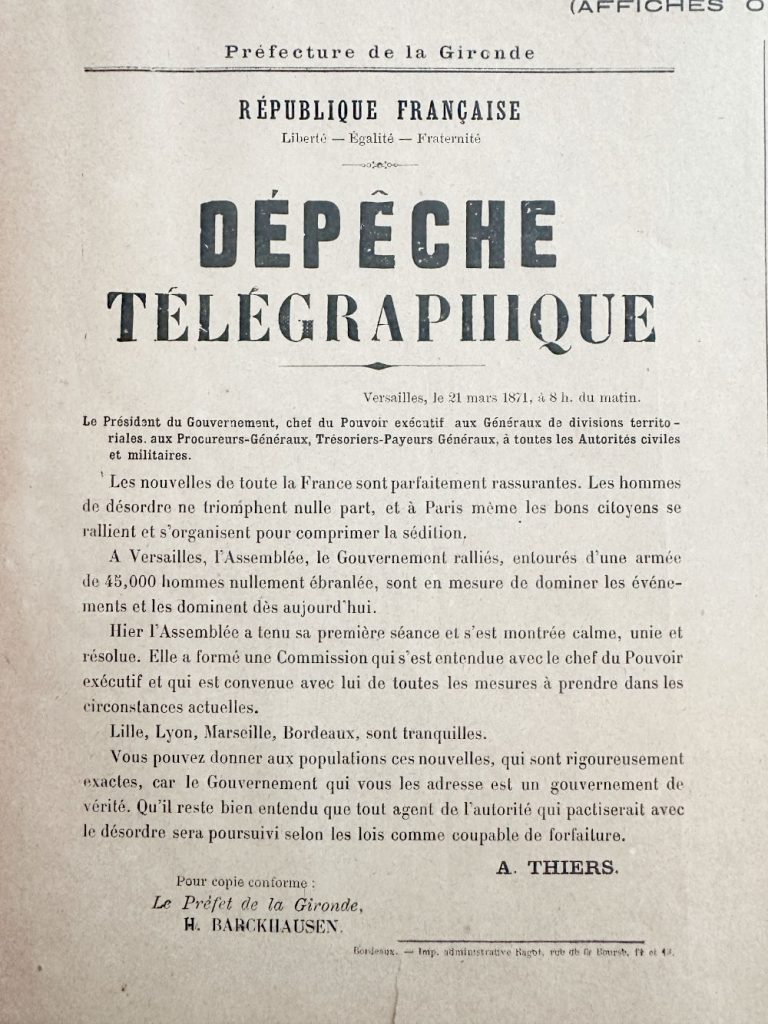
English Translation
Prefecture of the Gironde
FRENCH REPUBLIC
Liberty – Equality – Fraternity
TELEGRAPHIC DISPATCH
Versailles, 21 March 1871, 8 a.m.
The President of the Government, Head of the Executive Power, to the Generals commanding territorial divisions, to the Prosecutors-General, to the Treasurers-General, to all civil and military authorities.
The news from all of France is entirely reassuring. The men of disorder are triumphing nowhere, and even in Paris the good citizens are rallying and organising themselves to suppress sedition.
At Versailles, the Assembly and the Government, united and surrounded by an army of 45,000 men, entirely unshaken, are in a position to control events and are already controlling them today.
Yesterday the Assembly held its first sitting and showed itself calm, united, and resolute. It formed a Commission which conferred with the head of the Executive Power and agreed with him on all the measures to be taken in the present circumstances.
Lille, Lyon, Marseille, Bordeaux are tranquil.
You may communicate this information to the populations, for it is strictly accurate, since the Government that sends it to you is a government of truth. It must be clearly understood that any agent of authority who makes terms with disorder will be prosecuted under the law as guilty of treason.
A. Thiers.
For certified copy:
The Prefect of the Gironde,
H. Barckhausen.
Bordeaux – Administrative Printing Office Ragot, rue de la Bourse, 17 and 43.
Central Committee Proclamation of 23 March 1871
This proclamation of 23 March 1871, issued by the Central Committee of the National Guard, reflects the brief but decisive moment when power in Paris lay not yet with the elected Commune but with the revolutionary committee that had seized authority after 18 March. Its tone is assertive and expansive: rather than defending itself against accusations, the Committee presents the government at Versailles as isolated and illegitimate, while portraying the revolutionary movement as spreading organically across France.
The text’s emphasis on delegations from provincial cities serves both as reassurance and as propaganda, suggesting that Paris is not alone and that analogous uprisings are imminent. Historically, the proclamation is significant because it reveals the Committee’s strategic objective in these days: to break the informational blockade imposed by Versailles, to encourage provincial imitation, and to transform a Parisian insurrection into a national revolutionary wave. The appeal to “France” and the insistence that the movement is prepared “everywhere” highlight the hope, ultimately unrealised, that the Commune would become a federated, nationwide transformation rather than an isolated urban revolt.
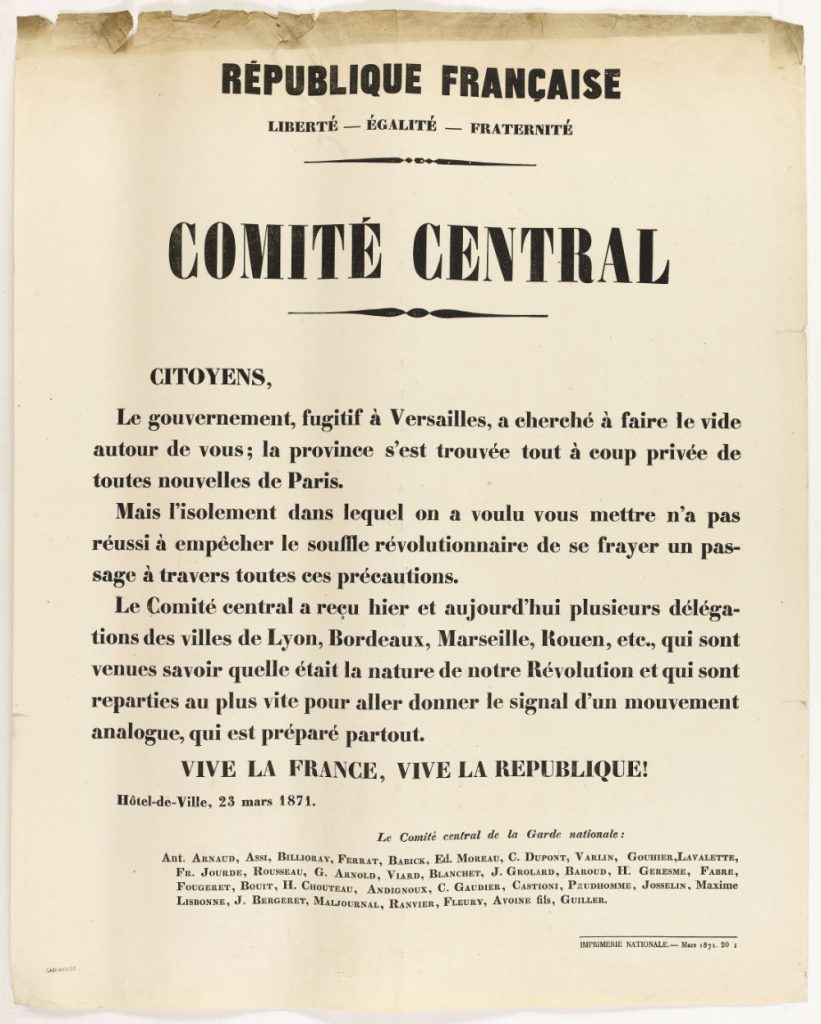
English Translation
FRENCH REPUBLIC
Liberty – Equality – Fraternity
CENTRAL COMMITTEE
CITIZENS,
The government, a fugitive at Versailles, has sought to create a void around you; the provinces have suddenly found themselves deprived of all news from Paris.
But the isolation in which they wished to place you has not succeeded in preventing the revolutionary breath from forcing its way through all these precautions.
The Central Committee has received yesterday and today several delegations from the cities of Lyon, Bordeaux, Marseille, Rouen, etc., who came to learn the nature of our Revolution and who have departed again with all speed to give the signal for a similar movement, which is being prepared everywhere.
LONG LIVE FRANCE, LONG LIVE THE REPUBLIC!
Hôtel de Ville, 23 March 1871.
The Central Committee of the National Guard:
[signatories]
National Printing Office — March 1871.
The Declaration of the Representatives of the Seine, 23 March 1871
This proclamation of 23 March 1871 occupies a crucial moment between the seizure of power on 18 March and the formal proclamation of the Commune. Issued by republican deputies of the Seine who remained in Paris, it represents a last attempt at constitutional mediation between Paris and Versailles.
Its central argument is procedural rather than revolutionary: the crisis, it insists, should be resolved “by the vote, not by arms.” By appealing to municipal elections as the legitimate means of restoring order and authority, the signatories sought to anchor the unfolding upheaval within republican legality rather than insurrectionary rupture.
The document reveals that, in these early days, the conflict was not yet framed in absolutist terms; conciliation and avoidance of bloodshed were still publicly invoked as possible outcomes. Historically, the proclamation is significant because it marks the narrowing of political options: when conciliation failed and elections proceeded under revolutionary conditions, the path toward an autonomous Commune and open civil war became effectively irreversible.
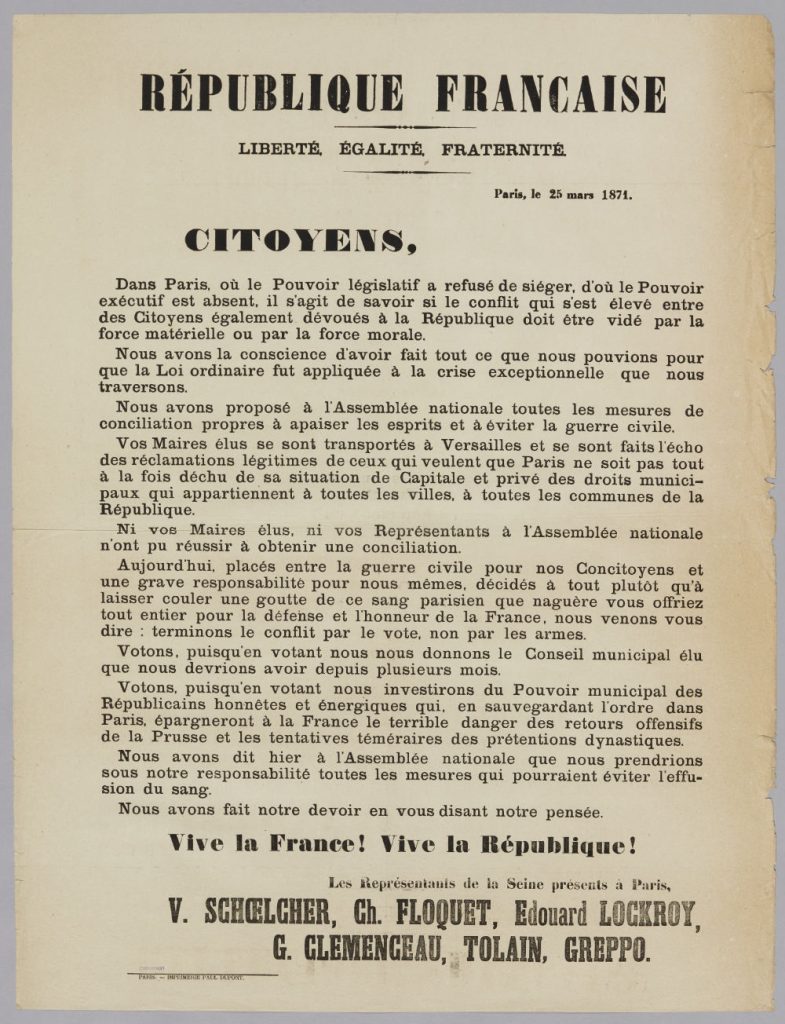
English Translation
FRENCH REPUBLIC
Liberty, Equality, Fraternity
Paris, 23 March 1871
CITIZENS,
In Paris, where the Legislative Power has refused to sit and from which the Executive Power is absent, the question is whether the conflict that has arisen between citizens equally devoted to the Republic must be resolved by material force or by moral force.
We are conscious of having done all that we could to ensure that ordinary law be applied to the exceptional crisis through which we are passing.
We have proposed to the National Assembly every measure of conciliation capable of calming minds and preventing civil war.
Your elected Mayors have gone to Versailles and have made themselves the interpreters of the legitimate demands of those who wish Paris not to be at once stripped of its status as Capital and deprived of the municipal rights which belong to all cities, to all communes of the Republic.
Neither your elected Mayors nor your Representatives in the National Assembly have succeeded in obtaining conciliation.
Today, placed between civil war for our fellow citizens and a grave responsibility for ourselves, resolved at any cost not to allow a single drop of that Parisian blood to be shed which formerly you offered entirely for the defence and honour of France, we come to say to you: let us end the conflict by the vote, not by arms.
Let us vote, since by voting we shall give ourselves the elected Municipal Council that we should have had for several months.
Let us vote, since by voting we shall entrust municipal power to honest and energetic Republicans who, while safeguarding order in Paris, will spare France the terrible danger of renewed Prussian offensives and the rash attempts of dynastic pretensions.
We declared yesterday to the National Assembly that we would assume, under our responsibility, all measures capable of preventing bloodshed.
We have done our duty in telling you our thought.
Long live France! Long live the Republic!
The Representatives of the Seine present in Paris:
V. Schœlcher, Ch. Floquet, Ed. Lockroy,
G. Clemenceau, Tolain, Greppo.
Paris – Paul Dupont Printing House.
Ministerial Directive, 23 March 1871
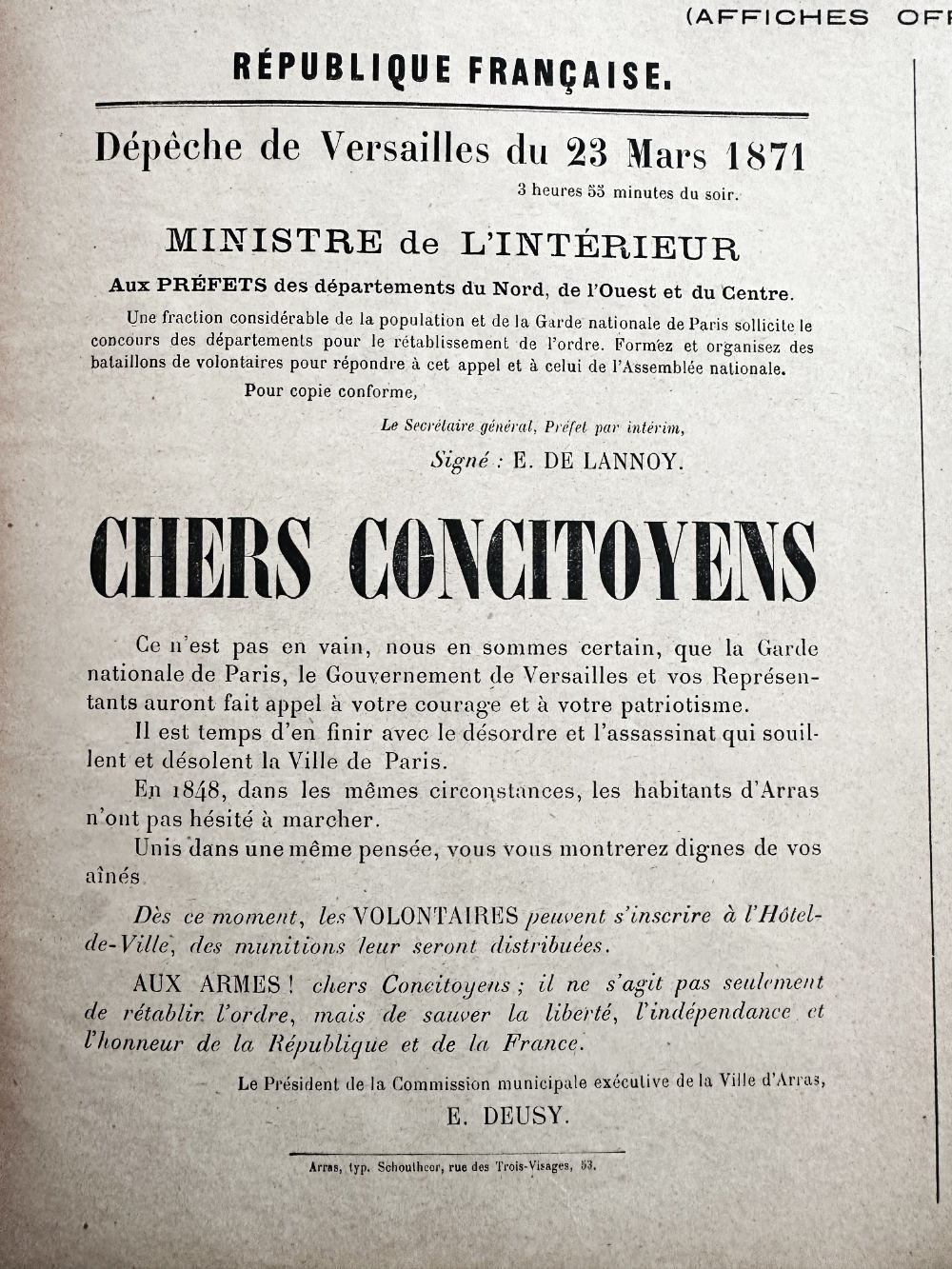
This poster combines two layers of mobilisation: a ministerial directive from Versailles and a local patriotic appeal from Arras. It illustrates how the central government sought not merely to reassure provincial authorities but to activate them militarily against Paris.
The language reframes the conflict as a national defence of “liberty, independence, and honour” against disorder and assassination, thereby casting the Commune as both criminal and anti-republican. The invocation of 1848 situates the appeal within a revolutionary memory familiar to provincial citizens, suggesting continuity with earlier moments when local volunteers defended national order.
Historically, the document is significant because it demonstrates the widening of the conflict beyond Paris: Versailles was transforming the struggle into a national mobilisation, recruiting provincial forces to suppress the Commune. It reveals how the government used administrative networks and patriotic rhetoric to prevent the spread of insurrection and to construct the repression as a defence of the Republic rather than a war against it.
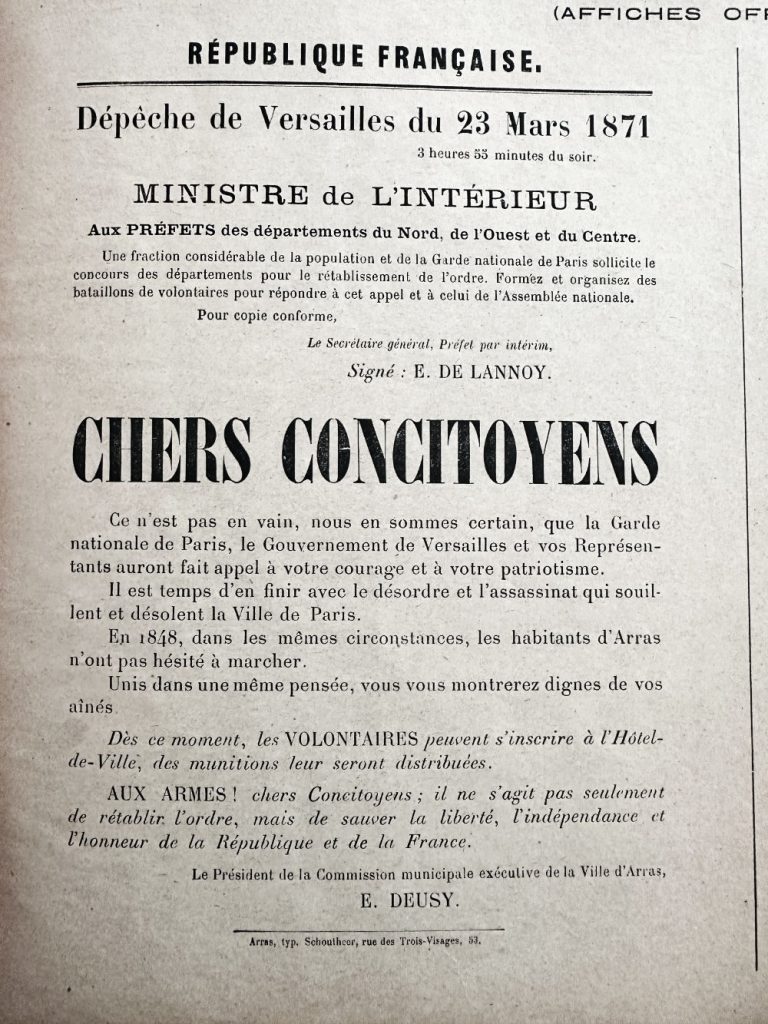
English Translation
FRENCH REPUBLIC
Dispatch from Versailles of 23 March 1871
3:55 in the afternoon
MINISTER OF THE INTERIOR
To the Prefects of the departments of the North, the West, and the Centre.
A considerable fraction of the population and of the National Guard of Paris is requesting the assistance of the departments for the restoration of order. Form and organise battalions of volunteers to respond to this appeal and to that of the National Assembly.
For certified copy,
The Secretary-General, Acting Prefect,
Signed: E. de Lannoy.
DEAR FELLOW CITIZENS,
It is not in vain, we are certain, that the National Guard of Paris, the Government of Versailles, and your Representatives have appealed to your courage and your patriotism.
It is time to put an end to the disorder and the assassinations that stain and lay waste the City of Paris.
In 1848, under similar circumstances, the inhabitants of Arras did not hesitate to march.
United in one common purpose, you will prove yourselves worthy of your elders.
From this moment, VOLUNTEERS may enrol at the Hôtel de Ville; munitions will be distributed to them.
TO ARMS! dear fellow citizens; it is not merely a question of restoring order, but of saving the liberty, the independence, and the honour of the Republic and of France.
The President of the Municipal Executive Commission of the City of Arras,
E. Deusy.
Arras, Schoutheer Printing House, rue des Trois-Visages, 53.
To Our Adversaries, 24 March 1871
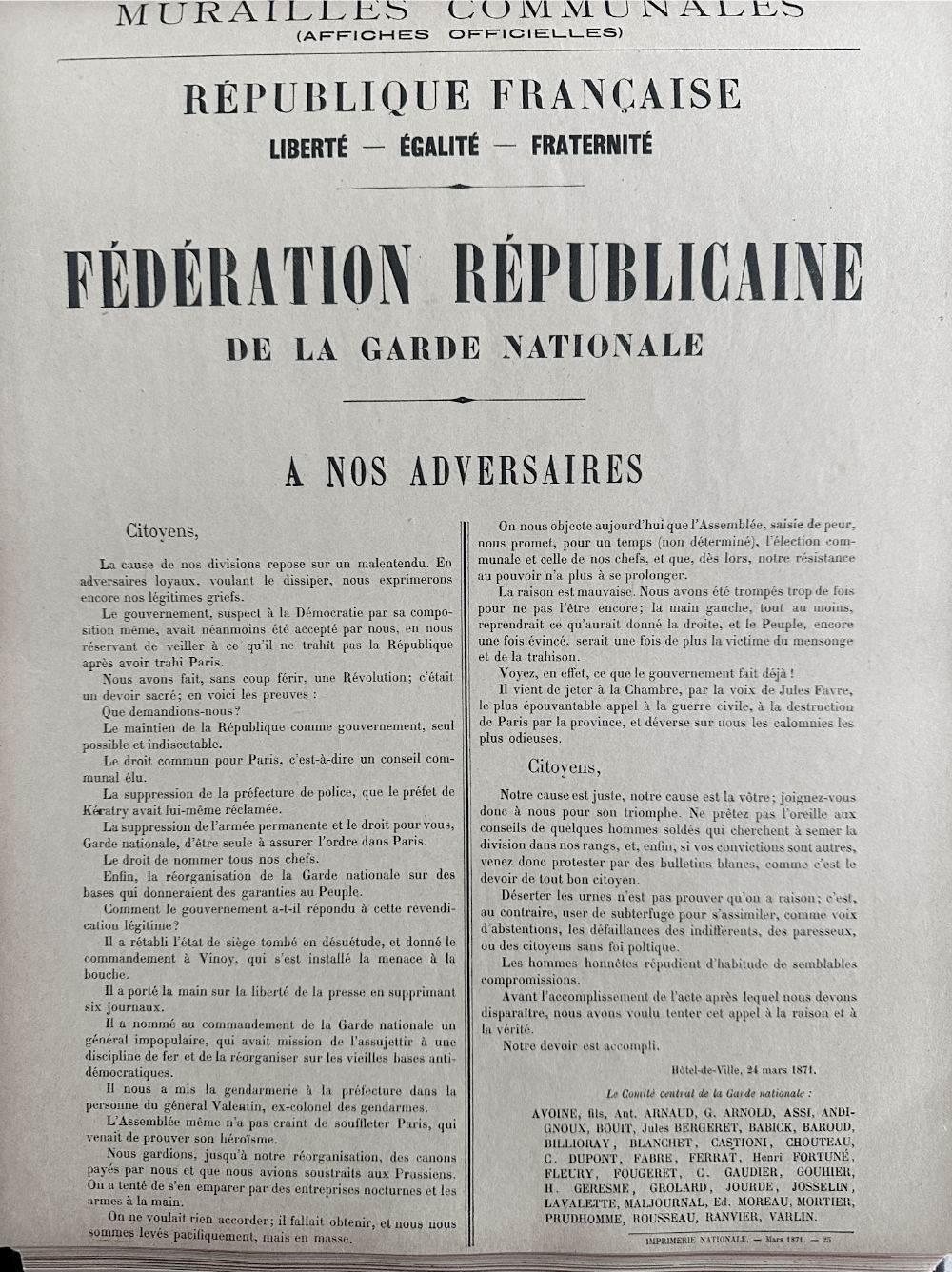
This address To Our Adversaries, issued by the Federation of the National Guard on 24 March 1871, represents one of the Commune’s most explicit ideological justifications of its revolution. Unlike proclamations directed solely to supporters, this text engages directly with critics and opponents, framing the uprising as a defensive act in response to governmental repression. It articulates the core constitutional demands of the movement: communal autonomy, abolition of the Prefecture of Police, suppression of the standing army, democratic election of officers, and the primacy of the Republic.
The document is significant because it reveals the theoretical coherence of the Communard position: the struggle is portrayed not as anarchic rebellion but as a contest between authoritarian centralisation and municipal democracy. At the same time, the polemical tone and denunciation of Versailles figures demonstrate how quickly political disagreement had hardened into mutual delegitimisation.
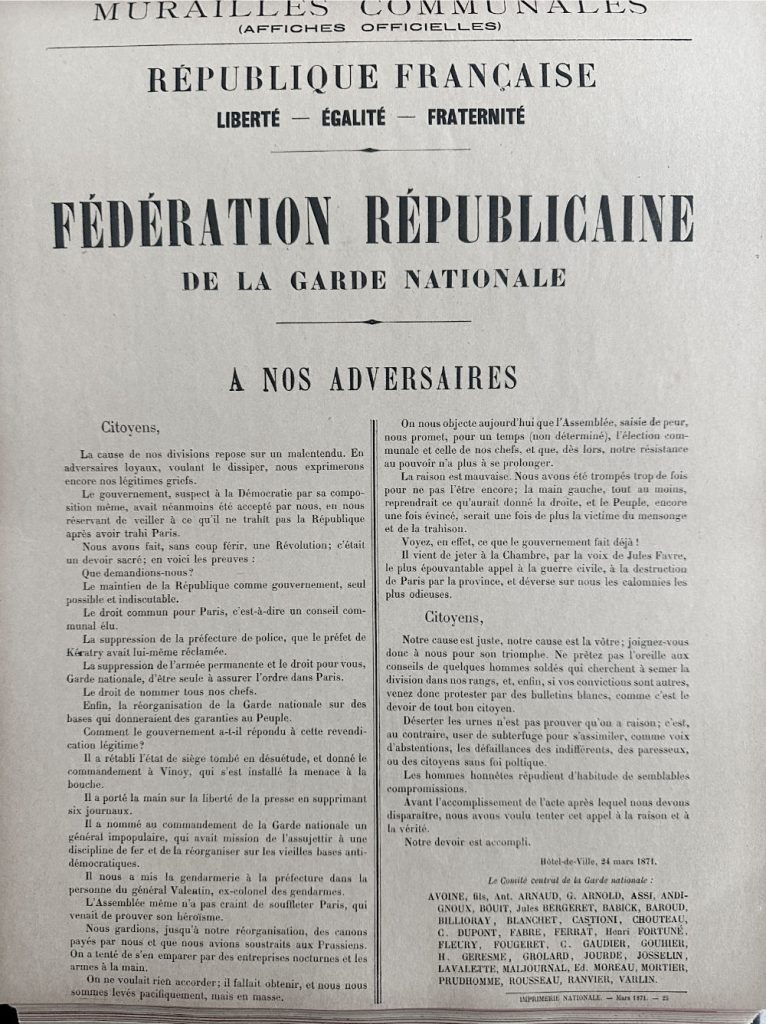
English Translation
FRENCH REPUBLIC
Liberty – Equality – Fraternity
NATIONAL GUARD
FEDERATION OF THE NATIONAL GUARD
TO OUR ADVERSARIES
Citizens,
The cause of our divisions rests upon a misunderstanding. In raising ourselves to defend our rights, we were expressing grievances that were still legitimate. The Assembly, meeting at Bordeaux, had decreed measures which, in themselves, were perhaps acceptable to some, but which were not accepted by us, because they did not safeguard the Republic.
We acted without ulterior motive; we made a Revolution; that was our right and our duty.
What do we demand?
The Republic as a government, the only possible and indisputable one.
The communal Republic for Paris, that is to say, a communal council freely elected.
The suppression of the Prefecture of Police; the prefecture of police being incompatible with municipal autonomy.
The suppression of the standing army and the right for you, as for us, to organise the National Guard.
The right to appoint all our chiefs.
The autonomy of the National Guard on bases which would guarantee real liberties to the People.
How has the government responded to these demands?
It re-established the state of siege, abolished deliberation, and muzzled the mouth.
It placed its hand upon the freedom of the press by suppressing six newspapers.
It sought to reimpose upon the National Guard an unpopular general and to reorganise it on the old authoritarian foundations.
It sent the gendarmerie into the Prefecture in the middle of the night.
The Assembly did not fear to insult Paris.
We have guarded our organisation, our cannons, which we had saved from the Prussians.
We have been told that we had abducted prisoners.
We have been told that we were rebels.
We have risen peacefully, but en masse, and we have taken our arms in hand.
Today we are told that the Assembly, seated at Versailles, wishes to hold elections to impose upon us a power that has no right to prolong itself.
The reason is bad. We have been too often deceived by laws that masked privilege and betrayal.
They wish to judge us in their Chamber, by the voice of Jules Favre, by the voice of men who are preparing civil war and the destruction of Paris.
Citizens,
Our cause is just; our cause is yours. Judge your own representatives by the advice of a few soldiers who seek to sow division.
Protest against white ballots, as is your right.
Desertion is not to be sought in reason; it lies, on the contrary, in subterfuge, in assassination, in the voice of bad citizens without faith or politics.
Our duty is accomplished.
Hôtel de Ville, 3 April 1871.
The Central Committee of the National Guard.
Elections of the Commune, 25 March 1871
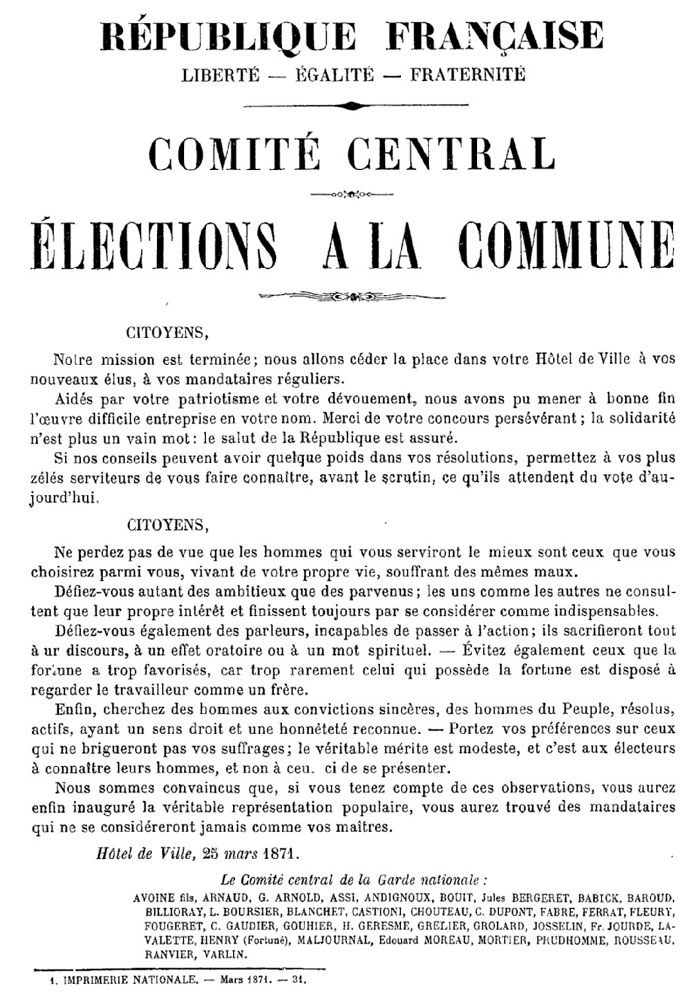
This proclamation of 25 March 1871 captures the transitional moment between revolutionary seizure of power and democratic legitimation. The Central Committee, having exercised de facto authority since 18 March, publicly declares its intention to step aside in favour of elected representatives. This gesture is crucial: it presents the uprising not as a coup but as a provisional guardianship of popular sovereignty.
The document’s tone is pedagogical and moral rather than incendiary; it instructs citizens on how to choose their representatives, emphasising modesty, working-class solidarity, sincerity, and action over rhetoric. Its suspicion of ambition, wealth, and oratorical flourish reveals the Commune’s democratic ethos and distrust of professional political elites.
Historically, the proclamation is significant because it articulates the Commune’s claim to be a genuinely popular government rooted in direct civic virtue rather than parliamentary careerism. In renouncing power voluntarily and urging vigilant democratic selection, the Central Committee sought to anchor the Revolution in electoral legitimacy, thereby reinforcing its moral claim to represent the will of Paris.
English Translation
FRENCH REPUBLIC
Liberty – Equality – Fraternity
CENTRAL COMMITTEE
ELECTIONS TO THE COMMUNE
CITIZENS,
Our mission is finished; we are about to yield your Hôtel de Ville to your newly elected representatives, your regular mandatories.
Supported by your patriotism and your devotion, we have been able to bring to a successful conclusion the difficult task undertaken in your name. Thanks to your persevering cooperation; solidarity has not been in vain: the salvation of the Republic is assured.
If our counsel can carry some weight in your deliberations, permit your most devoted servants to make known to you, before the ballot, what they expect from today’s vote.
CITIZENS,
Do not lose sight of the fact that the men who will serve you best are those you choose from among yourselves, living your own lives, suffering the same hardships.
Beware as much of the ambitious as of the self-made upstarts; both consult only their own interests and always end by considering themselves indispensable.
Beware equally of the talkers, incapable of passing from words to action; they will sacrifice everything to a fine speech, to an oratorical effect, to a clever phrase.
Avoid also those whom fortune has too greatly favoured; too rarely is the man who possesses wealth inclined to look upon the worker as a brother.
Finally, seek out men of sincere convictions, men of the People, resolute, active, possessing upright judgment and recognised honesty. Give your preference to those who do not seek your suffrages; true merit is modest, and it is for the electors to know their men, not for the candidates to present themselves.
We are convinced that, if you take these observations into account, you will at last inaugurate true popular representation; you will have found representatives who will never consider themselves your masters.
Hôtel de Ville, 25 March 1871.
The Central Committee of the National Guard:
[signatories]
National Printing Office — March 1871.
Proclamation of 28 March 1871
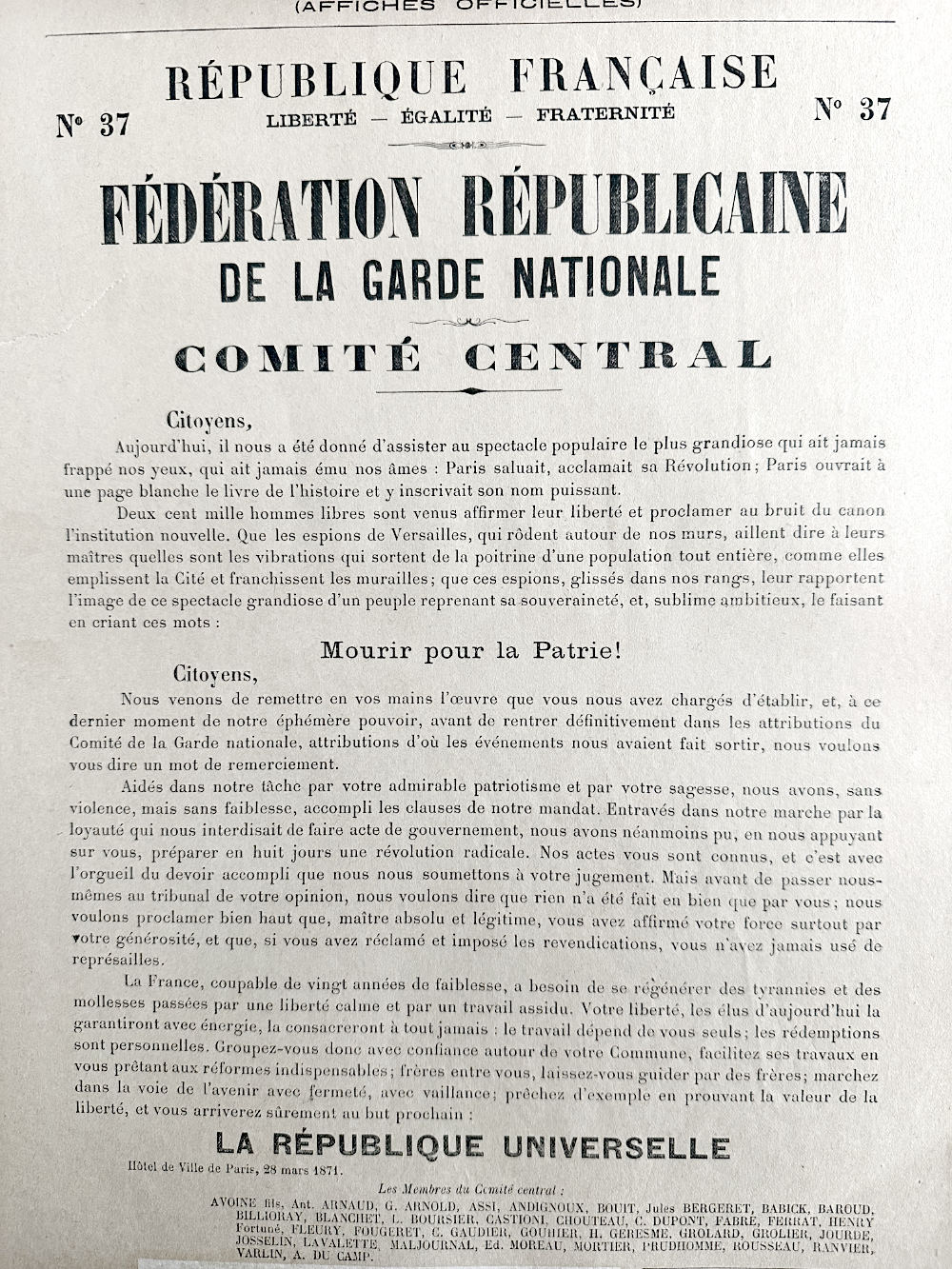
This proclamation of 28 March 1871 was issued on the day the Commune was formally proclaimed at the Hôtel de Ville. It captures the ceremonial and symbolic dimension of the revolution, presenting the event not as a coup but as a collective act of popular sovereignty. The language is exalted and theatrical, invoking a unified Paris rising “like a single man” and framing the moment as a historic reclaiming of rights. The repeated emphasis on voluntary mandate and the renunciation of reprisals is strategically important: the Central Committee seeks to legitimise its brief tenure by portraying itself as a disciplined guardian of popular will rather than a factional authority.
The document also marks the transfer of power from the provisional revolutionary committee to the elected Commune, reinforcing the narrative that authority derives from the people. Historically, this text is significant because it represents the high point of Communard optimism, when the revolution appeared to embody civic unity, moral restraint, and democratic renewal, just before the conflict hardened irreversibly into full-scale civil war.
Citizens,
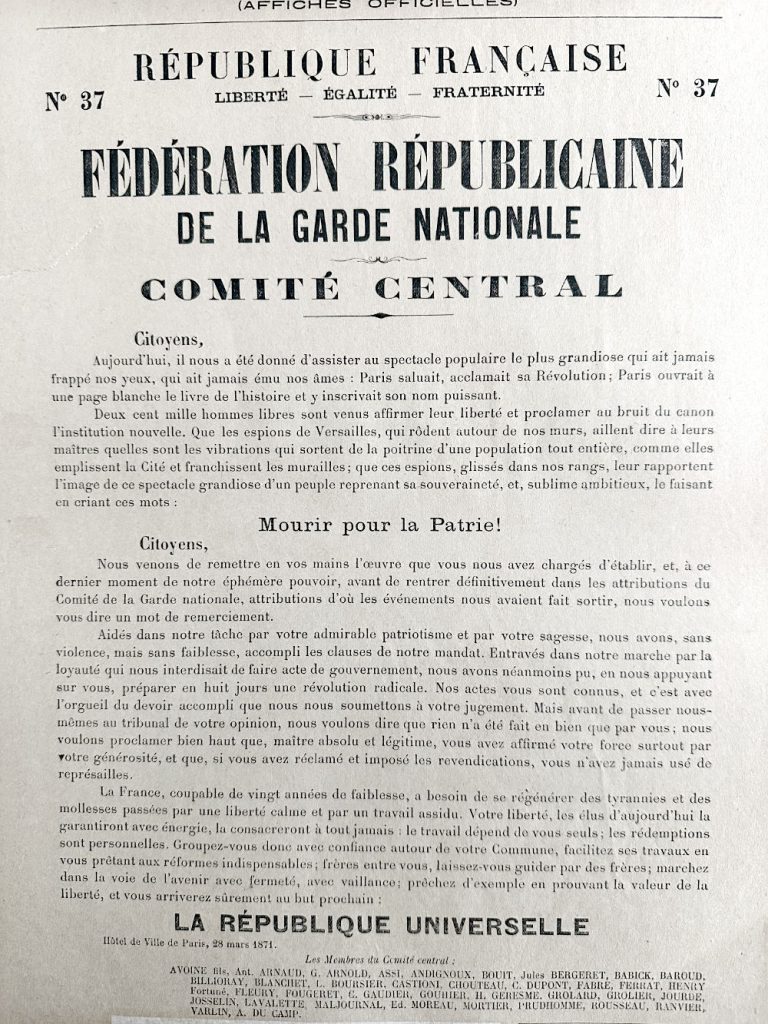
English Translation
FRENCH REPUBLIC
Liberty – Equality – Fraternity
No. 37
FEDERATION OF THE NATIONAL GUARD
CENTRAL COMMITTEE
Today we have been given to witness the most grandiose popular spectacle that has ever struck human eyes and souls: Paris rising, acclaiming its Revolution; Paris working toward a new page of history.
Two hundred thousand free men have come to affirm their liberty and to proclaim, to the thunder of cannon, the new institution. Let the spies of Versailles, prowling around our walls, go tell their masters what vibrations surge from the breast of an entire population; how this vast city, like a single man, rises to affirm its sovereignty; how this magnificent spectacle of a people resuming its rights resounds with these words:
“To die for the Fatherland!”
Citizens,
We have just placed in your hands the work you charged us to accomplish, and at this solemn moment, before laying down the powers which events had entrusted to us, we wish to address you a final word of gratitude.
Sustained in our task by your admirable patriotism and by your wisdom, we have, without violence and without hatred, accomplished the mandate that you imposed upon us. Though barred from any act of government, we have nevertheless prepared in eight days a radical revolution. Our acts are known to you, and we submit them to your judgment. But before passing from the stage, we wish to proclaim aloud that, as we have done nothing except at your insistence and in your name, and since you have demanded and imposed the realisation of these claims, we have never made use of reprisals.
Your generosity, which, if necessary, you have known how to impose, has never failed us.
The Republic, guilty of twenty years of weakness, must now regenerate itself from tyrannies and indulgences of the past, through calm liberty and sustained labour. Your liberty and your rights will be guaranteed by energy and perseverance; the future depends on you alone. Redemption belongs to those who will know how to remain united.
Citizens, gather confidently around your Commune; facilitate its labours in the path of the future; let yourselves be guided by its firm and vigilant hands; march with resolution and example, proclaiming the triumph of liberty.
Hôtel de Ville, 28 March 1871.
The Central Committee of the National Guard.
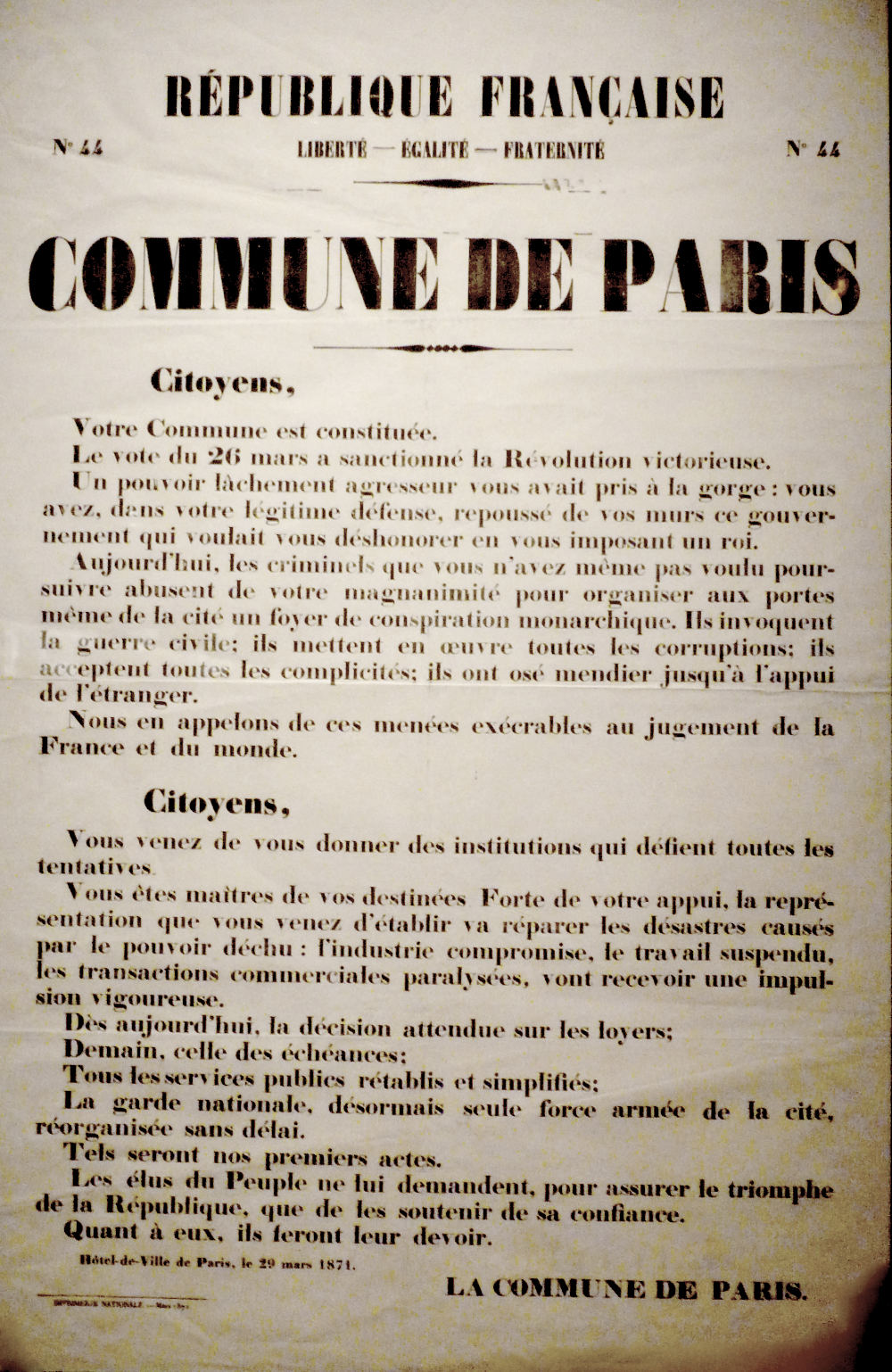
Proclamation of the Commune, 29 March 1871
The proclamation of 29 March 1871 marks the formal inauguration of the Paris Commune following the municipal elections of 26 March. Unlike earlier appeals that sought conciliation or procedural legitimacy, this text speaks with the authority of a constituted government. Its tone is declarative and programmatic: the Revolution is described as “ratified” by the vote, and the Commune presents itself as the legitimate political expression of Parisian sovereignty.
The document simultaneously denounces Versailles as monarchist and conspiratorial while outlining immediate practical reforms, particularly on rents, debts, public services, and the reorganisation of the National Guard. This dual structure – revolutionary rhetoric paired with administrative promises – reveals the Commune’s effort to combine insurrectionary legitimacy with governmental responsibility.
Historically, the proclamation is significant because it transforms the uprising into an institutional reality: from this moment, the Commune is no longer a movement but a self-declared sovereign authority governing Paris, thereby crystallising the rupture with Versailles.
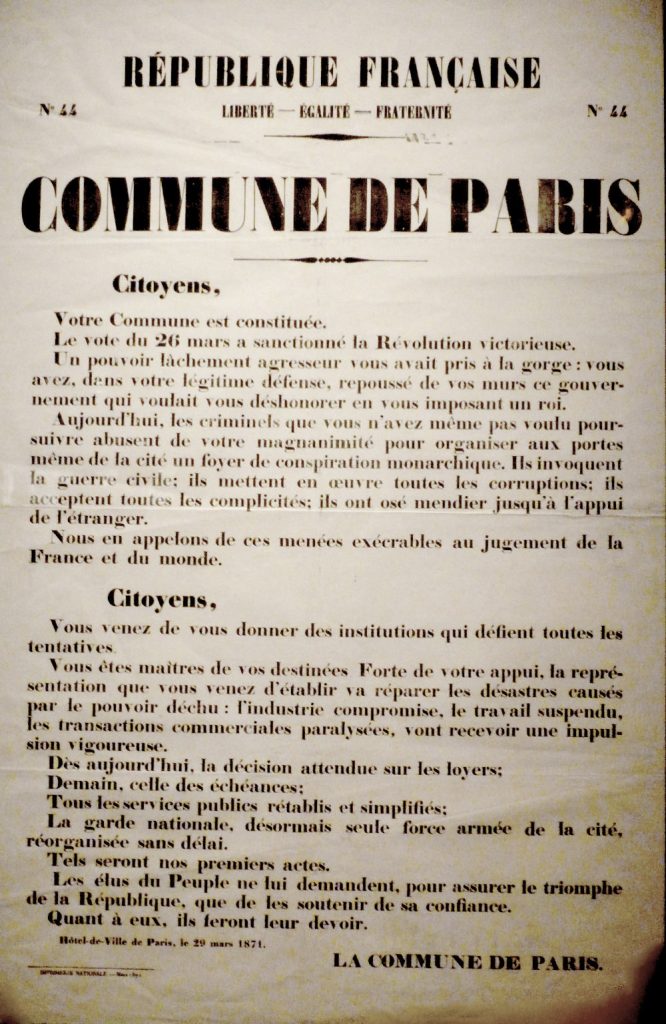
English Translation
FRENCH REPUBLIC
LIBERTY — EQUALITY — FRATERNITY
No. 44
COMMUNE OF PARIS
Citizens,
Your Commune is constituted.
The vote of 26 March has ratified the victorious Revolution.
A cowardly and aggressive power had you by the throat: in your legitimate defence, you have driven from your walls that government which sought to dishonour you by imposing a king upon you.
Today, the criminals whom you did not even wish to pursue, abusing your magnanimity, are organising at the gates of the city a centre of monarchist conspiracy. They are calling for civil war; they are employing every corruption; they accept every complicity; they have dared to beg for the support of the foreigner.
We appeal from these execrable intrigues to the judgment of France and of the world.
Citizens,
You have just given yourselves institutions that defy all attempts against them.
You are masters of your destiny. Strengthened by your support, the representation you have just established will repair the disasters caused by the fallen power: compromised industry, suspended labour, paralysed commercial transactions will receive a vigorous impulse.
As of today, the awaited decision concerning rents;
Tomorrow, that concerning debts;
All public services restored and simplified;
The National Guard, henceforth the sole armed force of the city, reorganised without delay.
Such will be our first acts.
The elected representatives of the People ask of them, to ensure the triumph of the Republic, only the support of their confidence.
As for themselves, they will do their duty.
Hôtel de Ville of Paris, 29 March 1871.
THE COMMUNE OF PARIS.
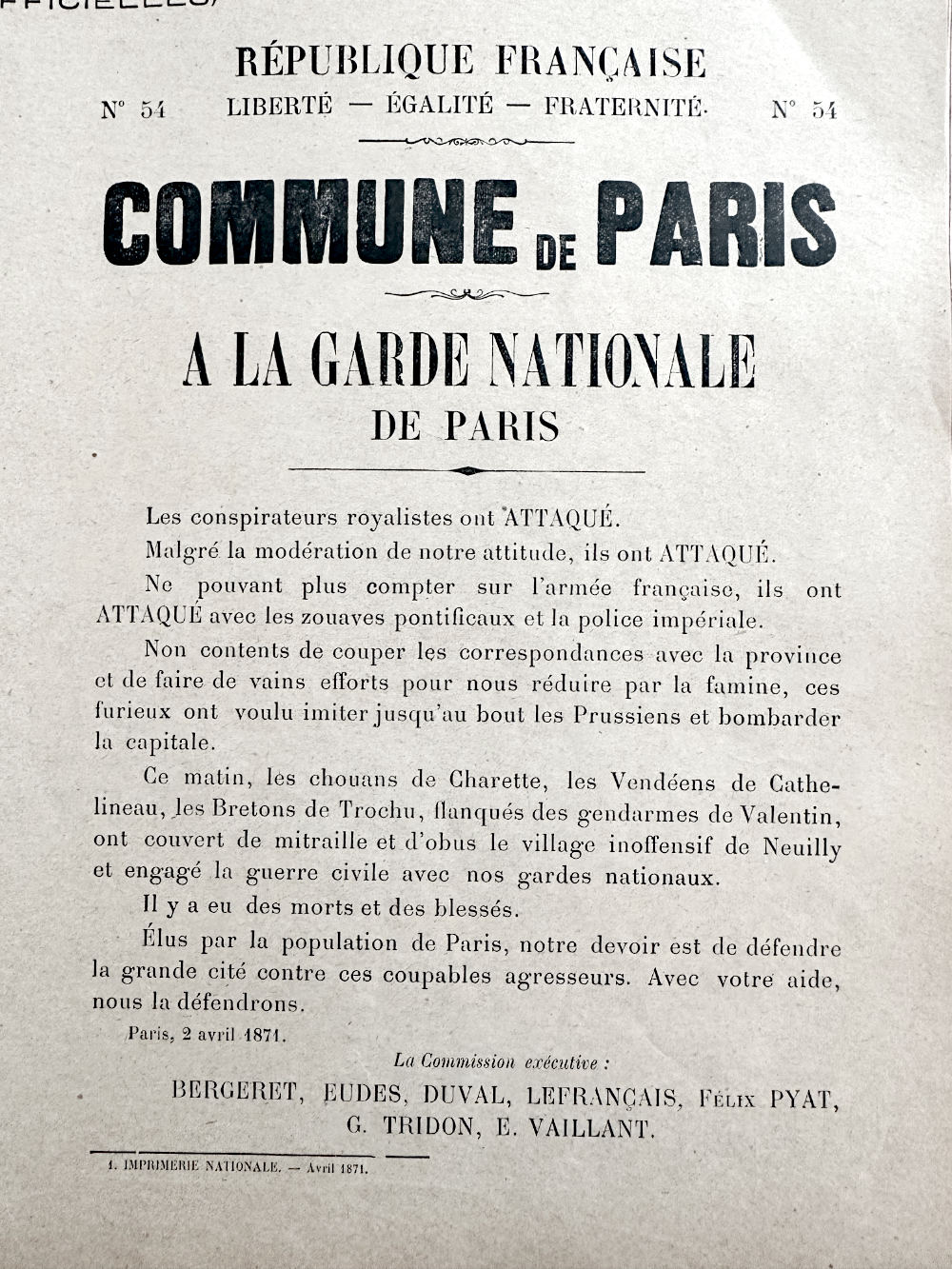
Versailles Attacks, 2 April 1871
This proclamation of 2 April 1871 marks a decisive rhetorical escalation at the moment when open military confrontation between Paris and Versailles began in earnest. Addressed directly to the National Guard, it frames the conflict as defensive rather than insurgent: the Commune presents itself as the victim of aggression by “royalist conspirators” who have initiated civil war.
The repeated emphasis on “ATTACKED” functions as both alarm and justification, constructing Versailles as the aggressor and associating it symbolically with reactionary forces such as the Chouans and Vendéens, thereby invoking memories of counter-revolutionary uprisings. By comparing the bombardment to Prussian tactics, the text further delegitimises Versailles as betraying national honour.
Historically, this document is significant because it formalises the transition from revolutionary seizure of authority to organised civil war. It seeks to consolidate morale within the National Guard while recasting the Commune’s struggle as a patriotic defence of Paris and of the Republic itself, reinforcing the narrative that the true threat to France lay not in the insurgent capital but in the reactionary forces gathered at Versailles.
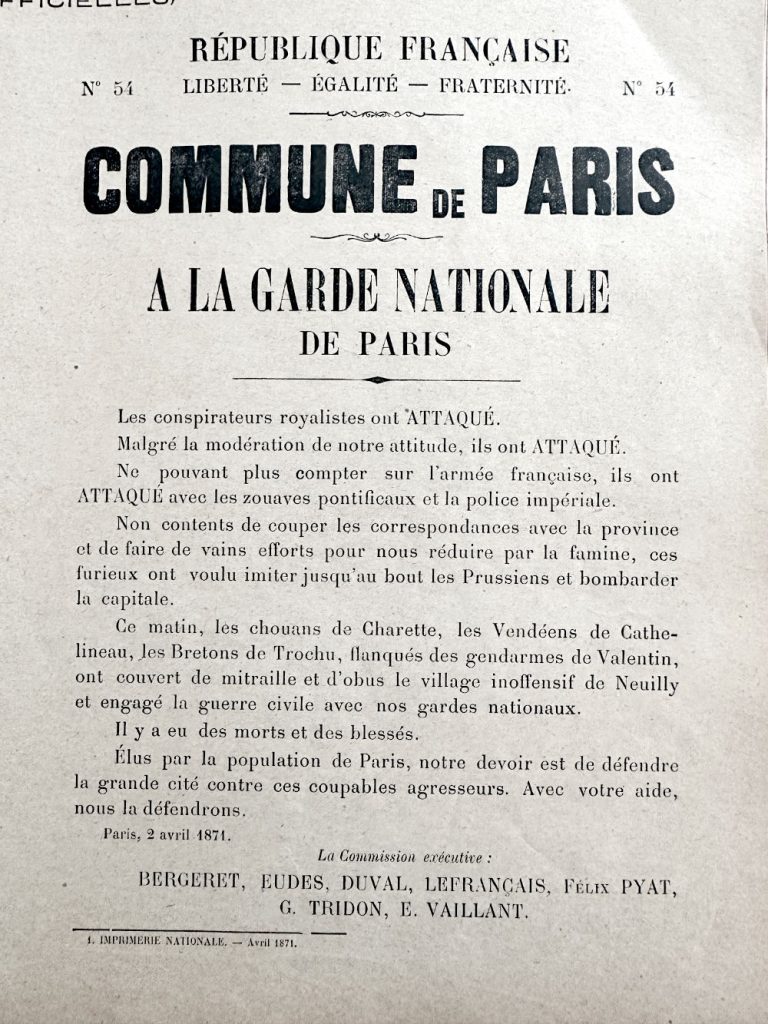
English Translation
FRENCH REPUBLIC
Liberty – Equality – Fraternity
No. 54
COMMUNE OF PARIS
TO THE NATIONAL GUARD OF PARIS
The royalist conspirators have ATTACKED.
Despite the moderation of our attitude, they have ATTACKED.
No longer able to rely on the French army, they have ATTACKED with the Papal Zouaves and the imperial police.
Not content with cutting communications with the provinces and making vain efforts to reduce us by famine, these furious men have sought to imitate the Prussians to the end and to bombard the capital.
This morning, the Chouans of Charette, the Vendéens of Cathelineau, the Bretons of Trochu, supported by Valentin’s gendarmes, rained grapeshot and shells upon the harmless village of Neuilly and have engaged in civil war with our National Guards.
There have been dead and wounded.
Elected by the population of Paris, it is our duty to defend the great city against these guilty aggressors. With your help, we shall defend it.
Paris, 2 April 1871.
The Executive Commission:
Bergeret, Eudes, Duval, Lefrançais, Félix Pyat,
G. Tridon, E. Vaillant.
National Printing Office — April 1871.
Separation of Church and State, 3 April 1871
This decree is important because it shows that the Paris Commune was not only fighting a military battle against Versailles, but also trying to reshape French society at a fundamental level. By separating Church and State and abolishing state funding for religion, the Commune argued that true republican liberty begins with freedom of conscience. In its view, forcing citizens to finance a religion they might not believe in contradicted the principles of the Republic, and the clergy’s historic alignment with monarchy made separation politically necessary.
By nationalising Church property, the Commune also linked ideas of freedom to material change, asserting its authority to reorganise power and wealth. In the context of the Paris Commune, this decree demonstrates that the movement saw itself as the legitimate embodiment of republican sovereignty, determined to carry out deep structural reform even while under siege.
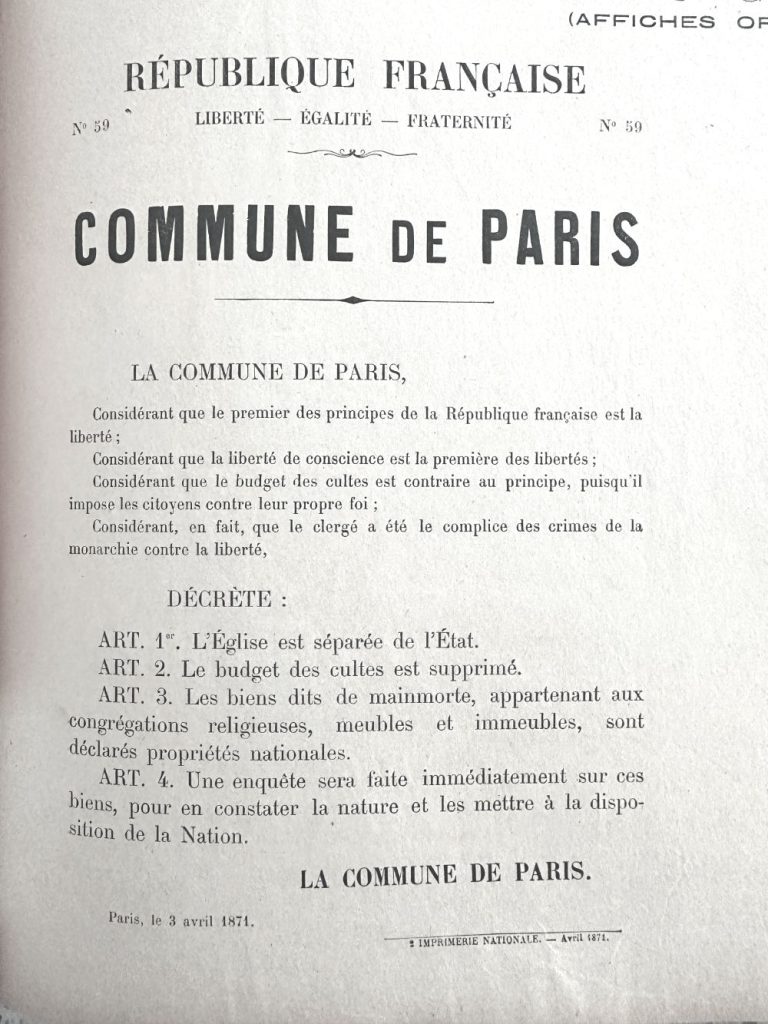
English Translation
FRENCH REPUBLIC
Liberty – Equality – Fraternity
COMMUNE OF PARIS
No. 59
THE COMMUNE OF PARIS,
Considering that the first of the principles of the French Republic is liberty;
Considering that freedom of conscience is the first of liberties;
Considering that the budget of public worship is contrary to this principle, since it imposes upon citizens against their own faith;
Considering, in fact, that the clergy has been the accomplice of the crimes of monarchy against liberty,
DECREES:
Article 1. The Church is separated from the State.
Article 2. The budget of public worship is abolished.
Article 3. The so-called mortmain properties belonging to religious congregations, movable and immovable, are declared national property.
Article 4. An inquiry shall be conducted immediately into these properties, in order to determine their nature and to place them at the disposal of the Nation.
Paris, 3 April 1871.
THE COMMUNE OF PARIS.
Statement of the Paris Commune, 5 April 1871
This proclamation is a document written under conditions of siege, outrage and escalating brutality. By early April 1871, Versailles troops had begun executing captured Communard soldiers, including recognised officers, in open violation of the Geneva Convention 1864, to which France was a party. From the perspective of the Commune, which had been elected on 26 March and which regarded itself as the legitimate municipal authority of Paris, these killings were not acts of lawful repression but deliberate political murder. The text reflects a population that believed it had exercised its democratic mandate only to be attacked militarily by a government that had fled the capital.
The tone is anguished and incredulous, stating that the People are “generous and just” and that it abhors civil war. The threat of reprisals appears as a last resort, framed as forced upon them by Versailles’ abandonment of the “laws of war and humanity.” In other words, the Commune presents retaliation not as vengeance but as an attempt to deter further executions.
Historically, the document reveals the psychological turning point of the conflict. The Commune had begun by asserting legality, autonomy and republican principles; here it speaks from a position of shock at the violence being inflicted upon it and from the fear that its elected representatives and soldiers could be slaughtered with impunity. The proclamation embodies both horror and powerlessness, transformed into a stern warning: if Versailles continues to treat captured Communards as criminals rather than combatants, Paris will respond in kind. It is the language of a besieged city attempting to assert dignity, reciprocity and survival in the face of what it regarded as illegitimate aggression.
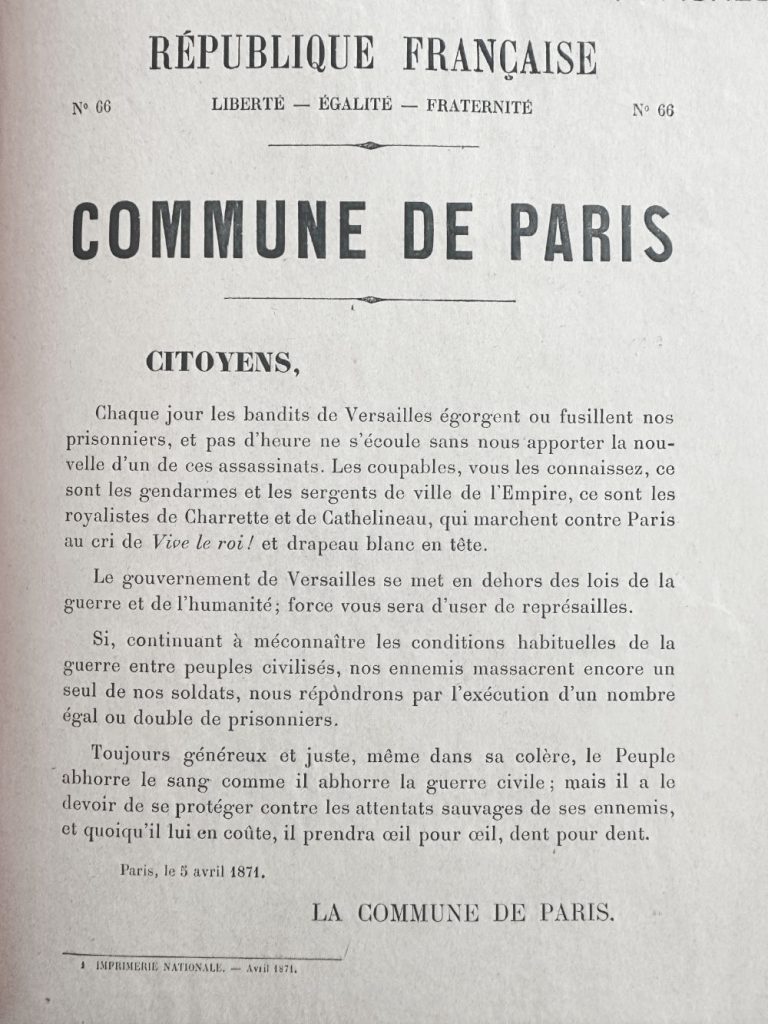
English Translation
FRENCH REPUBLIC
Liberty – Equality – Fraternity
No. 66
COMMUNE OF PARIS
CITIZENS,
Each day the bandits of Versailles slaughter or shoot our prisoners, and hardly an hour passes without bringing us news of one of these assassinations. The guilty men, you know them: they are the gendarmes and the city sergeants of the Empire; they are the royalists of Charette and of Cathelineau, who march against Paris crying “Long live the King!” with the white flag at their head.
The Government of Versailles has placed itself outside the laws of war and of humanity; force will oblige you to make use of reprisals.
If, by continuing to disregard the customary conditions of war between civilised peoples, our enemies massacre even one of our soldiers, we shall respond by executing an equal or double number of prisoners.
Always generous and just, even in its anger, the People abhors bloodshed as it abhors civil war; but it has the duty to protect itself against the savage attacks of its enemies, and, however much it may cost, it will take eye for eye, tooth for tooth.
Paris, 5 April 1871.
THE COMMUNE OF PARIS.
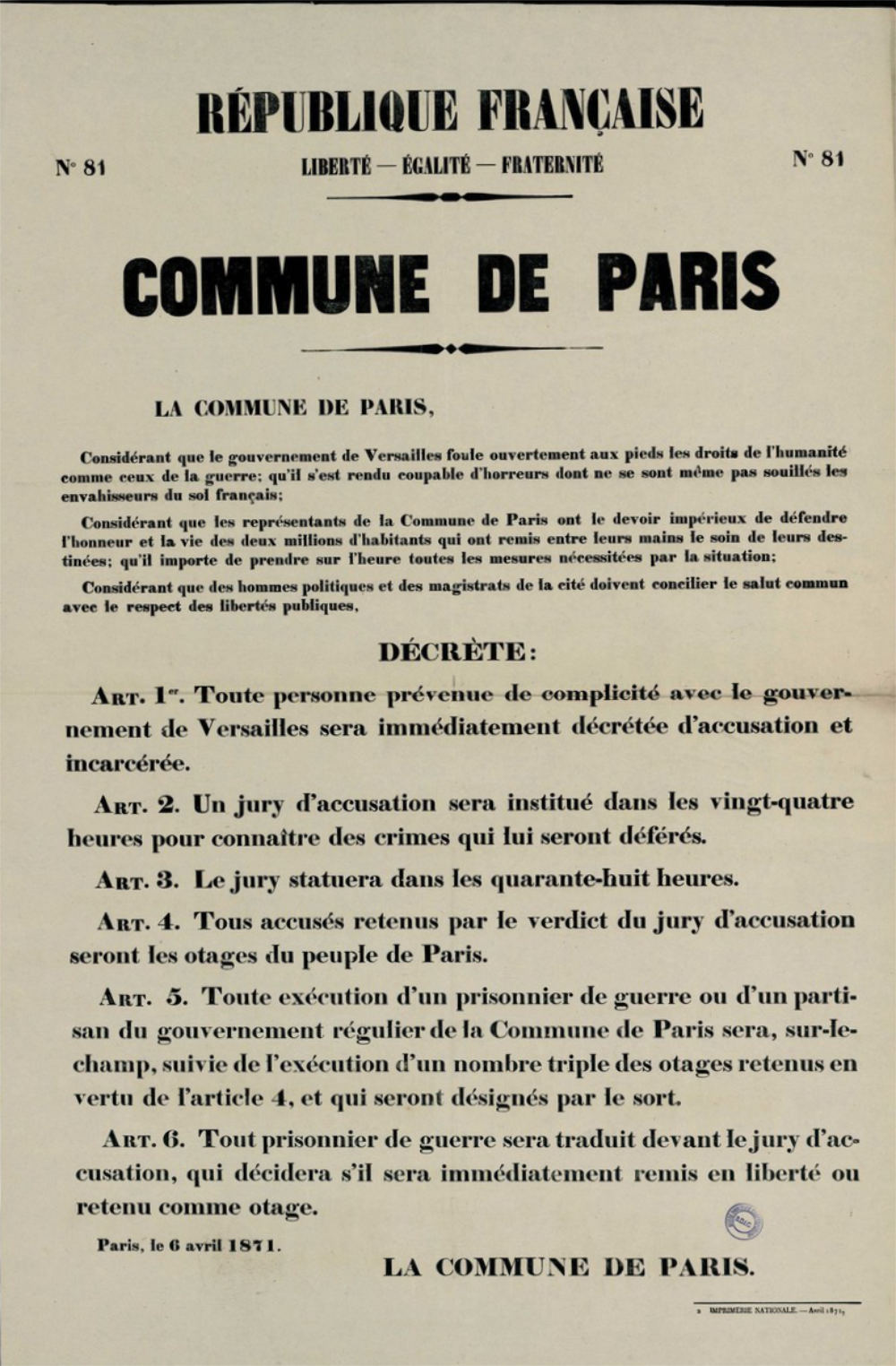
Hostages Declaration, 6 April 1871
The decree of 6 April 1871, commonly known as the Hostages Decree, marks a decisive radicalisation of the Paris Commune’s position in its conflict with Versailles. Issued amid reports of summary executions of captured Communards by government forces, the decree institutionalised the taking of hostages as a formal policy of reprisal. By creating a jury of indictment and declaring that accused persons would become “hostages of the people of Paris,” the Commune sought to frame its actions within a legal structure rather than as arbitrary vengeance.
Article 5, which threatened the execution of triple the number of hostages in response to any execution carried out by Versailles, was intended as a deterrent measure grounded in the laws of war as understood in the nineteenth century. Historically, the decree is significant because it reveals both the Commune’s attempt to assert sovereign authority and the escalating logic of civil war: the conflict had moved beyond political dispute into reciprocal terror. Although it was not enforced until the last tragic moments of Bloody Week, and despite it being controversial even within the Commune, the decree became a central element in Versailles propaganda, used to portray the Communards as lawless extremists and to justify the severity of the repression that followed.
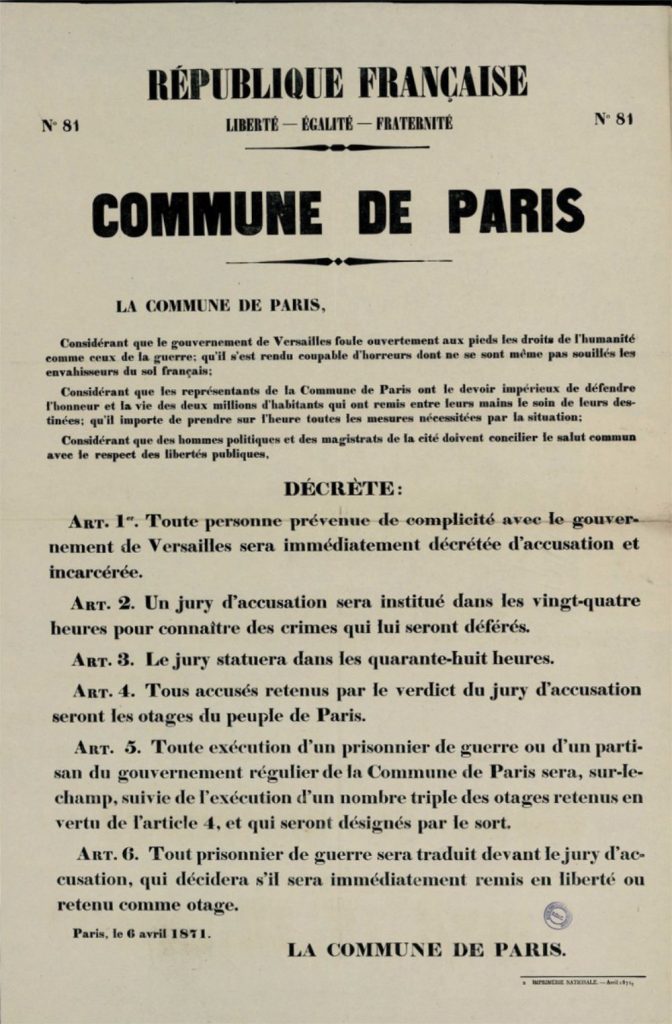
English Translation
FRENCH REPUBLIC
LIBERTY — EQUALITY — FRATERNITY
No. 81
COMMUNE OF PARIS
THE COMMUNE OF PARIS,
Considering that the government of Versailles openly tramples underfoot the rights of humanity as well as the laws of war; that it has made itself guilty of horrors with which even the invaders of French soil have not stained themselves;
Considering that the representatives of the Commune of Paris have the imperative duty to defend the honour and the lives of the two million inhabitants who have placed in their hands the care of their destinies; that it is necessary to take, without delay, all measures required by the situation;
Considering that political leaders and magistrates of the city must reconcile the common safety with respect for public liberties,
DECREES:
Art. 1. Any person accused of complicity with the government of Versailles shall immediately be formally charged and imprisoned.
Art. 2. A jury of accusation shall be instituted within twenty-four hours to examine the crimes brought before it.
Art. 3. The jury shall give its decision within forty-eight hours.
Art. 4. All accused persons held by the verdict of the jury of accusation shall be hostages of the people of Paris.
Art. 5. Any execution of a prisoner of war or of a supporter of the regular government of the Commune of Paris shall be immediately followed by the execution of a number triple that of the hostages held under Article 4, who shall be designated by lot.
Art. 6. Every prisoner of war shall be brought before the jury of accusation, which shall decide whether he is to be immediately released or held as a hostage.
Paris, 6 April 1871.
THE COMMUNE OF PARIS.
Statement of the Commune, 7 April 1871
This proclamation is one of the clearest expressions of the Commune’s outrage at the summary executions carried out by Versailles. The text quotes Versailles’ own official language, which attempts to cloak the shooting of captured men in the formal vocabulary of “military law.” By reproducing the wording verbatim, the Commune exposes what it sees as a legal fiction masking political murder. The phrase “horrible admission” signals that the crime lies not only in the act itself but in its bureaucratic justification.
The emotional force of the document is striking. The appeal to “vengeance” arises not from cruelty, but from the shock of seeing soldiers executed after capture, at a time when modern European warfare was increasingly governed by recognised conventions. The Commune presents itself as engaged in legitimate combat, defending a republic born of election, while Versailles treats captured combatants as criminals rather than belligerents. The line “They assassinate; the Republicans fight” draws a sharp moral distinction: one side kills prisoners, the other defends principles.
Historically, this text reveals a critical escalation. By early April, executions by Versailles had shattered any remaining illusion that the conflict might remain restrained. The Commune’s rhetoric becomes both accusatory and defiant, framing the violence of Versailles as evidence of fear and moral weakness. The closing assertion, “the Republic will triumph,” transforms grief and anger into resolve. It is the voice of a besieged government asserting that, despite repression and bloodshed, it embodies the true continuity of republican legitimacy.
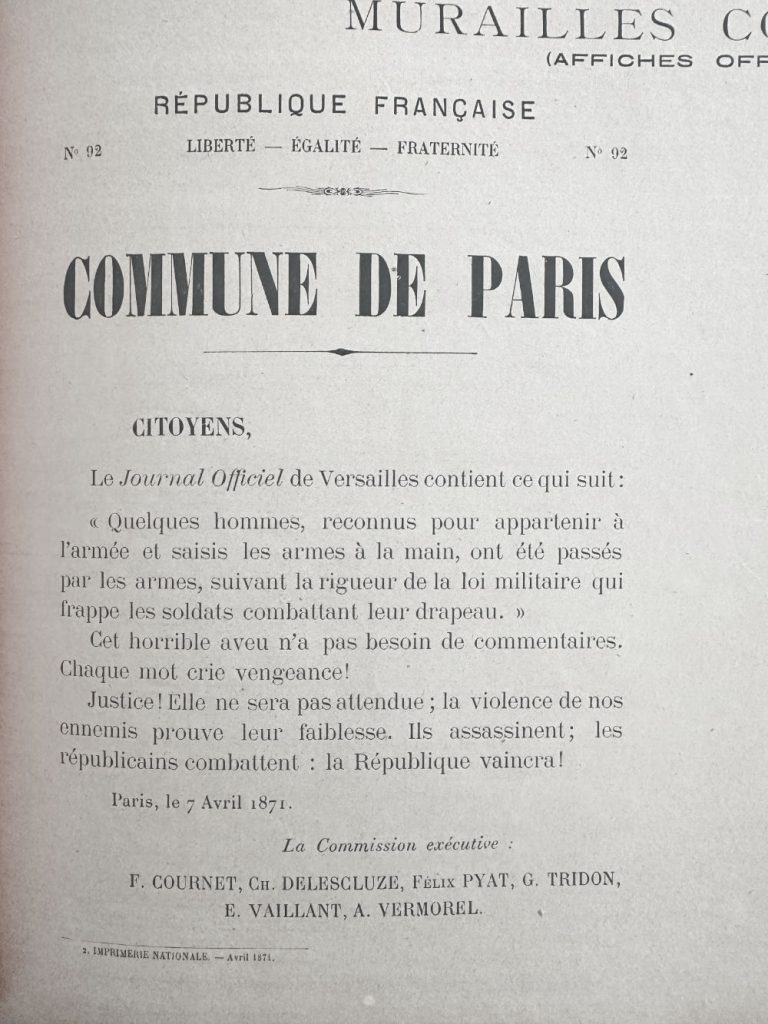
English Translation
FRENCH REPUBLIC
Liberty – Equality – Fraternity
No. 92
COMMUNE OF PARIS
CITIZENS,
The Official Journal of Versailles contains the following:
“Some men, recognised as belonging to the army and seized with arms in hand, have been subjected, according to the rigour of military law, to the punishment that strikes soldiers fighting under their flag.”
This horrible admission needs no commentary.
Each word cries out for vengeance!
Justice will not be delayed; the violence of our enemies proves their weakness. They assassinate; the Republicans fight: the Republic will triumph!
Paris, 7 April 1871.
The Executive Commission:
F. Cournet, Ch. Delescluze, Félix Pyat, G. Tridon, E. Vaillant, A. Vermorel.
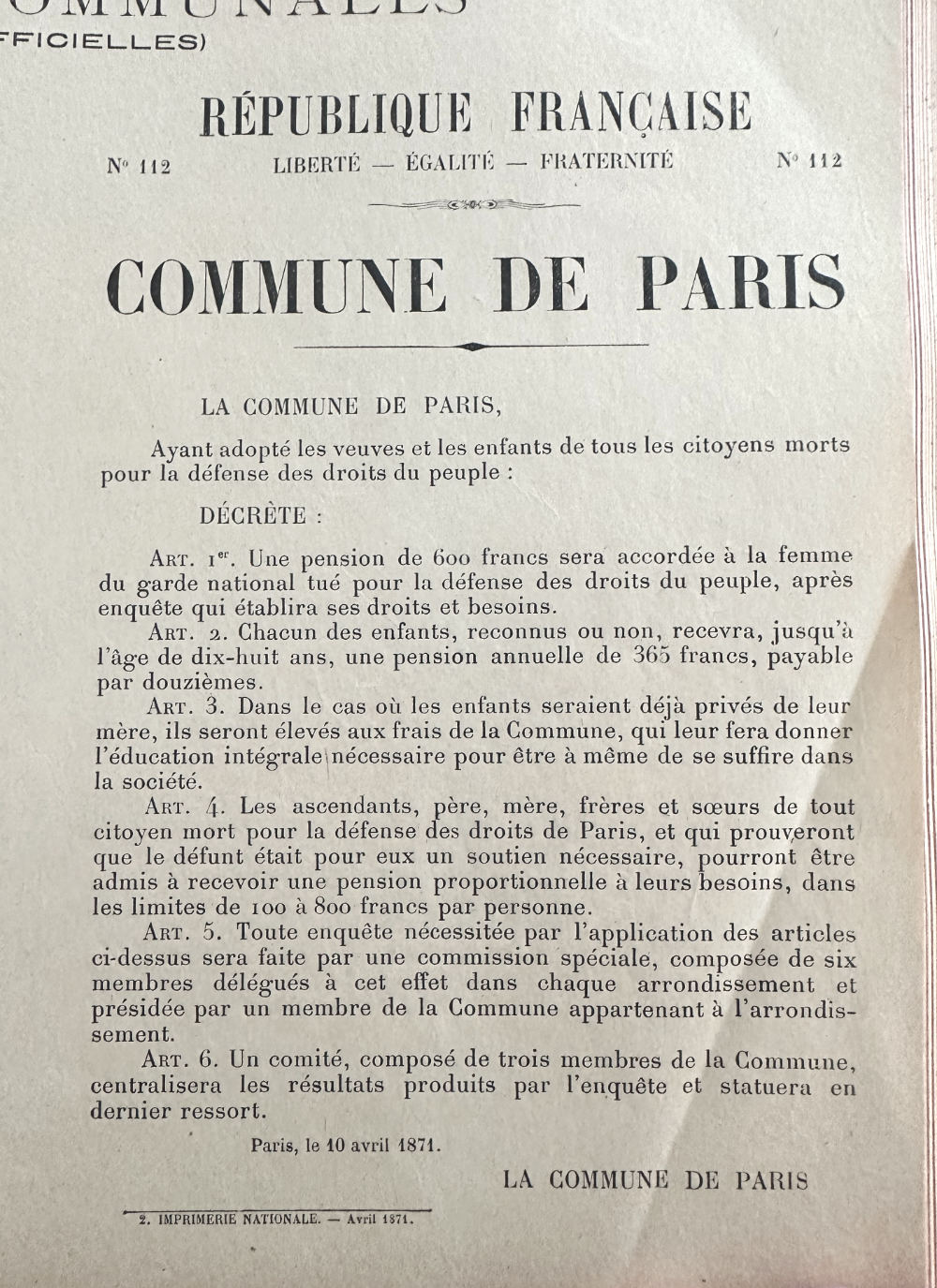
Establishment of Pensions for War Widows and Orphans, 10 April 1871
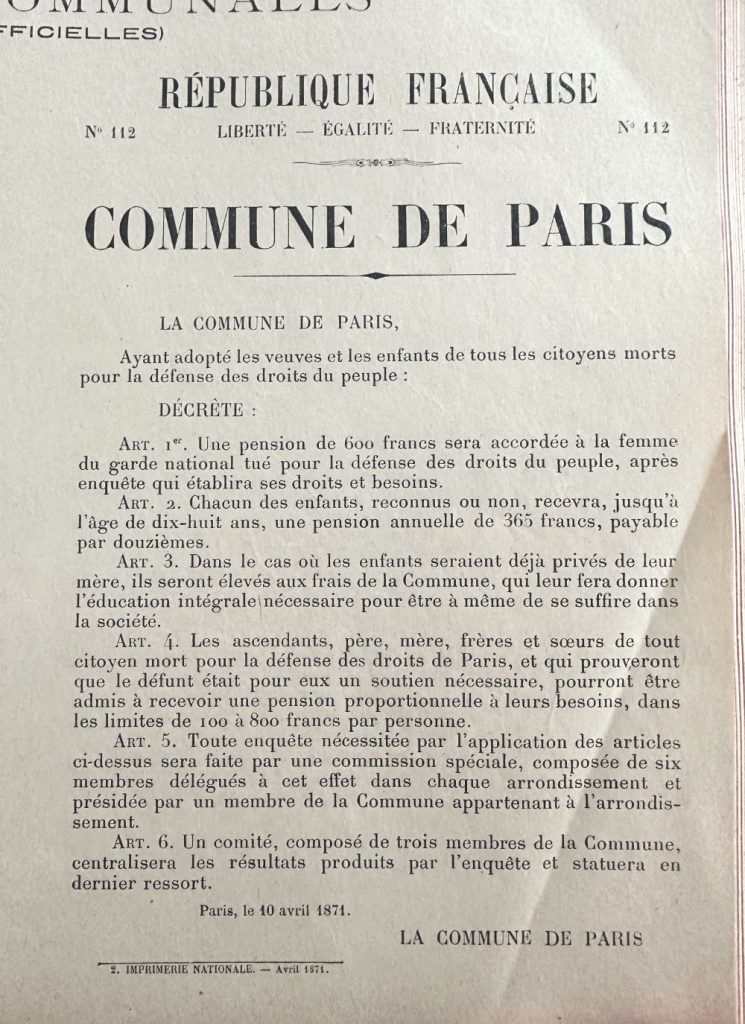
This decree is significant because it reveals the Commune’s commitment to social justice even in the midst of war. By granting pensions to the widows and children of those killed defending Paris, and by recognising all children, whether legally acknowledged or not, it affirmed a radical principle of equality and collective responsibility.
Support was not limited by traditional moral or legal distinctions, and children were guaranteed both financial aid and education at the Commune’s expense. In the context of the Paris Commune, this measure demonstrates that the revolution was not only about political power but about reshaping the social contract, protecting the most vulnerable, and embodying the idea that the Republic must materially care for those who sacrifice for it.
English Translation
The Commune of Paris,
Having adopted the widows and children of all citizens who have died in defence of the rights of the people:
Decrees:
Article 1. A pension of 600 francs shall be granted to the widow for the defence of the rights of the people, following an inquiry to establish her rights and needs.
Article 2. Each child, whether legally recognised or not, shall receive, up to the age of eighteen, an annual pension of 365 francs, payable in quarterly instalments. If the children have already been deprived of their mother, they shall be raised at the expense of the Commune, which shall provide them with the full education necessary to support themselves in society.
Article 4. Ascendants, father, mother, brothers and sisters of any citizen who died in defence of the rights of the people, and who prove that the deceased was their sole support, shall be entitled to receive a pension proportional to their needs, within limits of 100 to 800 francs per person.
Article 5. Any inquiry required for the application of the above articles shall be conducted by a special commission composed of six members appointed in each arrondissement and presided over by a member of the Commune belonging to the arrondissement.
Article 6. A committee composed of three members of the Commune shall centralise the results produced by the inquiry and shall decide as a final authority.
Paris, 10 April 1871.
The Commune of Paris.
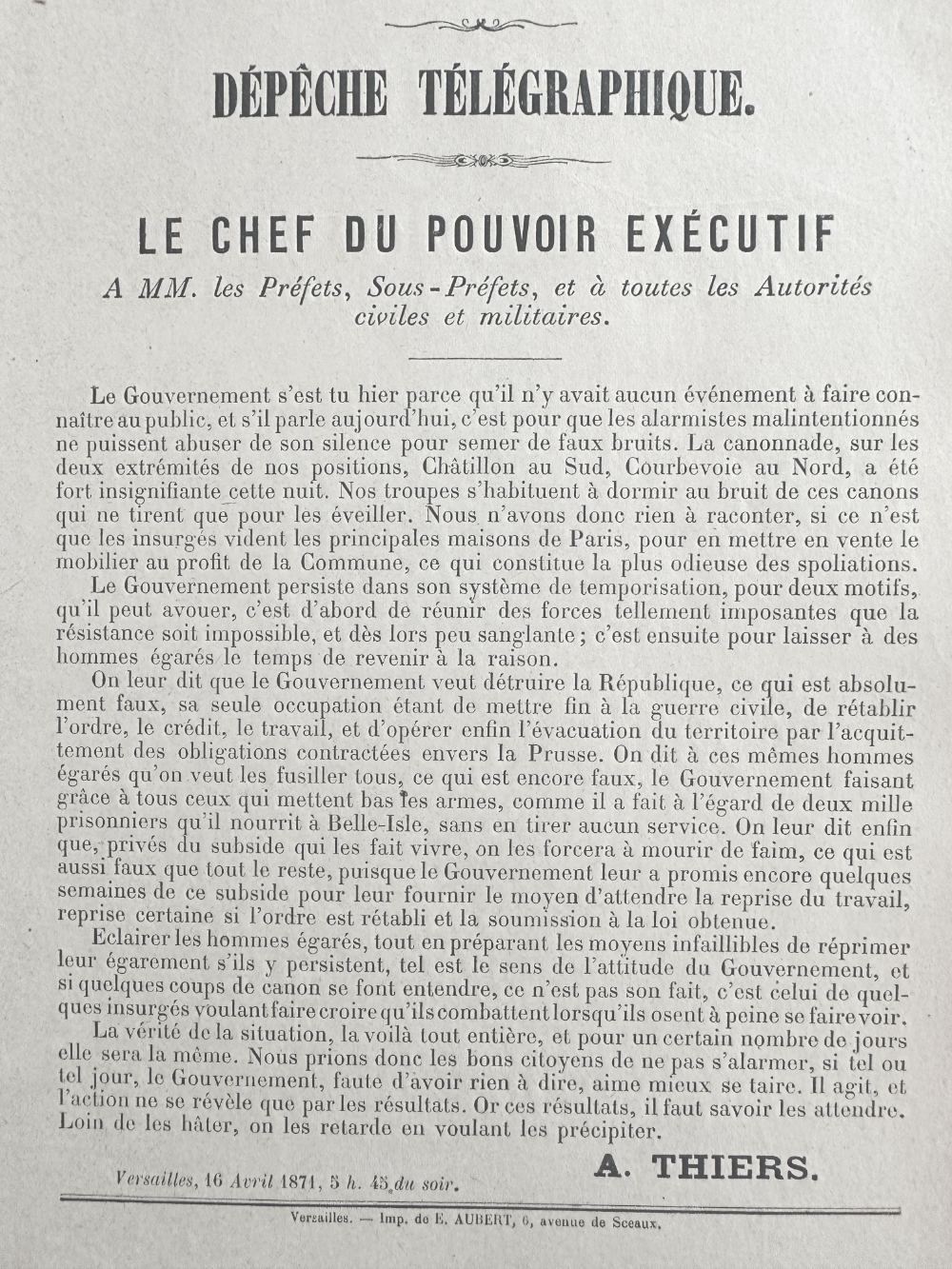
Telegraphic Dispatch, 16 April 1871
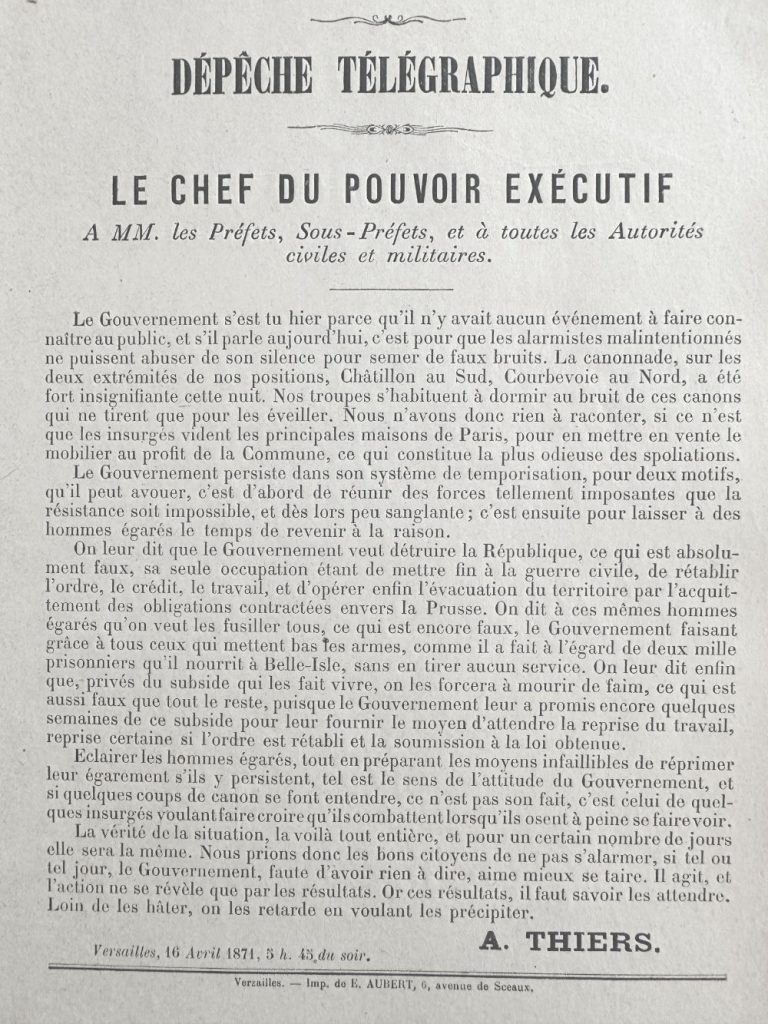
This dispatch illustrates the rhetorical strategy of Versailles in mid-April: minimisation, reassurance, and delegitimisation. Thiers presents events around Paris as minor disturbances rather than open civil war, while simultaneously preparing “infallible means of repression.” The text is carefully constructed to calm provincial authorities and prevent solidarity with Paris. It insists that the Republic is not in danger and denies any intention to destroy it, even as the government concentrates overwhelming force against the elected Commune.
What stands out is the attempt to recast the conflict as a problem of “misguided men” rather than a political confrontation between two competing republican authorities. By reducing the Commune to “alarmists” and “insurgents,” Versailles refuses to recognise the electoral legitimacy of the Parisian mandate. At the same time, the language of “repression,” “submission to the law,” and the promise to crush resistance reveals that military resolution is already anticipated. The appeal to calm and silence masks preparation for decisive force.
From the Commune’s point of view, such dispatches would have confirmed their sense of isolation and misrepresentation. While Paris experienced bombardment and executions, Versailles publicly framed the situation as orderly, controlled, and morally justified. The document therefore exemplifies the information war accompanying the military one: a struggle not only over territory, but over narrative, legitimacy, and the definition of the Republic itself.
English Translation
FRENCH REPUBLIC
TELEGRAPHIC DISPATCH
THE HEAD OF THE EXECUTIVE POWER
To the Prefects, Sub-Prefects, and to all Civil and Military Authorities.
The Government remained silent yesterday because there was no event to make public; and if it speaks today, it is so that alarmists with bad intentions may not abuse its silence to spread false rumours. The cannonade, at the extremities of our positions, from Châtillon in the south, Courbevoie in the north, was intended to frighten the insurgents; it fired only to awaken them. We therefore have nothing to report, except that the insurgents are emptying the principal houses of Paris, putting them up for sale to the benefit of the Commune, which constitutes the most odious of spoliations.
The Government persists in its policy of temporisation for two reasons: first, because it is hoped that by reuniting forces so imposing that resistance becomes impossible, this resistance, if it breaks out, will be crushed at once; and next, to leave misguided men time to return to reason.
They are told that the Government wishes to destroy the Republic, which is absolutely false; its sole occupation is to put an end to civil war, to re-establish order, credit, labour, and finally to carry out the evacuation of the territory by the payment of the indemnity. The Republic is in no danger. It is false to say that these same men, whom it is desired to shoot when they lay down their arms, as was done with two thousand prisoners whom it is alleged were fed at Belle-Île without their being of any use. They are even told that, deprived of the subsidy which sustains them, they will be forced to die of hunger, which is equally false, since the Government has promised them still several weeks of pay, provided order is restored and submission to the law resumes.
To enlighten the misguided men, and to prepare infallible means of repression should they persist, such is the meaning of the Government’s attitude; and if some cannon shots are heard, it is not its doing, but that of some insurgents, against whom a serious act will soon have to be taken.
The truth of the situation will soon become entirely clear, and when it does, it will be the same everywhere. We therefore ask good citizens not to be alarmed if this or that fact appears exaggerated; the Government, having nothing to hide, prefers silence. It acts, and it will make itself known by its results. Now these results must be awaited, not precipitated.
Versailles, 16 April 1871, 8:43 in the evening.
A. THIERS.
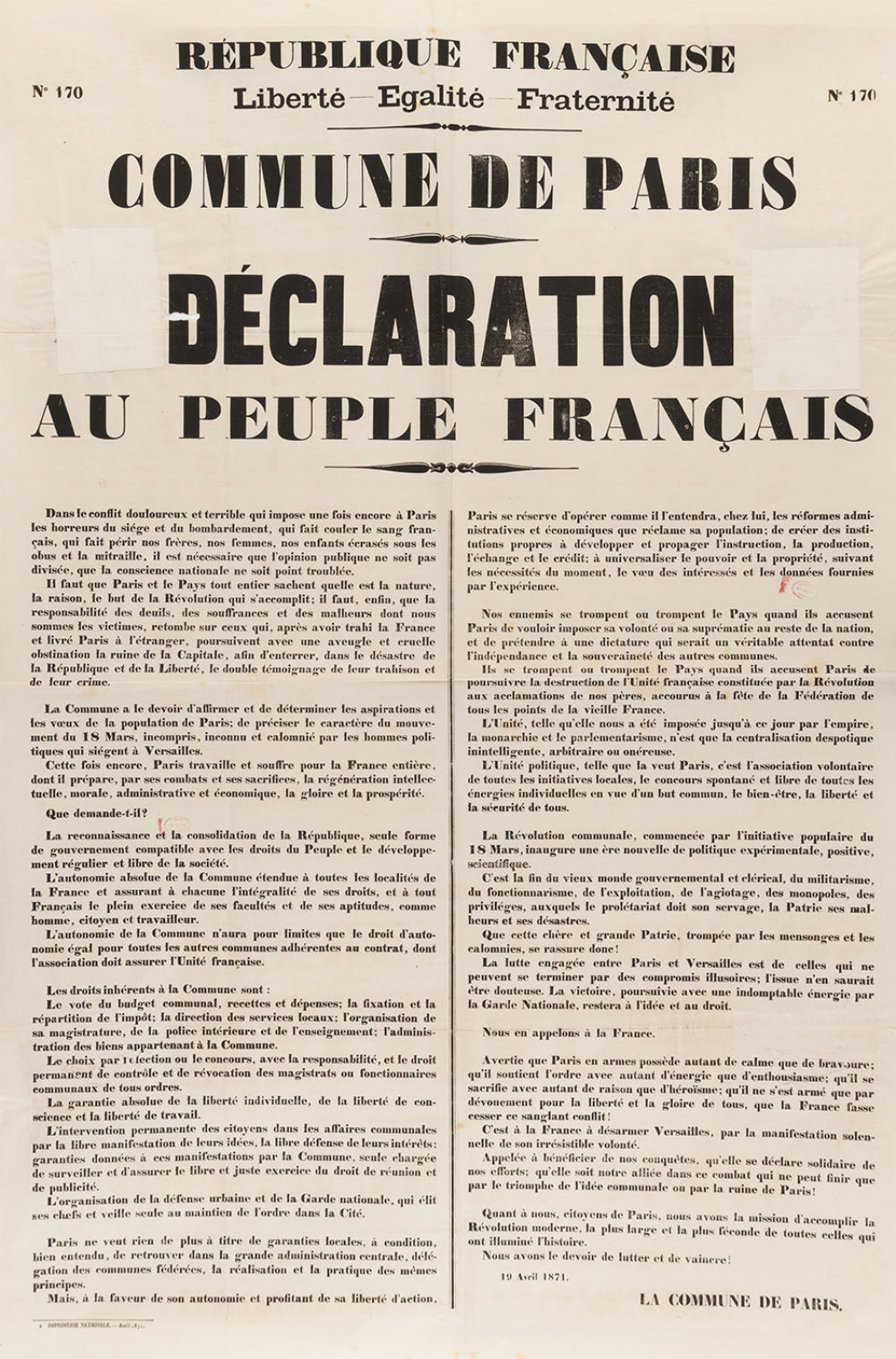
The Paris Commune’s Declaration to the French People, 19 April 1871
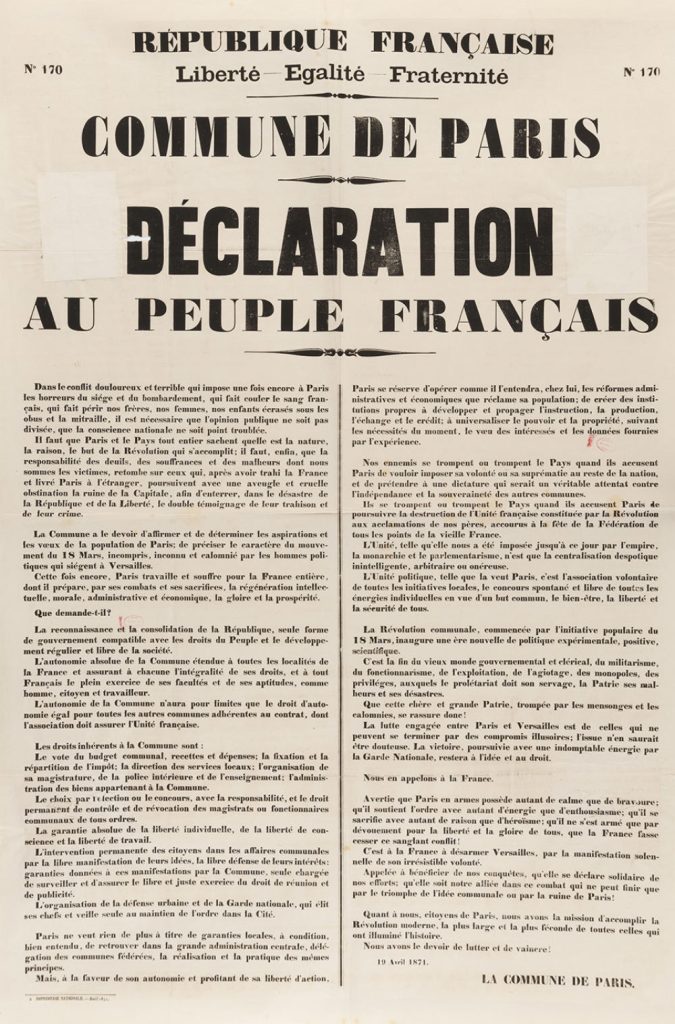
The Declaration to the French People of 19 April 1871 was the Paris Commune’s most comprehensive political manifesto and its clearest attempt to legitimise itself before the nation. Issued one month after the uprising of 18 March, it sought to counter the Versailles government’s portrayal of the Commune as anarchic and separatist by presenting it instead as the logical continuation of the French Revolution.
The document reframed the conflict not as rebellion but as a struggle between democratic municipal autonomy and authoritarian centralisation. By articulating principles such as communal self-government, elected and recallable officials, civil liberties, secular education, and the federation of communes, it offered a constitutional vision rather than a mere insurrectionary programme.
Crucially, it addressed “France” directly, asserting that Paris did not seek domination but voluntary unity through association. In doing so, the Declaration transformed the Commune from a local revolt into a theoretical model of republican federalism, giving it enduring ideological significance far beyond its brief existence.
English Translation
FRENCH REPUBLIC
Liberty – Equality – Fraternity
No. 170
COMMUNE OF PARIS
DECLARATION
TO THE FRENCH PEOPLE
In the painful and terrible conflict which once again imposes upon Paris the horrors of siege and bombardment, which makes French blood flow, which causes our brothers, our women, and our children to perish beneath shells and bullets, it is necessary that public opinion not be divided, that the national conscience not be shaken.
It is up to Paris to make it clear to the entire country what is the nature, the purpose, and the aim of the Revolution that is taking place; that the responsibility for the grief, the sufferings, and the misfortunes of which we are the victims falls upon those who, after betraying France and delivering Paris to the foreigner, now pursue, with blind and cruel obstinacy, the ruin of the Capital, the burial, in the disaster of the Republic and of Liberty, of the double testimony of their betrayal and their crime.
The Commune has the duty to affirm and determine the aspirations and wishes of the population of Paris; to specify the character of the movement of 18 March, misunderstood, unknown, and slandered by the political men who sit at Versailles.
This movement is still the work of France entire, preparing, through its struggles and sacrifices, the intellectual, moral, administrative, and economic regeneration, the glory and prosperity of the country.
What does it demand?
The recognition and consolidation of the Republic, the only form of government compatible with the rights of the People and with the normal and free development of society.
The absolute autonomy of the Commune, extended to all localities in France, assuring to each the full integrity of its rights, and to every Frenchman the full exercise of his faculties and aptitudes, as a man, a citizen, and a worker.
The autonomy of the Commune shall have no limits other than the equal right of autonomy for all other communes adhering to the contract, whose association must ensure French unity.
The rights inherent to the Commune are:
The vote on the communal budget, revenues and expenditures; the fixing and distribution of taxes; the direction of local services; the organisation of its judiciary, police, and education; the administration of property belonging to the Commune.
The choice by election or competitive examination, with responsibility and the right of permanent control and revocation, of magistrates and communal officials of all orders.
The absolute guarantee of individual liberty, liberty of conscience, and liberty of labour.
The permanent intervention of citizens in communal affairs through the free expression of their ideas and the free defence of their interests; guarantees given to these manifestations by the Commune, which alone is charged with supervising and ensuring the free and just exercise of the right of assembly and of publicity.
The organisation of urban defence and of the National Guard, which elects its chiefs and alone maintains order in the City.
Paris wants nothing more by way of local guarantees, provided, of course, that it finds in the great central administration — delegation of the federated communes — the realisation and practice of the same principles.
But, in favour of its autonomy and profiting from its liberty of action, Paris reserves the right to carry out, as it sees fit within its own territory, the administrative and economic reforms demanded by its population; to create institutions proper to it; to develop and propagate education, production, exchange, and credit; to universalise power and property, according to the needs of the moment, the wishes of interested parties, and the information provided by experience.
Our enemies are mistaken or they deceive the country when they accuse Paris of wishing to impose its will or supremacy upon the rest of the nation and of pretending to a dictatorship which would be a true attack upon the independence and sovereignty of other communes.
They are mistaken or they deceive the country when they accuse Paris of pursuing the destruction of French unity constituted by the Revolution at the acclamation of our fathers and carried to its logical conclusion by the Federation of all parts of old France.
Unity, as it has been imposed upon us until today by the Empire, the monarchy, and parliamentarism, is nothing but despotic, unintelligent, arbitrary, or onerous centralisation.
Political unity, as Paris desires it, is the voluntary association of all local initiatives, the spontaneous and free cooperation of all individual energies with a view to a common goal: the well-being, liberty, and security of all.
The communal Revolution, begun by the popular initiative of 18 March, inaugurates a new era of experimental, positive, and scientific politics.
It is the end of the old governmental and clerical world, of militarism, of officialism, of exploitation, of jobbery, of monopolies, of privileges, to which the proletariat owes its servitude and the country its misfortunes and disasters.
May this beloved and great Fatherland, deceived by lies and calumnies, be reassured!
The struggle engaged between Paris and Versailles is one which cannot be ended by illusory compromises; the outcome cannot be doubtful. The victory, pursued with indomitable energy by the National Guard, will remain with the idea and with right.
We appeal to France.
Warn that Paris in arms possesses as much calm as bravery; that it supports order with as much energy as enthusiasm; that it sacrifices itself with as much reason as heroism; that it has armed itself only out of devotion to liberty and glory for all; may France put an end to this bloody conflict!
It is for France to disarm Versailles by the solemn manifestation of its irresistible will.
Called upon to benefit from our conquests, let it declare itself in solidarity with our efforts; let it be our ally in this struggle which can end only in the triumph of the communal idea or in the ruin of Paris!
As for us, citizens of Paris, we have the mission of accomplishing the modern Revolution, the broadest and most fruitful of all those that have illuminated history.
We have the duty to struggle and to conquer!
19 April 1871
THE COMMUNE OF PARIS
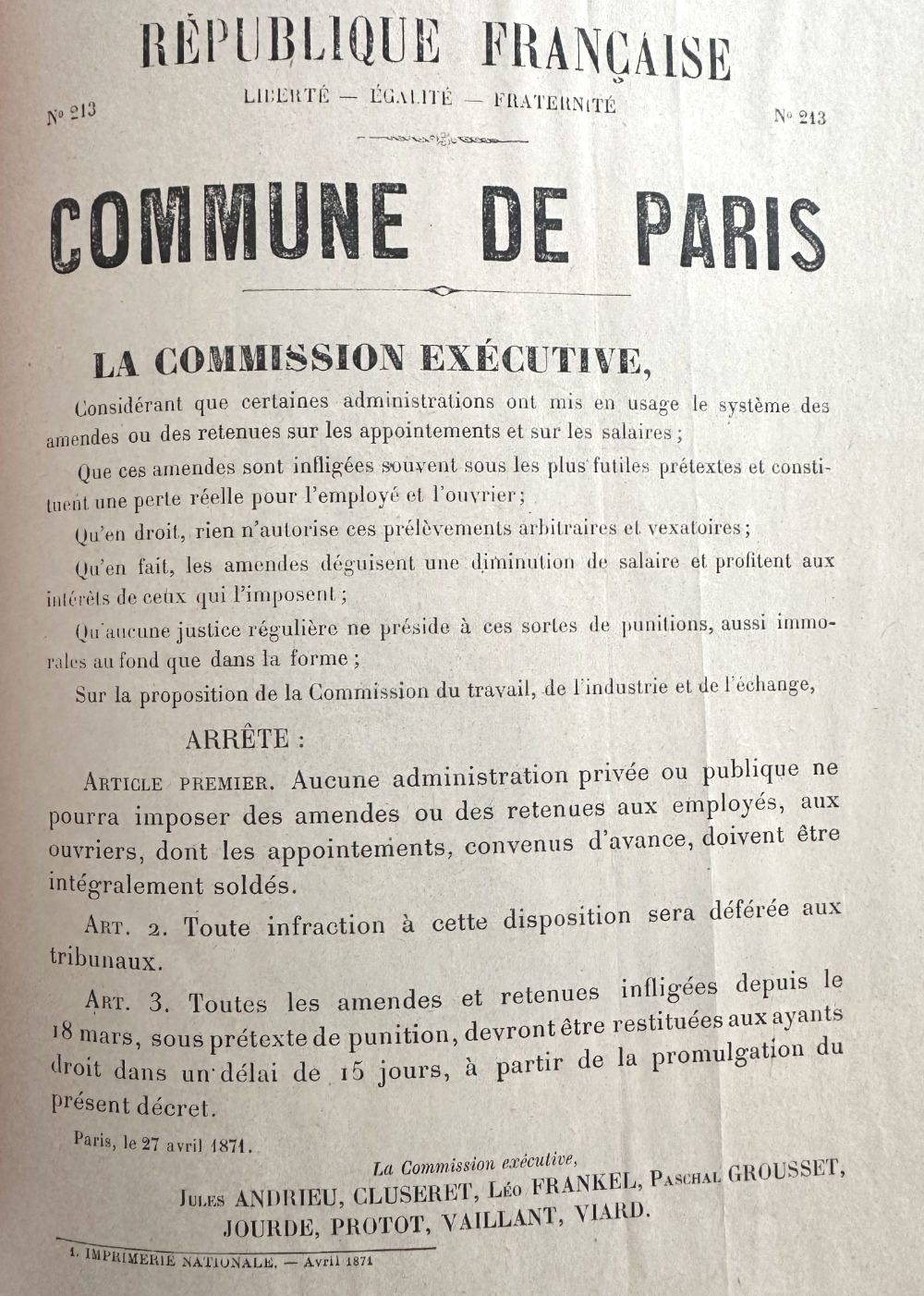
Decree on Wages, 27 April 1871
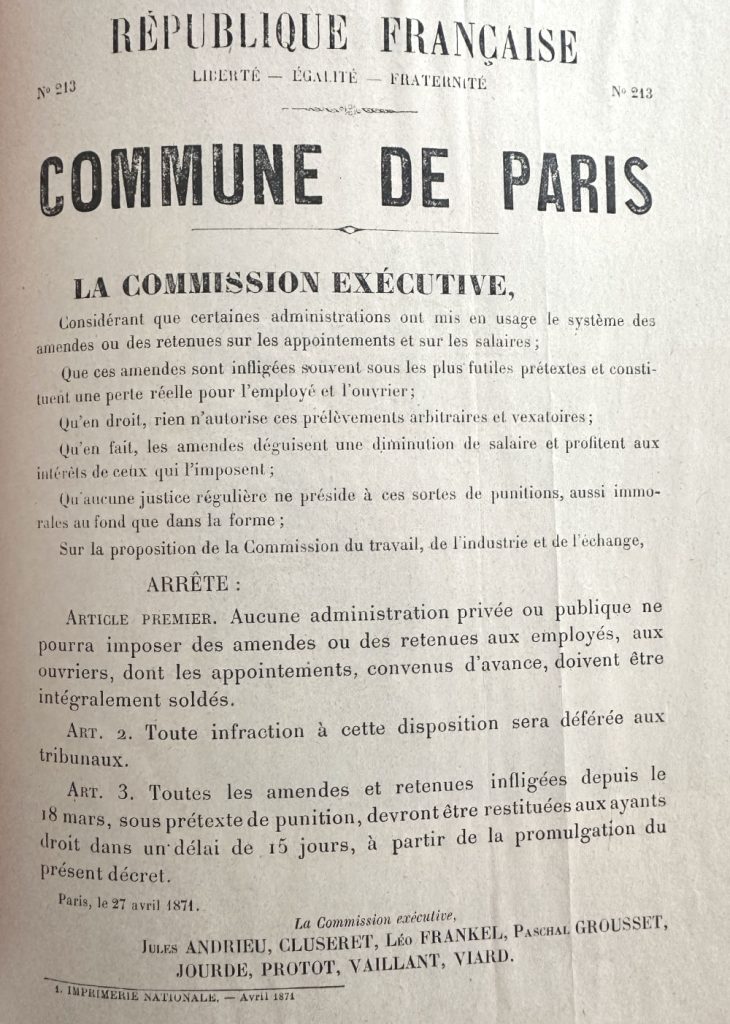
This decree illustrates one of the most concrete social reforms undertaken by the Commune: the defence of workers against wage exploitation. It directly attacks the widespread practice of employers imposing arbitrary fines and salary deductions, which effectively lowered wages without due process. By declaring such practices illegal and ordering restitution of sums deducted since 18 March, the Commune positioned itself as a government of social justice rooted in labour rights. The text is notable for its legal tone and structured reasoning: it invokes both principle and law, arguing that such deductions are arbitrary, unjust, and function as concealed wage reductions.
In the broader context of the Commune, this decree demonstrates that the uprising was not solely military or symbolic but legislative and practical. While Versailles accused the Communards of chaos and disorder, documents such as this reveal a deliberate attempt to construct a new social order based on economic fairness. The involvement of the Commission of Labour reflects the Commune’s commitment to working-class representation within government. At a moment when Paris was under siege, the Communards were still regulating workplace justice, signalling that for them the Revolution was not only about political sovereignty but about restructuring everyday economic relations in favour of workers.
English Translation
Republic of France
Liberty – Equality – Fraternity
Commune of Paris
No. 313
The Executive Commission
Considering that certain administrations have adopted the system of fines or deductions from wages and salaries;
That these fines are often imposed under the most futile pretexts and constitute a real loss for the employee and the worker;
That in law nothing authorises such arbitrary and vexatious deductions;
That in fact these fines disguise a reduction of wages and benefit those who impose them;
That no regular justice presides over these forms of punishment, unjust even in their principle;
Upon the proposal of the Commission of Labour, Industry and Exchange,
Decrees:
Article 1. No private or public administration may impose fines or deductions upon employees, workers, or salaried staff; any sums taken in advance must be fully paid.
Article 2. Any infraction of this provision shall be referred to the tribunals.
Article 3. All fines and deductions imposed since 18 March, under the pretext of punishment, must be returned to those concerned within fifteen days of the promulgation of the present decree.
Paris, 27 April 1871.
The Executive Commission:
Jules Andrieu, Cluseret, Léo Frankel, Paschal Grousset, Jourde, Protot, Vaillant, Viard.
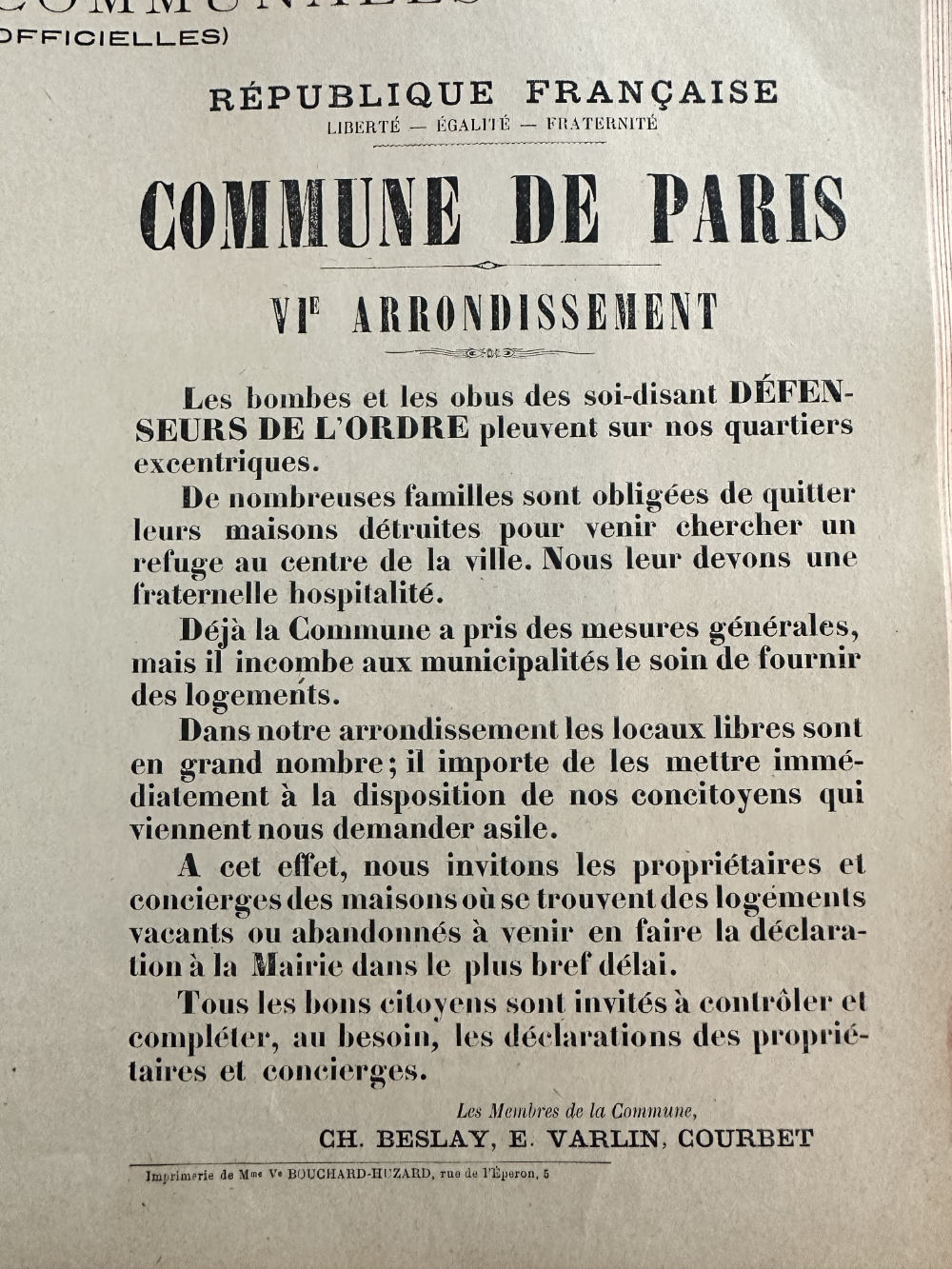
Commune Statement on Humanitarian Measures, April 1871
This notice reflects the immediate humanitarian crisis caused by the bombardment of Paris by Versailles forces. The text deliberately calls the attackers “so-called defenders of order,” exposing the Communards’ view that those claiming to restore order were in fact destroying civilian neighbourhoods. The emphasis is not on retaliation but on solidarity: “fraternal hospitality” becomes a civic duty. The Commune presents itself not as an abstract revolutionary authority but as a municipal government organising shelter for displaced families.
Politically, the document also reveals the Commune’s approach to property during wartime. Rather than immediate expropriation, it calls upon owners to declare vacant housing and places moral pressure on “all good citizens” to ensure compliance. This reflects a form of social mobilisation rooted in communal responsibility rather than bureaucratic coercion. In the context of the siege and bombardment, the text demonstrates that the Commune sought to maintain civil administration and mutual aid even while under military assault. It reinforces the idea that the Revolution was grounded in practical social care and collective solidarity, particularly in working-class districts that bore the brunt of Versailles artillery.
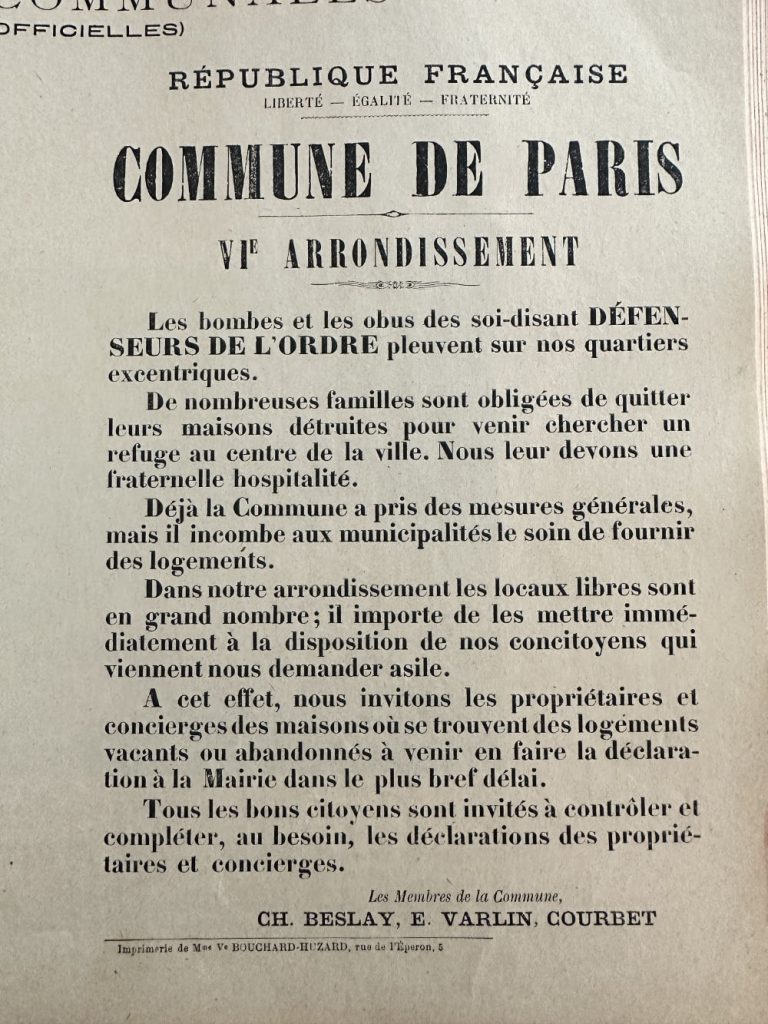
English Translation
Translation
Republic of France
Liberty – Equality – Fraternity
Commune of Paris
Sixth Arrondissement
The bombs and shells of the so-called defenders of order are raining upon our eccentric quarters.
Numerous families are forced to leave their destroyed homes to seek refuge in the centre of the city. We owe them fraternal hospitality.
The Commune has already taken general measures, but it falls to the municipalities to provide housing.
In our arrondissement, many premises are vacant; it is important to place them immediately at the disposal of our fellow citizens who are coming to seek asylum.
To this end, we invite the owners and caretakers of houses where dwellings are vacant or abandoned to come and make a declaration at the Town Hall without delay.
All good citizens are invited to monitor and complete, if necessary, the declarations of owners and caretakers.
Ch. Beslay, E. Varlin, Courbet
Members of the Commune
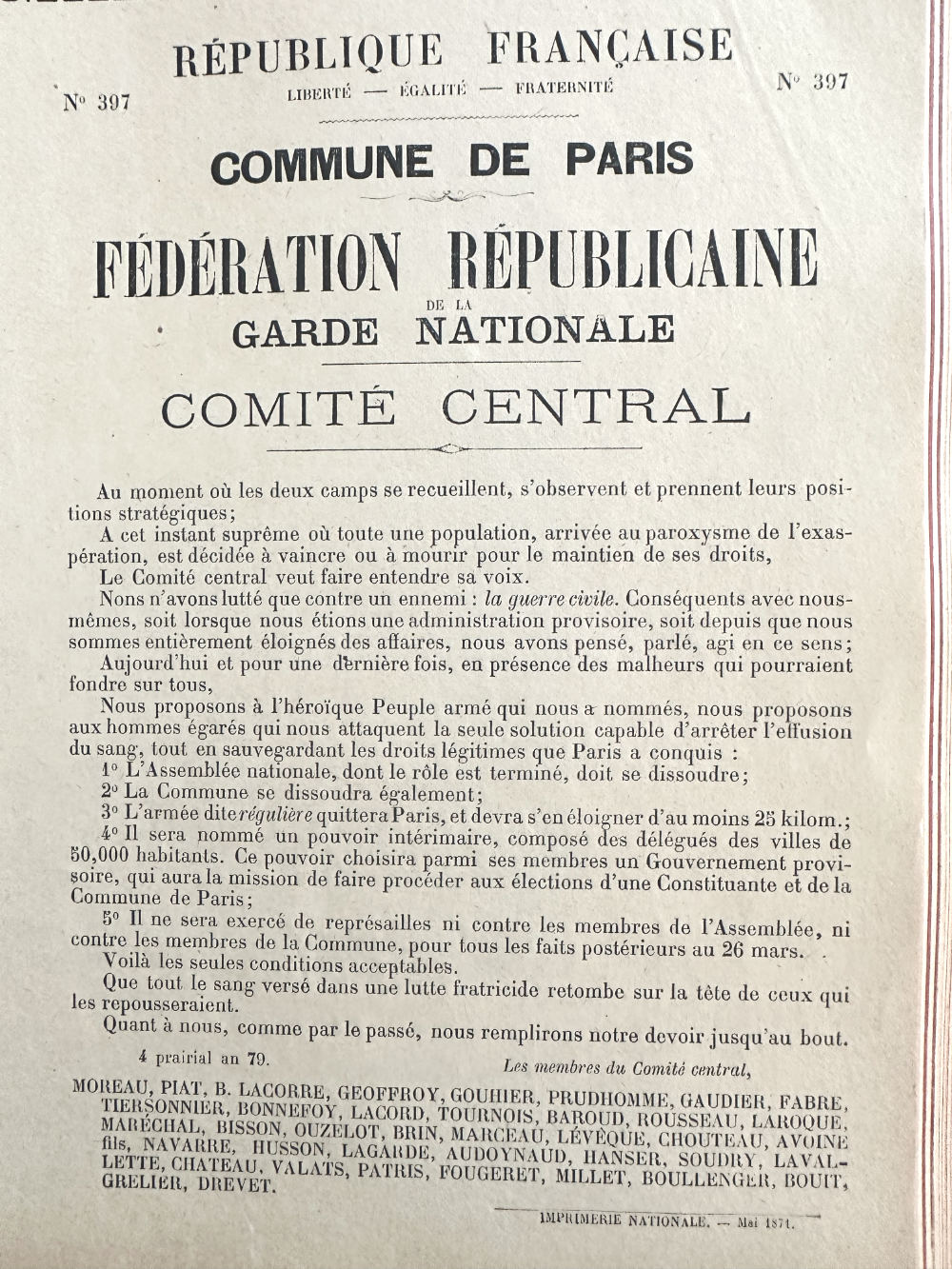
Statement of the Commune, 20 May 1871
This proclamation, issued on 20 May 1871 during the final phase of the conflict, is striking for its tone of tragic lucidity. Far from calling for escalation, the Central Committee proposes mutual dissolution and fresh elections by universal suffrage, effectively offering to relinquish power if a democratic reset can prevent further bloodshed.
The document frames the struggle not as rebellion but as a defence against “civil war,” and places moral responsibility for continued violence on those who refuse negotiation. In the context of the Paris Commune, this text is crucial because it challenges the narrative of uncompromising insurrection. It shows the Communards attempting, at the brink of defeat, to ground their legitimacy in popular sovereignty and to halt what they understood as a fratricidal slaughter.
The appeal to universal suffrage, the refusal of reprisals, and the willingness to dissolve themselves underline how the Commune saw itself not as a faction seeking domination, but as the expression of the armed people seeking democratic recognition in the face of overwhelming force.
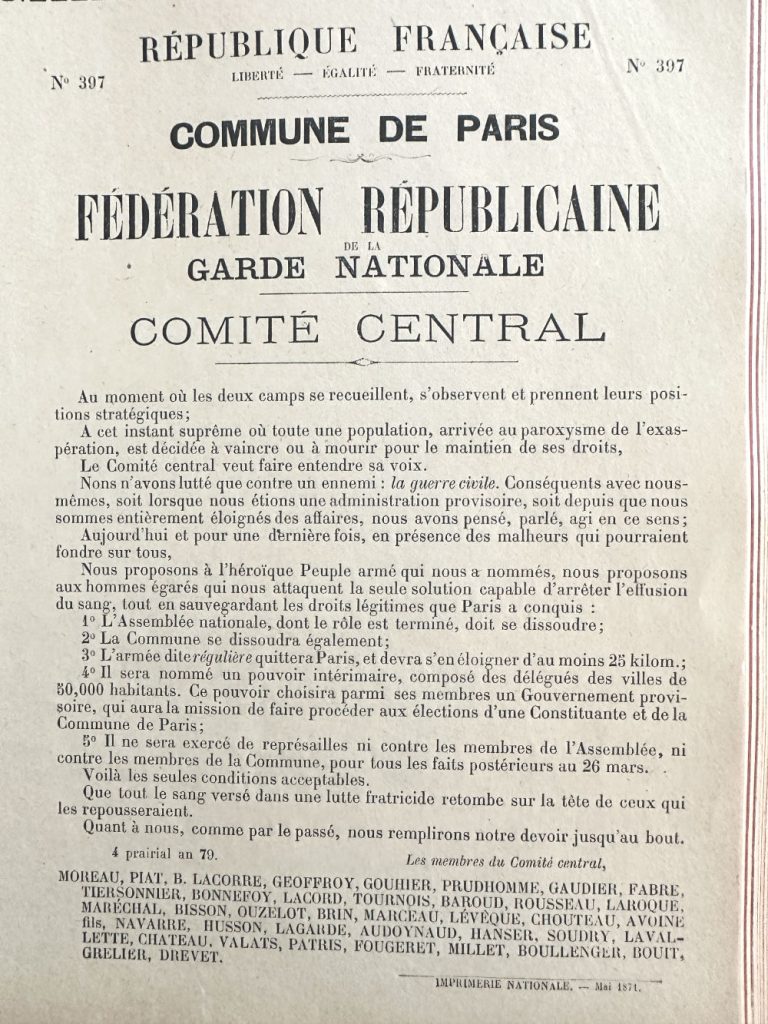
Republic of France – Commune of Paris
Federation of the National Guard
Central Committee
At the moment when the two camps withdraw, observe one another, and take up their strategic positions, at this supreme instant when an entire population, brought to the height of exasperation, is resolved either to conquer or to die in order to maintain its rights, it is decided to attempt once more an appeal to reason.
We have fought only against an enemy: civil war. Conscious of ourselves, whether as a provisional administration or since we were entirely removed from public affairs, we have thought, spoken, and acted in this spirit; let us act in this way once more, in the face of the misfortunes that may fall upon us.
We propose to the heroic armed People who have appointed us, and to the men of goodwill who attack us, the only solution capable of stopping the shedding of blood. We demand:
- The National Assembly, whose role is ended, must dissolve itself;
- The Commune must likewise dissolve itself;
- The irregular government must leave Paris and withdraw at least 25 kilometres;
- The population of Paris will proceed to the election, by universal suffrage of its 50,000 inhabitants, of a power that will choose from among its members a government responsible for organising elections for a Constituent Assembly.
No reprisals shall be carried out against members of the Assembly nor against members of the Commune for acts prior to 26 March.
These are the only acceptable conditions. Let the blood shed in a fratricidal struggle fall upon the heads of those who refuse them.
As for us, as in the past, we shall fulfil our duty to the end.
Prairial, Year 79 (May 1871).
The members of the Central Committee.
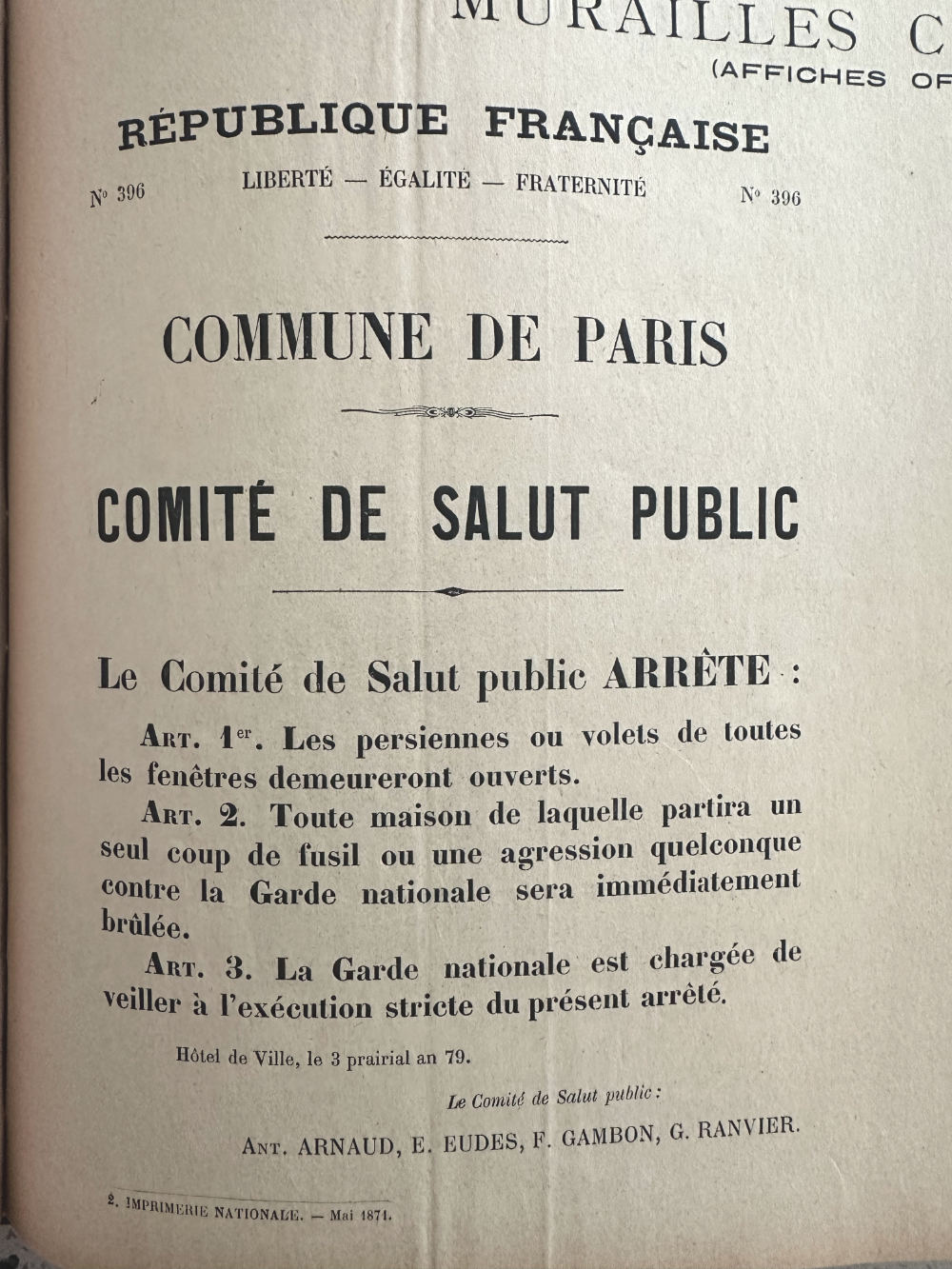
Decree of the Commission of Public Safety, 23 May 1871
This decree, issued on 23 May 1871 during the final days of the Paris Commune, reflects the extreme military pressure and atmosphere of siege in which the Communards were operating. By ordering all shutters to remain open, the Commune sought to prevent hidden snipers and clandestine attacks as Versailles troops advanced street by street into Paris. The second article, threatening the immediate burning of any house from which shots were fired against the National Guard, reveals both the fear of infiltration and the desperate need to maintain defensive coherence in urban warfare.
Rather than a policy of arbitrary terror, the decree reads as an emergency wartime measure born of encirclement, mistrust, and the rapid collapse of organised resistance during the “Semaine sanglante.” Its relevance to the Paris Commune lies in how it illustrates the transformation of a revolutionary municipal government into a besieged defensive authority: a body attempting to preserve its legitimacy and protect its fighters under conditions of invasion, internal betrayal, and overwhelming force.
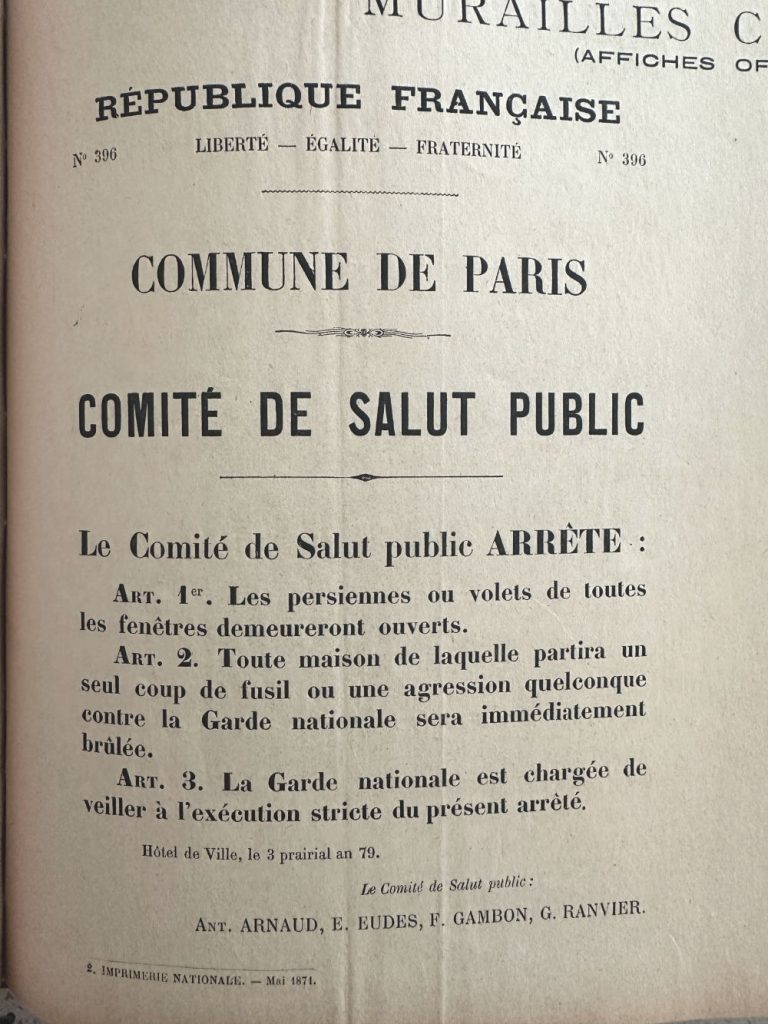
English Translation
Republic of France
Liberty – Equality – Fraternity
Commune of Paris
Committee of Public Safety
The Committee of Public Safety decrees:
Article 1. The shutters or blinds of all Parisian houses shall remain open.
Article 2. Any house from which a rifle shot or any aggression whatsoever is fired against the National Guard shall be immediately burned.
Article 3. The National Guard is charged with ensuring the strict execution of the present decree.
Hôtel de Ville, 3 Prairial, Year 79 (23 May 1871).
The Committee of Public Safety:
Ant. Arnaud, E. Eudes, F. Gambon, G. Ranvier.
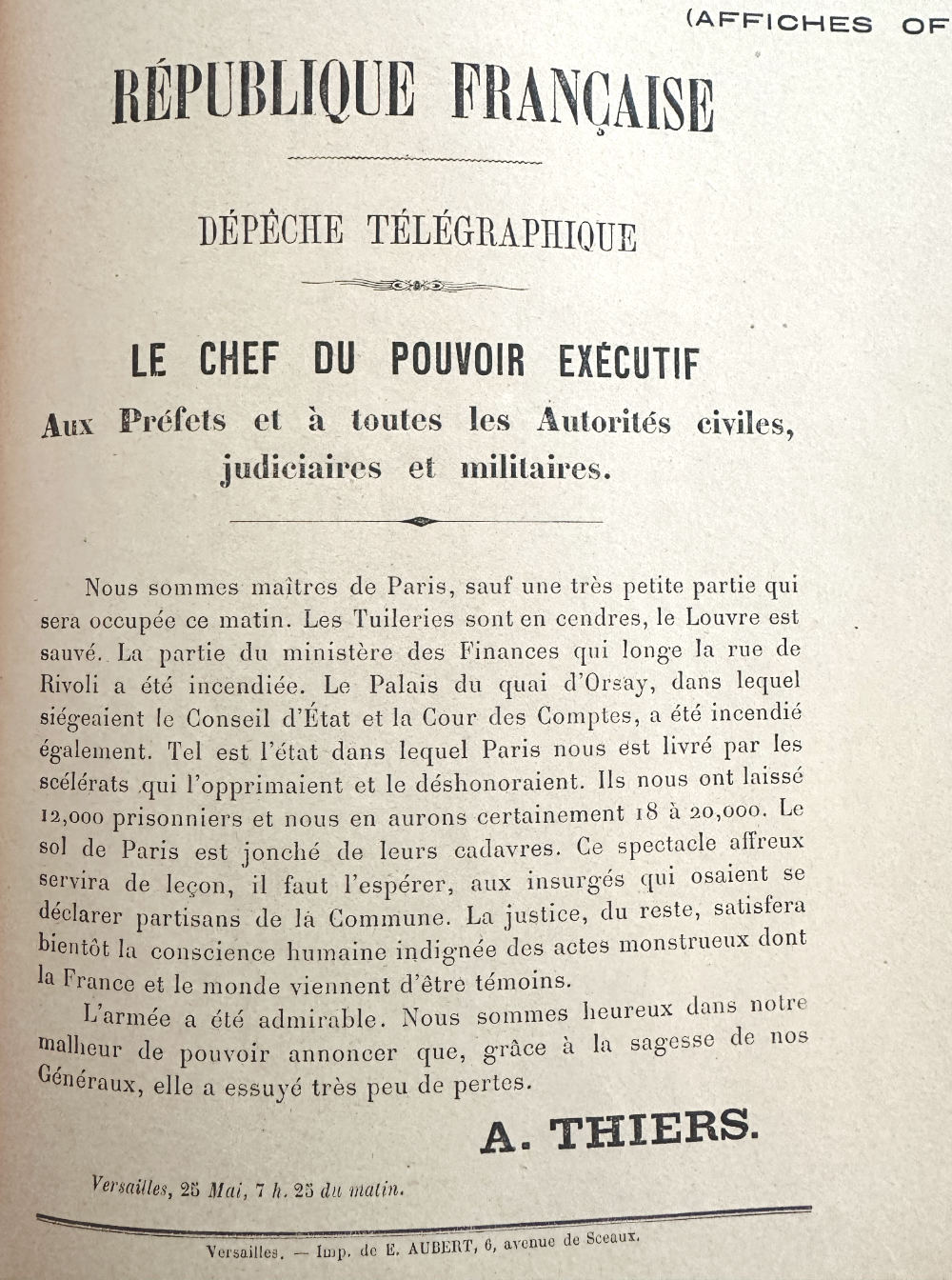
Telegraphic Dispatch by Thiers, 25 May 1871
This dispatch, dated 25 May 1871, is issued at the very end of the Semaine Sanglante, when Versailles troops had effectively crushed the Commune. It is a triumphant proclamation of military victory framed as moral vindication. Thiers describes Paris as devastated by “criminals,” presents the Communards as dishonouring the city, and justifies mass arrests and killings as necessary “justice.” The language is carefully constructed to convert large-scale repression into a moral lesson: the dead are not victims of civil war but proof of the righteousness of state authority. The emphasis on the army’s “admirable” conduct and minimal losses reinforces the image of orderly restoration rather than violent conquest.
In relation to the Paris Commune, this document is historically significant because it crystallises the Versailles narrative that would dominate official memory: the Commune as criminal insurrection rather than elected municipal government. It erases the Communards’ claim to democratic legitimacy and portrays their destruction as both inevitable and deserved. Coming on 28 May, effectively the last day of organised resistance, the dispatch also marks the moment when revolutionary sovereignty in Paris was extinguished by force and replaced by the reassertion of central state authority. It is therefore not just a military communiqué but a declaration of political closure: the Republic reclaims the capital, and with it, the monopoly on defining legitimacy, law and justice.
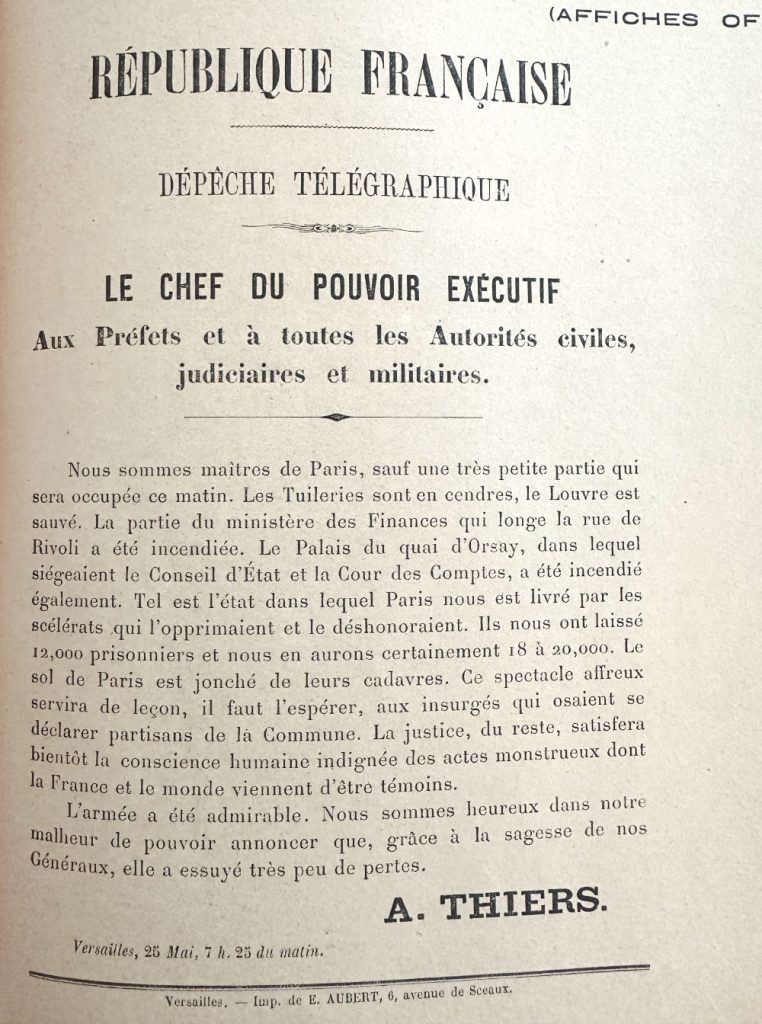
English Translation
Republic of France
Telegraphic Dispatch
The Chief of the Executive Power
To the Prefects and to all Civil, Judicial and Military Authorities
We are masters of Paris, except for a very small part which will be occupied this morning. The Tuileries are in ashes, the Louvre is saved. The section of the Ministry of Finance along the rue de Rivoli has been set on fire. The Palais d’Orsay, which housed the Council of State and the Court of Accounts, has also been burned.
Such is the state in which Paris has been left to us by the criminals who oppressed and dishonoured it. They have left us 12,000 prisoners, and we shall certainly have 18,000 to 20,000. The soil of Paris is strewn with their corpses. This frightful spectacle will serve as a lesson; one must hope that those insurgents who dared to declare themselves partisans of the Commune will be satisfied by the justice that, moreover, will soon be rendered. Human conscience, outraged by monstrous acts of which France and the world have just been witnesses, will approve.
The army has been admirable. We are happy in our misfortune to be able to announce that, thanks to the wisdom of our generals, it has suffered very few losses.”
Versailles, 28 May, 7:25 in the morning.
A. Thiers.